Nutrition and superfoods
Whole fruit or juice: why they are different choices
Format matters, but an everyday choice need not become a prohibition or a medical promise.
In this article
- The essentials in a minute
- Ask what you will actually eat
- What “free sugars” means
- What a fullness study observed
- Diabetes: an association is not a guarantee
- Four ways to make whole fruit easier
- Review a habit without imposing prohibitions
- Precautions and adaptations
- Frequently asked questions
- Sources consulted
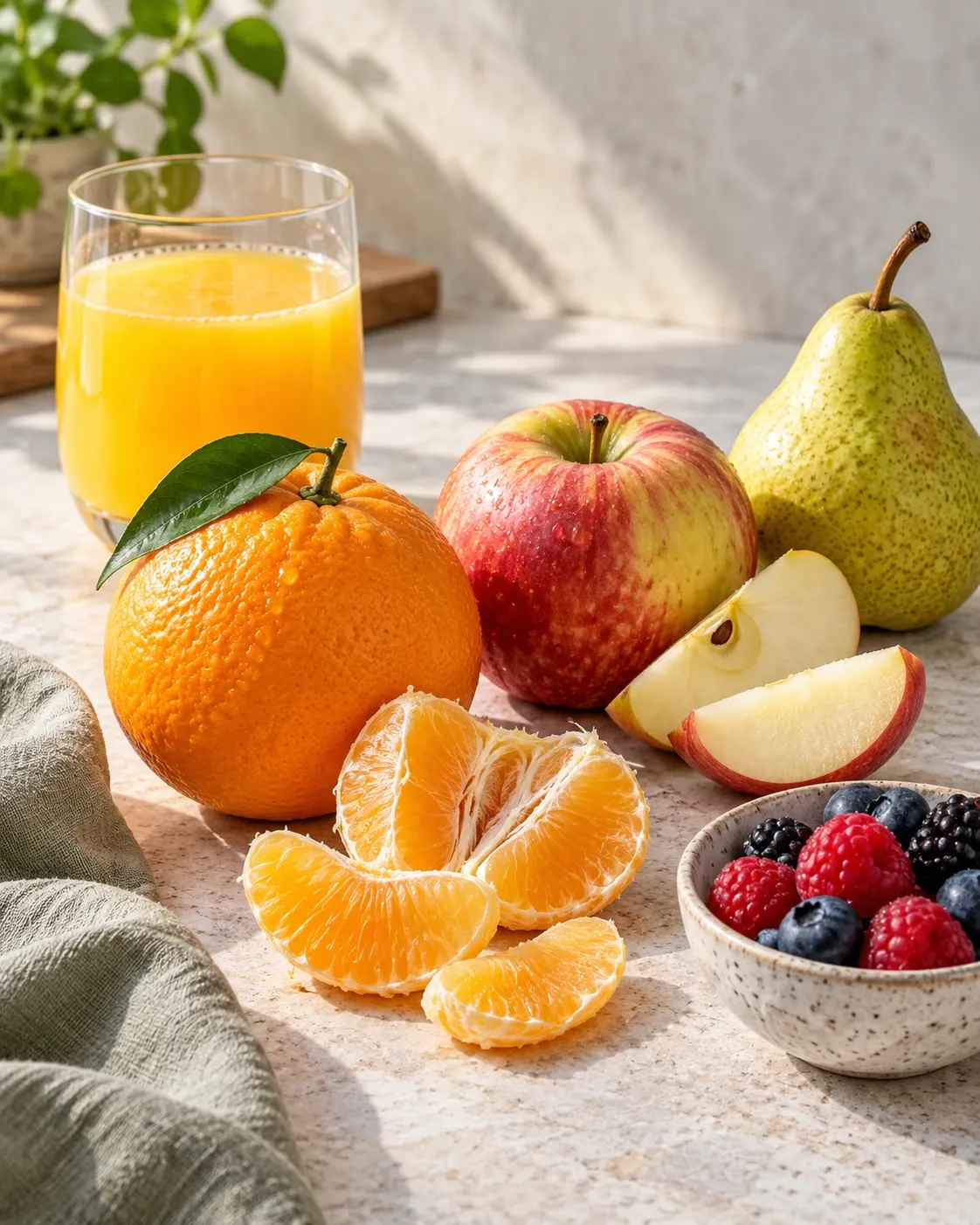
An orange in the fruit bowl and a glass of juice may come from the same food, but they are different everyday choices. The way you consume them, the amount you prepare and their place in a meal can change. Understanding that difference helps organise breakfasts and snacks without fearing fruit or treating an occasional glass as a reason for guilt.
The essentials in a minute
- Spain’s AESAN recommends prioritising whole fruit and states that juice does not replace it. 1
- “No added sugars” does not mean “no free sugars” in a juice. 2
- Food form can affect fullness; an experiment involving one meal does not establish long-term weight loss. 3
- Choosing an accessible fruit you enjoy is usually more practical than searching for a supposedly miraculous variety.
Ask what you will actually eat
Before debating whether a drink is natural, look at the whole preparation. Are you using one piece of fruit or several? Do you have it alongside other foods? Does the glass replace something, or add to what you already planned to eat?
These are organisational questions rather than a nutrition exam. Someone may choose a mandarin for work because it travels well. Another person might need prepared fruit in the fridge to remember it. The most useful starting point is the obstacle that actually appears in your day.
Avoid assuming that an option will help simply because it requires a new appliance or recipe. If juicing complicates the morning, leaving a piece of fruit beside your usual breakfast may be easier. Convenience matters when you want a choice to become repeatable.
What “free sugars” means
The WHO includes sugars naturally present in fruit juices and concentrates within free sugars. It does not classify the sugars in fresh whole fruit in the same way. The absence of added sugar therefore does not make the formats equivalent. 2
You do not need to translate this distinction into a list of forbidden fruits. Its purpose is to recognise what you are buying and how you consume it. A front label can accurately describe one characteristic while leaving other questions about the complete choice unanswered.
Check the product name and ingredients. Juice, nectar and a fruit-containing drink should not be treated as interchangeable descriptions. Use the full label rather than relying only on a fruit photograph or a highlighted word. If the wording is unclear, compare the complete product descriptions before deciding.
What a fullness study observed
A crossover trial involving 58 adults compared apple pieces, purée and juices before a meal. Whole apple produced greater fullness; adding fibre to juice did not match that result. 3
The research challenges the assumption that every liquid version reproduces the experience of eating fruit. However, it measured responses to laboratory meals. It cannot promise that swapping one glass for an apple will make you lose a particular amount of body fat.
Turn the idea into a modest observation: is your chosen option satisfying and easy to repeat? That everyday reflection is not a clinical measurement. Nor must you experience exactly the average response recorded in a study. It is information about how a choice fits your own routine.
Diabetes: an association is not a guarantee
Three US cohorts linked greater whole-fruit and juice consumption to different patterns of type 2 diabetes incidence. This was observational research, and the authors subsequently corrected some results. [4,5]
It does not establish that a particular fruit prevents disease by itself. Nor does it justify comparing people without considering their other habits and circumstances. We do not use it here to rank fruits in a competition or calculate your individual risk.
If you have diabetes or another condition requiring an eating plan, discuss the choice within that care. General advice about food form does not replace your plan or support adjusting medication. Take questions about your actual meals to the professional following your care.
Four ways to make whole fruit easier
The following are examples of household organisation. Pick one, see whether it helps, and keep what fits. You do not need to change every breakfast at once or buy equipment before beginning.
| Common obstacle | A possible preparation |
|---|---|
| You leave in a hurry | Put portable fruit beside your bag |
| Fruit spoils before you use it | Buy fewer pieces and review what remains |
| You dislike peeling it at work | Take a prepared portion stored appropriately |
| You forget it is available | Keep it visible or include it when planning |
Alternate seasonal fruit according to preference, price and availability. If you choose frozen or canned options, review their composition. WHO guidance also includes those presentations when they have no added sugars. 2
An expensive ingredient is unnecessary. A clean container, a realistic shop and a planned opportunity to eat may be more useful considerations than this week’s most elaborate recipe. You can adapt the preparation without needing to make the fruit look impressive.
Review a habit without imposing prohibitions
Imagine that you always prepare juice on Sunday. You can value that occasion while organising whole fruit for the rest of the week. Frequency and context can be reviewed without classifying meals as successes or failures.
If you choose a change, describe an action: “I will buy the fruit I plan to take to work on three days.” Afterwards, review waste, convenience and whether you want to repeat it. Do not interpret a few days of weight changes as proof of the effect of one choice.
The practical goal is to make the alternative visible. You do not need to count every mouthful or compensate for a glass by skipping another meal. Rigid adult rules should not automatically be transferred to children or people with particular nutritional needs.
Precautions and adaptations
Allergies, chewing or swallowing difficulties, digestive surgery and prescribed eating plans require suitable adaptations. Texture safety and individual needs take priority over general advice. Ask for guidance when a recommendation does not fit your circumstances.
Blending the whole fruit retains components lost when only juice is extracted. That does not establish that every smoothie is equivalent to a piece of fruit, or that all recipes behave alike. Check ingredients and the amount prepared; take the actual recipe if you need individual advice.
Frequently asked questions
Should I stop eating fruit because of sugar?
Prioritising whole fruit does not mean avoiding it. Distinguishing formats explains why they cannot simply be exchanged without consideration. [1,2]
Does homemade juice replace the piece of fruit?
Making it at home does not remove the format difference or automatically make the glass an equivalent serving of whole fruit. 1
Which fruit should I start with?
One you enjoy, can buy and will actually eat. Put a workable routine before finding an exceptional variety.
Sources consulted
- AESAN: healthy and sustainable dietary recommendations.
- World Health Organization: healthy diet.
- Flood-Obbagy and Rolls, 2009: fruit form, fullness and food intake at a meal. DOI: 10.1016/j.appet.2008.12.001.
- Muraki and colleagues, 2013: fruit and type 2 diabetes in three cohorts. DOI: 10.1136/bmj.f5001.
- Correction to Muraki and colleagues, 2013. DOI: 10.1136/bmj.f6935.
General information: this article does not replace individual medical advice.