


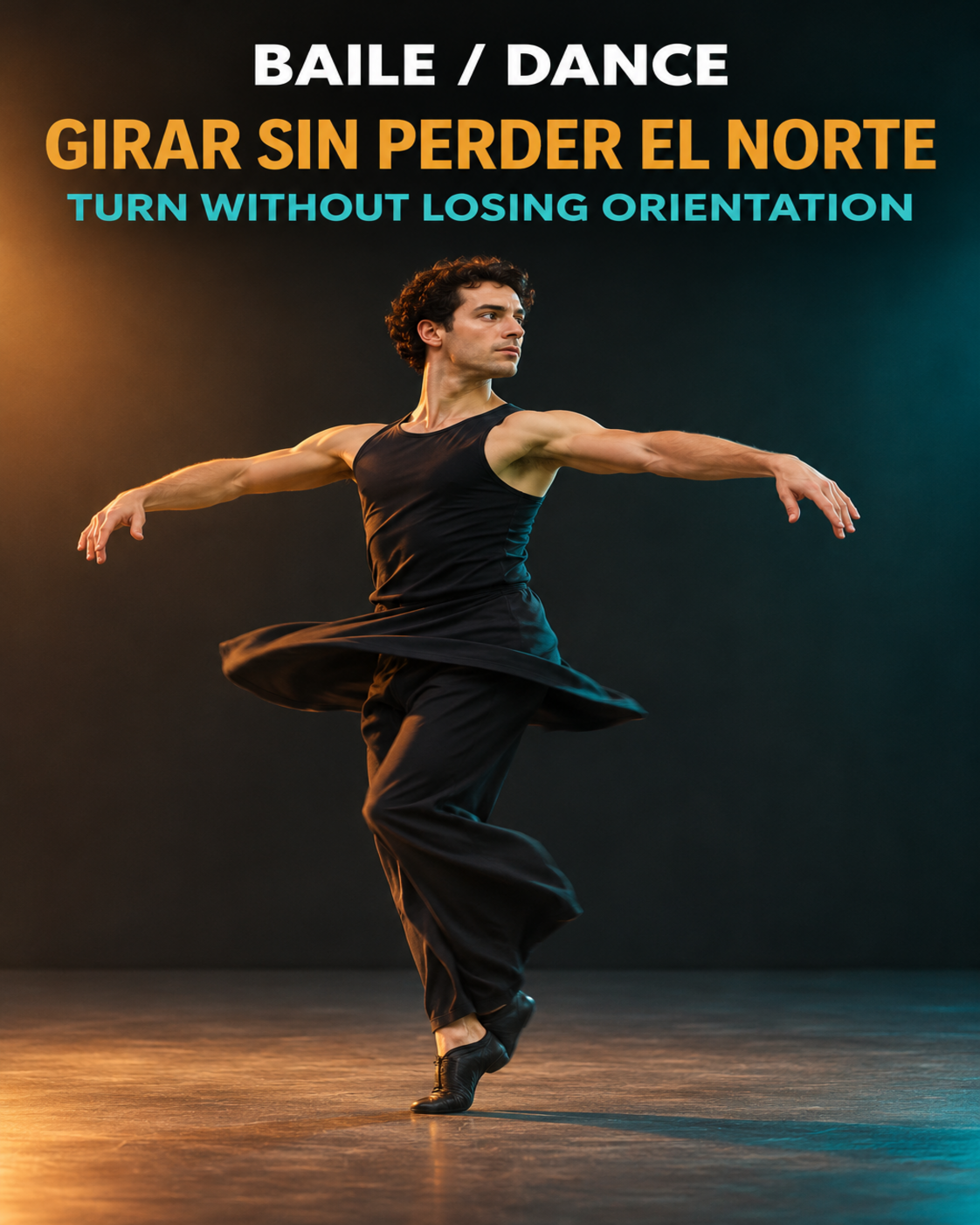
You finish the turn near the intended place, but need two extra steps to work out which way you are facing. Somebody says “find a fixed point”. You find it, try to hold it with your gaze and move your neck at the wrong moment. A reference helps as part of a coordination pattern; it cannot organise the whole turn on its own.
What spotting coordinates
Spotting combines directed gaze with head movement that is relatively independent of the torso. For part of the turn you retain the reference; the head then changes orientation and the eyes find it again. Timing matters as much as the place you look.
An expert consensus study on spotting highlights head isolation, timing and gaze specificity. It also relates the skill to orientation and rhythm. Agreement across rankings was not uniform: the study provides a framework for examining coordination rather than an identical recipe for every style and level.
In practice, the goal is neither holding the head still at any cost nor whipping it around as forcefully as possible. Look for a comfortable relationship between head, torso and support, with clear orientation at the finish. If your neck hurts, reduce the task and ask for correction; forcing it does not improve the reference.
Less dizziness does not guarantee balance
A study of rotations in dancers found less subjective dizziness when spotting was used. It did not find an equivalent improvement in postural stability after active rotations. Feeling less dizzy and controlling the body better are different outcomes.
That leads to a useful decision: assess the finish as well as the sensation. Can you end without improvised steps? Do you recognise your orientation? Is your support available for the next movement? You do not need additional rotations to investigate this; a small turn and clear stop already provide information.
Spotting does not eliminate dizziness. If it develops, stop and wait until you feel normal before considering another attempt. Intense, unusual or persistent dizziness, especially with other symptoms, means ending practice and seeking qualified assessment.
Do not begin by copying an expert
In a trial of pirouette learning in beginners, specific spotting instructions did not produce better overall performance than the comparison technical teaching. Few participants retained the spotting technique in a later test. Expert coordination should not therefore be presented as an automatic shortcut.
If you are still learning support or the exit, prioritise those with your instructor. Work on orientation through simple turns without simultaneously demanding a large rotation, unfamiliar speed and complex head coordination. The progression below is an editorial proposal to adapt with a teacher, rather than a protocol those studies have proved effective.
Choose a reference you can recognise
Select a real, stable detail at a comfortable viewing height: a wall marker or a feature in the room. Avoid following another moving person, your changing reflection or a light that makes you raise your chin.
Check that the floor and space are suitable first. A visual reference cannot compensate for an inappropriate surface or people crossing your path. Leave room, check footwear and agree which area each participant will use.
In social dance, urban dance or fitness classes, the intended finishing direction may change with the sequence. The reference should serve the task and style; one permanent forward-facing point is not required throughout a choreography. Work through that choice with the person teaching it.
Learn timing with few rotations
Begin with a fraction of a turn you can already control and finish steadily. Know in advance where you intend to face. If you add gaze work, avoid increasing speed at the same time. Head coordination accompanies a body movement that is already manageable.
During a simple turn, notice when you leave the reference and when you find it again. A brief cue from the instructor may help more than considering five details while moving. Stop afterwards, discuss what happened and restart only when comfortable and oriented.
There is no universal repetition count here. Your response and finishing quality determine the length of practice. Two clear attempts may be more useful than a sequence in which every rotation adds disorientation. Rest lets you recognise the outcome of the previous attempt.
Rhythm without chasing speed
Use a slow, familiar musical pulse when appropriate. First keep the beginning and finish within the rhythm, then work on the timing of gaze recovery. Accelerating before that relationship is established may briefly conceal a problem without teaching you to solve it.
If the turn arrives late, do not automatically assume your head needs to move harder. Support organisation, anticipation of the exit or understanding the sequence may be involved. Ask the instructor to observe the whole action instead of repeating one instruction increasingly quickly.
Practise both directions only at a difficulty you can control in each. Differences between sides provide information rather than an invitation to equalise them through fatigue. Reduce the turn or return to an earlier task if the second direction needs different preparation.
Observe the finish too
At the exit, notice whether extra steps are needed to chase the reference. Does the torso keep rotating after you intended to stop? Does the head arrive so early that you lose its relationship with your feet? These are descriptions to discuss with a teacher, not diagnoses of balance.
If you record an attempt, obtain consent and stay outside the practice space. Video can show sequence and orientation without explaining the cause by itself. Review one detail at a time and retain a simple cue for the next attempt.
Our article on learning without depending on mirrors addresses another aspect of orientation: remembering and performing without constantly copying an image. The tasks can complement each other without making gaze the sole source of control.
Common mistakes
Practising until dizzy to become accustomed to it, choosing a moving reference and chaining turns to compensate for a poor attempt all spend your learning margin. So does holding the head until your neck forces an abrupt release.
A good-looking finish does not automatically mean enough stability for repeated attempts. An absence of dizziness does not permit unlimited practice volume either. With neck pain, unusual vision or instability that does not settle after stopping, finish and seek professional advice.
Checklist before another turn
- Do I have a stable reference and an intended finishing direction?
- Are the space and floor suitable for safe practice?
- Can I control support without adding more speed?
- Am I comfortable, without dizziness or neck pain?
- Have I regained orientation before repeating?
- Does the cue address one detail, or am I trying to correct everything?
Save the session in YouVisible with the cue that helped you finish clearly. Remembering one useful decision can help the next class more than counting how many rotations you linked together.