


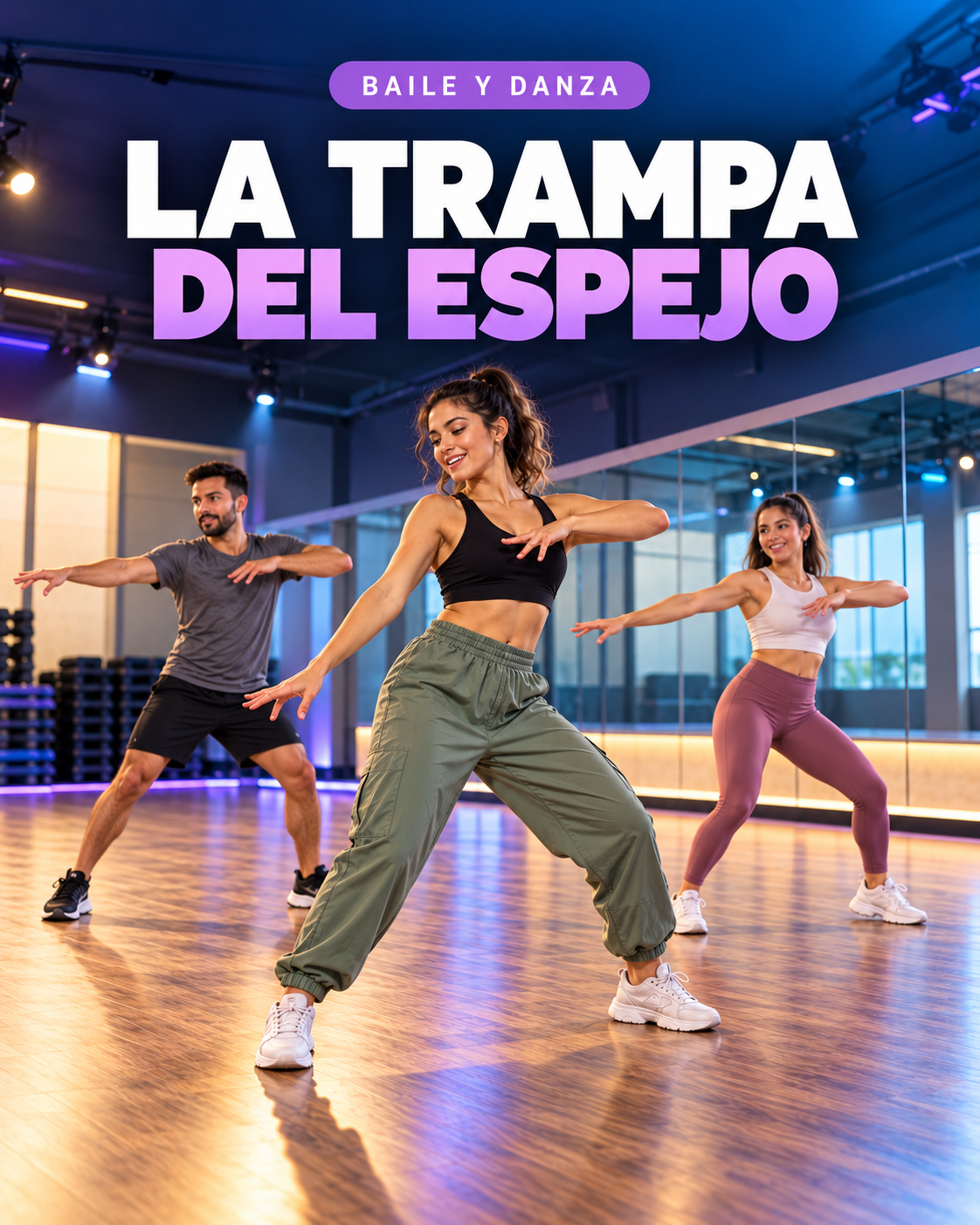
You follow the song perfectly: steps, arms and changes of direction. The instructor stops demonstrating to encourage the group, moves to one side and suddenly you have no idea what comes next. You were watching every movement, but could not yet anticipate it.
This is familiar in Zumba, dance fitness and other group classes with music. Following a visual reference successfully does not, by itself, show that you have learned the sequence. Mirrors and instructors help; choosing when to watch them can give you more independence while keeping that support available.
Copying now and remembering later
Copying answers an immediate question: “What are they doing?” Learning a phrase also involves knowing what comes next, where you are heading and which foot will hold your weight. You can reproduce an impressive shape without understanding its connection to the next movement.
The difference emerges when the demonstration disappears. Keeping the rhythm, recognising the beginning and knowing which support prepares the change give you references of your own. Waiting for someone else to start may mean you are still reconstructing each movement from outside information.
Imitation is a useful starting point. The suggestion is to alternate observation with small attempts at recall, instead of judging learning only by how closely you follow the instructor during a continuous demonstration.
Right and left: an extra task
When the instructor faces you, their right appears on your left. They may teach as your mirror image, adapting their sides for you to follow visually, or ask you to use the same anatomical side as them. Clarify this convention before a new combination.
Mentally transforming directions while listening to music and coordinating arms and feet adds another simultaneous task. A hesitation about sides can look like poor rhythm when you are actually working out whose right matters.
Watching the instructor from behind, facing the same direction, may simplify early attempts: you both travel towards the same side of the room. That perspective is not universally superior; facing the instructor also gives you expressions, gestures and useful cues.
Versace and colleagues (2026) analysed 31 dancers with at least three years of ballet. Results generally favoured the back view, depending on experience and outcome; not every comparison was significant. Mental workload was inferred from performance rather than measured directly. This offers limited support for trying that orientation, rather than a rule established in gym beginners.
What the mirror offers, and what it cannot guarantee
A mirror helps you locate yourself within the group, check synchronisation and review overall execution. It also provides visual correction: you might notice an excessively wide arm or a travelling step that ends outside your space. During early attempts it reduces uncertainty.
Seeing a position does not ensure that you can remember it or feel it without looking. Proprioception is your sense of body position and movement; recognising your reflection is different. Looking coordinated does not necessarily mean you are transferring weight effectively, either.
| Mirror use | Additional check |
|---|---|
| Find your place | Know where the phrase goes next |
| Match the group | Start without waiting for others |
| Review a position | Recognise the supporting foot |
| Correct the overall shape | Repeat without copying |
Memory, proprioception, automatically better balance and independence from visual references are not guaranteed by practising in front of a mirror. The reverse does not follow: mirrors do not always harm these abilities, and these studies do not demonstrate that they cause injuries.
Five signs to notice
These signs can guide practice; they are not a scientific test of dependence:
- You lose the sequence whenever you look away, even with a familiar song.
- You change sides when the instructor stops or moves elsewhere.
- You recognise the arms but cannot identify the leg holding your weight.
- You are consistently half a beat late, waiting to see before acting.
- You cannot begin a phrase until you see the group start moving.
A single sign might also reflect novelty, fatigue or an unclear instruction. Notice whether it repeats during a simple, familiar phrase. In recreational classes, enjoying yourself while following the group is valid too: independence is an option, rather than an examination.
Three phases: learn, check and withdraw
Learn. Choose an orientation that is easy to understand and break down the phrase. Watch the feet first: where they land, when they receive weight and which foot becomes available. Ask for clarification if you confuse a light tap with a full weight transfer.
Check. Use the mirror for one repetition to review direction, space and general timing. Choose one useful detail. Trying to fix shoulders, hands, hips and feet simultaneously can stop you recognising the sequence's order.
Withdraw. Repeat a short fragment looking ahead, eyes open, without constantly chasing the reflection or instructor. Keep the space you are moving through visible. Afterwards, return to the reference and check the result.
These phases are a reasonable practical suggestion, rather than a protocol validated by the cited studies. If you become disorganised, shorten the fragment or restore visual support. There is no need to remove it all at once.
An eight-count phrase, step by step
Try a combination your instructor is already teaching, without adding travel of your own. A simple example: step right and tap on 1–2, step left and tap on 3–4, then march on the spot on 5–8.
- Learn feet and weight shifts. The sideways step receives your weight; the tap touches down without taking it fully. Marching alternates support. Check which foot is available to restart the phrase.
- Add the arms. Keep gestures simple until your feet maintain their order. If the arms disrupt the weight change, return temporarily to the foot pattern and establish it again.
- Choose a musical reference. This might be the beginning of the chorus or a clear accent. Associate “sides” with 1–4 and “march” with 5–8; you need not name every joint.
- Do one repetition with visual support. Follow the demonstration to check direction and the starting point.
- Repeat looking ahead. Retrieve the phrase from the music and your supports, without searching for every movement someone else makes. Stay aware of the group and surrounding space.
- Review at the end. Return to the mirror or instructor and choose one correction for the next repetition. Avoid trying to correct every movement while it is happening.
If you forget the order, maintain an allowed basic march and listen for the next entry. Ask “Which foot is free?” and rejoin at a recognisable beginning. Rushing to catch the missed movement often leaves you even further behind.
When the instructor changes position
Facing you: establish whether they are teaching in mirror image and use their directional cues. If confused, make movements smaller while clarifying the side; avoid automatically following whoever happens to be next to you.
Facing away: use the shared orientation to understand pathways and supports. Afterwards, check that you can start the fragment when the instructor stops demonstrating. An easier perspective does not guarantee memorisation, either.
Moving around the room: keep a stable spatial reference and listen for musical and verbal cues. Avoid twisting your whole body to chase the instructor. If new material is introduced outside your view, resume observation when possible without crossing other participants' paths.
Adjustments for different classes
In Zumba and Latin rhythms, identify the weight change supporting the basic step and the combination that returns with the chorus. In dance fitness, cardio dance, BodyJam or Sh’Bam, use repeated combinations to look away only during a familiar fragment.
In choreographed step, begin with a known pattern and maintain awareness of the platform, its edges and surrounding space. Never try the exercise during a new step onto the platform, a turn or a complex orientation change.
In urban dance, separate pathways, supports and accents before adding every arm detail. In technical dance, agree with the teacher when to check alignment and when to perform a known phrase without continually monitoring the reflection. Specific technical demands still require teaching.
Mistakes that complicate the exercise
Removing the mirror abruptly turns support into unnecessary difficulty. Watching only your own body can also make you lose the group's spatial organisation. Memorising arms before understanding the footwork leaves the connections between steps unresolved.
Avoid increasing jumps, speed or movement size before mastering direction. Do not close your eyes while travelling or turning: looking away from your reflection means looking into the space, rather than giving up sight. Try these variations only where they fit the class instructions.
What the research allows us to conclude
Acar and Tuncel (2026) compared three groups involving 39 women aged 18–25 over ten weeks. Their abstract reports worse knee proprioception and static balance, better dynamic balance and no mood differences; some results passages interpret changes inconsistently. That discrepancy adds caution and argues against turning this study into a general prohibition of mirrors.
Notarnicola and colleagues (2014) found no mirror advantage for balance after six months in 64 female ballet students aged 9–10. Bläsing and colleagues (2018) found advantages for starting with observation over starting with verbal instructions in 18 dance students; they were not testing mirror withdrawal in fitness classes.
These involve different populations and tasks. None validates this eight-count routine or determines how much you should look. Experience, musical familiarity and complexity can change the support you need.
Your experiment for the next class
Choose eight familiar counts: once with a reference, once looking ahead, then a final check. Notice whether you start on time and finish on the intended supporting foot. If you still need to watch, shorten it to four counts. Use the mirror to check and learn; also leave yourself a moment to remember independently.