


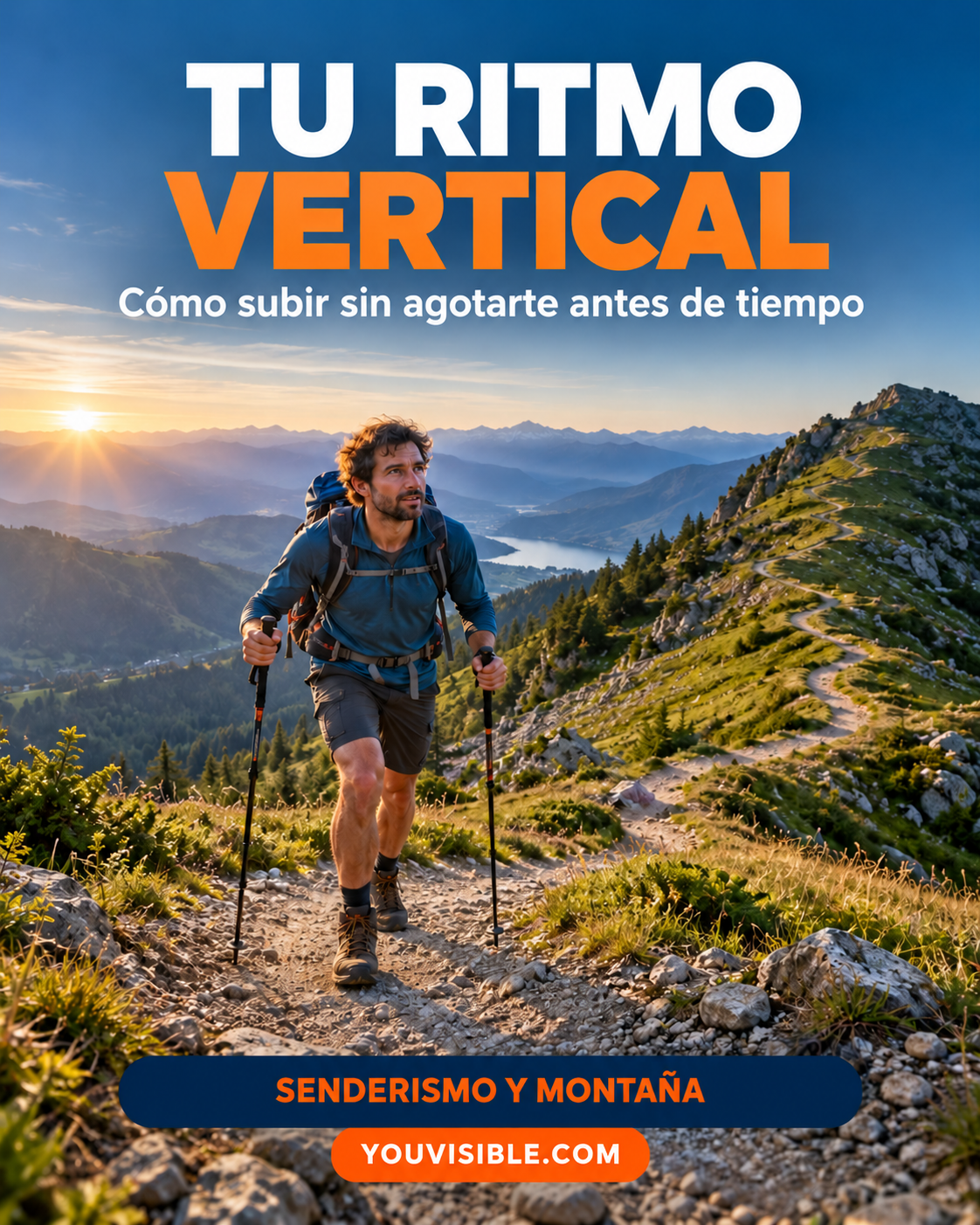
You start climbing at the group's pace, or try to maintain your usual speed on level ground. For the first few minutes, you feel strong. Then the stops begin: catch your breath, set off eagerly and stop again. There is still plenty of mountain ahead, and you are already exhausted.
The problem is not always a lack of fitness. Often, you have distributed your effort poorly. Finding a sustainable pace helps you climb steadily and keep something in reserve for the rest of the hike. You can learn by observing elevation gain, time, breathing and your legs, without an advanced watch or knowledge of physiology.
Why minutes per kilometre can be misleading
A kilometre might include 20, 100 or 200 metres of climbing. It could follow a smooth track, steps, rocks or mud. Add a backpack, wind or heat and the demands change again.
Horizontal pace helps when comparing similar sections or estimating times on familiar ground. It becomes insufficient when gradient and surface vary substantially. Research on walking speed and terrain accounts for those differences when predicting movement; it does not prescribe a compulsory pace for individual hikers.
What vertical pace means
Vertical pace is the amount of uphill elevation gained per unit of time, usually expressed in metres per hour. If you climb 300 metres in 45 minutes:
300 ÷ 45 × 60 = 400 m/h
That is approximately 400 vertical metres per hour. You do not need to calculate it continuously: a basic watch and a known elevation gain from a reliable route description are enough. You can also calculate it after the hike using the available data.
Record whether you use elapsed time or moving time. Breaks matter when planning a day; comparing records that include them with records that exclude them is misleading. If a climb contains intermediate descents, cumulative ascent is not simply the difference between starting and finishing altitudes.
Use it to understand yourself and compare similar climbs, without competing against someone else's numbers.
There is no universal target
Sustainable vertical pace depends on gradient, terrain, climb length, altitude, temperature, wind, backpack weight, existing fatigue, food intake, experience and the total duration of the hike.
The same person can sustain very different figures on two routes. A gentle slope requires more horizontal travel for each metre gained; a very steep slope may be limited by strength, traction or difficult footing. A rigid beginner-to-expert table cannot represent all those factors.
Find your personal range
Choose a familiar, continuous climb that normally takes about 30–60 minutes and fits your current abilities. Keep it comfortably below a maximum effort.
- Start deliberately conservatively, even if you want to speed up.
- Keep breathing controlled and notice how your legs respond.
- Record ascent, time, breaks, breathing comfort and muscle fatigue.
- Repeat on two or three occasions with comparable ground, load and conditions.
- Look for a range associated with steady progress, rather than a perfect number.
Your personal best describes your fastest ascent. Your training pace depends on the purpose of the session. Your pace for a long hike must leave capacity for the hours ahead. These are different references.
Three indicators that need no technology
The talk test
Say a complete sentence while walking. Being able to speak in full sentences with reasonable comfort suggests some reserve. Answering only in individual words indicates greater demand. If you cannot speak without repeatedly interrupting your breathing, slow down before exhaustion develops.
The review by Reed and Pipe supports the practical usefulness of the talk test. This informal check provides guidance; it is neither a diagnosis nor an exact medical measurement.
Effort on a scale of 1 to 10
Ask how hard the climb feels overall:
- 3–4: comfortable and sustainable.
- 5–6: clear work, but controlled.
- 7 or above: probably difficult to sustain throughout a long climb.
These are simple editorial reference points, not universal thresholds or a conversion of scientific scales. Perception varies between people. The review of subjective methods examines their usefulness and limitations; the uphill walking study found a weaker relationship between perceived effort and physiological measurements outdoors than on a treadmill. Combine the signals.
How your muscles feel
Controlled breathing and legs that feel normal allow you to continue monitoring. Legs that feel loaded but stable may still fit a manageable effort. Early burning, an increasingly shortened stride and frequent stops suggest reviewing your pace before pushing on.
Deliberately shortening your steps on a steep slope is an adjustment; steps shrinking involuntarily through exhaustion are a different signal. If you lose coordination, stop somewhere safe.
Divide a long climb into thirds
First third: begin more slowly than you feel like walking. Let breathing and muscles settle. Avoid automatically following faster hikers; agree safe meeting points with the group.
Middle third: aim for an intensity that does not demand repeated stops. Adjust step length and check speech and perceived effort when the gradient changes. Respond before you settle into a pattern of surges and recovery breaks.
Final third: maintain your effort if much of the route remains. Increase slightly only if you still feel comfortable and have capacity to spare. Avoid emptying the tank for the summit when a technical descent or further climbs follow.
This division is a practical pacing suggestion, rather than a validated protocol guaranteeing times or safety.
Walking faster does not always mean arriving sooner
Imagine two people on the same climb. Hiker A starts very quickly, stops for several minutes and then accelerates again, repeating the cycle until continuity disappears. Hiker B walks slightly more slowly, takes fewer breaks and arrives feeling more in control.
This fictional example does not establish that B always arrives first. It illustrates how, on some climbs, excessive speed can create breaks that cancel the early advantage. Compare elapsed time and how you finish, as well as time spent moving.
A complete example with 600 metres of ascent
Imagine a continuous climb with three sections and, for this example, no stops:
- Initial track: 150 metres gained in 25 minutes, about 360 m/h. You walk comfortably, with room to adjust your steps.
- Steeper middle section: 300 metres in 40 minutes, about 450 m/h. You shorten your steps and gain more height per metre travelled.
- Rocky finish: 150 metres in 30 minutes, about 300 m/h. You choose foot placements carefully and slow down to preserve stability.
The total is 600 metres in 95 minutes: approximately 379 m/h. These figures illustrate the idea; they are not training targets. Similar perceived effort can produce different vertical speeds. Do not accelerate over rocks to defend an average: the aim is sustainable effort, rather than identical metres per hour.
When to shorten your steps and how to pause
Try shorter steps when the slope steepens, the ground becomes irregular, traction deteriorates, breathing speeds up too much or you notice yourself pushing upwards in abrupt bursts. Seek stable footing and smooth movement. There is no universal stride length.
A brief pause for a drink or an equipment adjustment serves a specific purpose. A planned microbreak in a safe place can also help. Repeated stops because you cannot sustain your pace call for lower intensity; a long stop through exhaustion calls for reconsidering the route.
After stopping, restart gently for the first few minutes. Check breathing and legs before returning to your previous effort. If you need another break immediately, do not try to make up time by accelerating.
Backpacks and poles change the context
With a heavier load, your pace from a lightweight outing may be unsuitable. A study in mountain rescuers observed greater physiological demands when combining gradient and backpack load; its laboratory conditions do not establish personal limits for recreational hikers.
Poles can distribute work between arms and legs. The study of steep uphill walking found small energy savings at some inclines and lower perceived effort at several. They do not guarantee reduced energy expenditure in every situation. Use a familiar technique and avoid trying unfamiliar adjustments on difficult ground.
Three accessible practice sessions
Adapt these to your experience, allow adequate recovery between them and choose safe terrain:
- Easy continuous ascent: walk at conversational effort and observe whether you can remain steady without exhaustion breaks.
- Three progressive sections: start easily, increase slightly in the middle and add only a little more in the final section if control remains good. Finish with something in reserve.
- A familiar repeat: return another day to the same climb and compare sensations, breaks and continuity alongside time and ascent.
These are learning exercises, rather than a medical or elite training programme. You do not need a faster time to learn better pacing.
Signals to stop the activity
If you experience dizziness, chest pain, feeling faint, disproportionate breathlessness, unusual palpitations, loss of coordination or sharp pain, stop somewhere safe. Seek help or professional assessment as appropriate. Severe, persistent or potentially serious symptoms require urgent assistance; in Spain you can call 112. Do not dismiss them as a simple pacing problem.
Keep your references with YouVisible
You can record an activity with or without GPS and preserve duration, distance, ascent and route when those data are available. Add how you felt through activity notes or descriptions, as suggested in the sports diary guide.
Compare several personal climbs: load, conditions, time, breaks and how you finished. Calculate your vertical reference afterwards if useful. You make the comparison yourself; these recording features do not imply automatic vertical pace calculations, intensity recommendations or fatigue detection.
Scientific sources
- Wood A et al. (2023). Improved prediction of hiking speeds using a data driven approach. PLOS ONE.
- Eisenberger L et al. (2022). Assessment of Exercise Intensity for Uphill Walking in Healthy Adults Performed Indoors and Outdoors. International Journal of Environmental Research and Public Health.
- Reed JL, Pipe AL. (2014). The talk test: a useful tool for prescribing and monitoring exercise intensity. Current Opinion in Cardiology.
- Bok D et al. (2022). An Examination and Critique of Subjective Methods to Determine Exercise Intensity: The Talk Test, Feeling Scale, and Rating of Perceived Exertion. Sports Medicine.
- Pinedo-Jauregi A et al. (2022). Physiological stress in flat and uphill walking with different backpack loads in professional mountain rescue crews. Applied Ergonomics.
- Giovanelli N et al. (2019). Do poles save energy during steep uphill walking?. European Journal of Applied Physiology.
Reach the summit ready to continue
Before speeding up, check:
- Can I speak?
- Is my effort still stable?
- Are my legs maintaining coordination?
- Am I stopping too often?
- How much of the route remains beyond the summit?
The best climbing pace is not the fastest one in the first ten minutes. It is the one that preserves continuity, control and enough capacity to complete the rest of the route.