


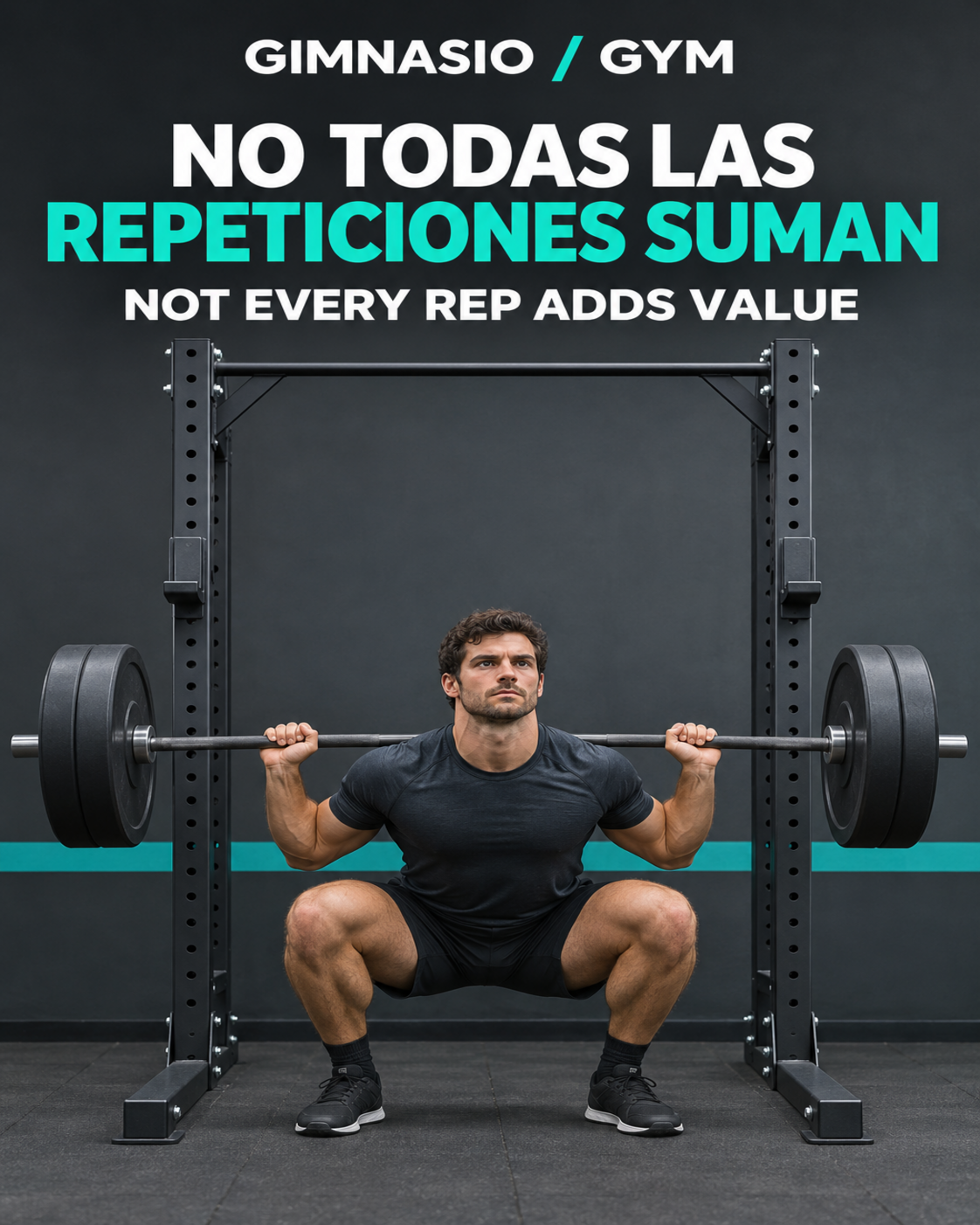
The opening repetitions rise smoothly. The next one includes an unplanned pause; then your hips shift and the load takes another path to reach the finish. You completed one more repetition, but it was no longer quite the same task. Making a decision there requires something more useful than counting to the written target.
Repetition speed and velocity loss
A repetition's speed describes movement under specific conditions. Velocity loss compares performance with a reference within the set. Research prescribing percentages uses instruments and procedures; watching a bar cannot reproduce that measurement accurately.
A heavy load may also move slowly from the first repetition. That alone does not establish substantial velocity loss. Without sensors, what you can notice is a clear change from your own preceding repetitions, with comparable technique and the same intended action.
Deliberately slowing the lowering phase or adding a planned pause changes the task. Do not interpret that slowness as involuntary fatigue. Observation starts with knowing which movement you intended, which phase you control and when you are trying to accelerate without losing position.
What the studies contribute
A trial using different velocity-loss thresholds found differences in volume and adaptations after squat training programmes. It does not establish one optimal stopping point for every person, exercise and goal. The thresholds were measured rather than guessed from facial expressions.
Research on recovery after different set configurations found greater fatigue and slower recovery in protocols allowing higher losses. That informs workload planning, but does not predict the exact number of hours you need after your session.
A study examining velocity and perceived repetitions in reserve shows that these perspectives are not interchangeable. Exercise, load and set number influence the relationship. Feeling that two repetitions remain does not automatically correspond to a particular velocity-loss percentage.
Establish a reference before fatigue builds
Choose a load you can handle and define the intended range, support and rhythm. During early repetitions, notice whether the upward movement is continuous, the path is familiar and you can organise breathing between actions according to the technique you use.
Fast intent means trying to move decisively during the intended phase while retaining control. It does not mean bouncing at the bottom, abandoning the lowering phase or throwing your body to keep the bar moving. If you are learning an exercise, a deliberately slow and consistent execution agreed with your coach may be the priority.
Prepare how the set will end as well: suitable supports, clear space and competent assistance when needed. You should not discover the exit only when you can no longer complete a repetition. Practising a safe finish is part of preparing the task.
Observable changes within a set
Obvious, unplanned slowing is one signal. Add context: a sticking point lasts longer, you reposition your feet or the load moves away from its usual path. The sequence of hips and trunk may change, or a compensation appears that earlier repetitions did not require.
Breathing adds information when you can no longer reorganise between repetitions, but does not measure speed or reserve. Noise, sweat and an expression of effort cannot calculate them either. Observe the task and your ability to repeat it under control.
A slow repetition with stable technique may fit the planned work. A fast repetition achieved through a substantial compensation may miss the goal. Judge speed, technique and purpose together, rather than making one isolated sign a universal rule.
For strength or explosive quality
As general guidance, protect the ability to produce quality efforts and avoid turning every set into a prolonged struggle. A clear reduction from the start can be a reason to finish, rest or review the load, depending on your plan.
You do not need to demonstrate failure to confirm that training occurred. If subsequent sets begin much worse despite rest, review volume and recovery instead of defending the same repetition count at any cost. Strength development includes managing fatigue between sets and sessions.
In power-oriented work, continuing after the movement stops meeting the exercise's intent can change the stimulus. A coach can help define the quality you need and acceptable deterioration without inventing percentages by eye.
For hypertrophy or learning technique
Hypertrophy training may include sets closer to failure within suitable programming and safe conditions. That does not make every compensation necessary or mean all sets should finish alike. Exercise choice, experience and the day's fatigue affect the decision.
When learning technique, it is generally reasonable to stop before repeatedly practising an execution that is becoming disorganised. Choose load and duration that let you recognise and retain the pattern. An extra repetition that rehearses an escape strategy may not teach the skill you intended.
Our article on calibrating repetitions in reserve explores that estimate in more detail. Here the task is noticing changes as they happen, rather than testing failure or converting sensations into an instrument reading.
A useful record between sets
Instead of writing “bad”, record an observation: “the sixth ascent slowed and I lost the path; I stopped there”. Add load, rest and purpose. Depending on the plan and your response, the next set might involve more recovery, less load or fewer repetitions.
If performance is disorganised from the first repetition, do not wait for further deterioration before responding. Review preparation and technique. Pain, dizziness or sudden weakness call for stopping and appropriate professional assessment; they are not another variation of a hard set.
Discuss repeated patterns with the person supervising your training. If every session ends with the same unexpected compensation, changing the target may be more useful than collecting increasingly strained final repetitions. A single successful repetition next time does not remove the need to examine a recurring problem.
Common errors
Guessing “twenty per cent” from a moving bar, treating all slowness as failure and changing the range to preserve a count are different mistakes with a similar consequence: you lose information about the actual task. Treating every training day as a maximal examination adds another unhelpful demand.
Video may support a discussion of path and rhythm with a professional, but perspective and frame rate limit what it shows. Do not turn it into an improvised sensor or let recording distract someone responsible for safety.
Checklist before another repetition
- Is this still the intended range and technique?
- Is the slowness deliberate, or did it develop within the set?
- Does the load remain on a controlled path?
- Does the repetition serve strength, hypertrophy or learning today?
- Can I finish safely if I stop now?
- Am I observing a change or defending a number?
Save the session in YouVisible with a specific note about where execution changed. That memory supports the next training decision without requiring a percentage you have not measured.