


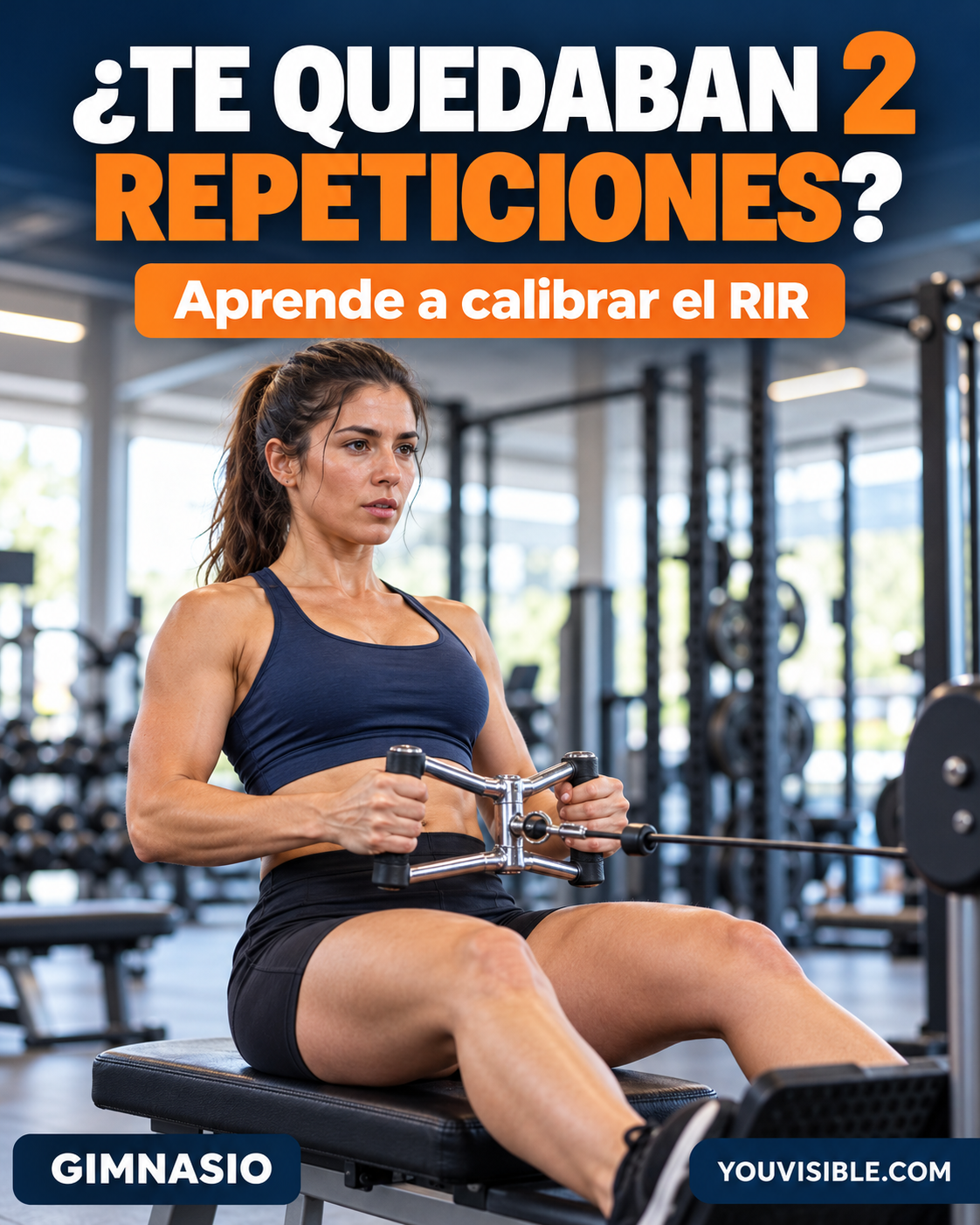
You complete ten seated cable rows. Your muscles burn, breathing feels harder and you stop: “I had two left.” During a controlled check, you continue immediately and complete five more valid repetitions. The set felt demanding, but you were further from your limit than you thought.
Feeling effort does not automatically mean you are close to failure. Calibrating RIR means checking that perception against what you can actually do under defined conditions. You do not need to compete, train maximally every session or predict a perfectly exact number.
What RIR means
RIR stands for repetitions in reserve: the additional repetitions you estimate you could complete before reaching the limit defined for that set.
- 4 RIR: you estimate that you could complete four more.
- 3 RIR: approximately three remain.
- 2 RIR: approximately two remain.
- 1 RIR: approximately one remains.
- 0 RIR: you could not complete another valid repetition.
This is an estimate, not an exact measurement. It requires the same load, agreed range and acceptable technique, without added rest. An RIR-based RPE scale links effort with remaining repetitions; it differs from a general effort scale.
Four different ways a set can end
Momentary muscular failure means being unable to complete another repetition despite trying. Several muscles contribute to a movement, so reaching that limit does not automatically reveal which muscle stopped performing.
At technical failure, you could still move the load, but only by substantially changing execution: shortening the movement, jerking the weight or losing a safe position.
A voluntary stop happens when you choose to finish because of effort, discomfort or uncertainty, although you could continue. A limitation outside the main target muscle can also end a set: grip, breathing, pain, stability or positioning.
For a recreational lifter, the useful reference is the last repetition you could complete with acceptable, safe technique. You do not need to push through dangerous technical failure to understand your effort. If your grip gives out first, record that limitation: you have not demonstrated that your back muscles reached failure.
Why we misjudge what is left
Muscle burn can begin well before your limit. A slightly slower repetition need not be your final possible repetition either. You may stop because discomfort is unfamiliar, you do not know your capacity or you have little experience of high effort.
A new exercise adds uncertainty. Very long sets combine muscular fatigue, breathing demands and tolerance of uncomfortable sensations. Grip can tire before the target muscles. Starting with strict repetitions and finishing with body swing also changes the test.
In Steele and colleagues’ study, participants tended to predict fewer repetitions than they could complete. Experience appeared helpful but did not ensure accuracy. Predicting performance before a set is also different from estimating remaining repetitions during it.
Zourdos and colleagues found that predictions during squats were more accurate closer to failure and less accurate in sets with more repetitions. Refalo and colleagues observed good average accuracy in trained people performing bench presses. These are specific findings, not personal certificates of accuracy.
Read several signals together
Look for involuntary slowing, a marked increase in effort from one repetition to the next, growing difficulty maintaining range of motion and a need to lengthen pauses. Notice changes in breathing, stability and technique as well.
No single signal tells you your exact RIR. Deliberately moving slowly is different from trying to move with your usual intent and being unable to maintain speed.
Even using an instrument, Mansfield and colleagues found limitations in predicting RIR from movement velocity. The relationship varies with exercise, load, set and individual. Watching a repetition cannot reliably translate into “exactly two left”.
An occasional check without technology
This learning method is not a clinical assessment or weekly requirement. Use it occasionally when you can finish safely.
- Choose a familiar, stable exercise.
- Initially favour a suitable machine where reaching your limit will not trap you or cause a fall.
- Use a familiar load after your normal preparation.
- Perform the set until you estimate 2 RIR.
- Say “two” or record your estimate without inserting an extra pause; someone else can write it down.
- Continue immediately with the same load, range, usual cadence and agreed technique, without resting.
- Count only additional valid repetitions; finish at your safe technical limit without forcing a dangerous attempt.
- Compare your prediction with the result and note what ended the set.
If you predicted two and completed two, your estimate matched this test. If you managed five, you were ending that set too early for the intended margin. If you completed only one, you were closer to your limit than you realised.
A single test does not define your accuracy permanently. If uncertainty or another limitation makes you stop, the result does not confirm the muscular reserve you intended to check. Changing load, assistance or technique prevents a direct comparison.
Make safety part of the method
Do not use this test on heavy free barbell squats, bench presses without safeties or a spotter, deadlifts with deteriorating technique, Olympic lifts or exercises where failure could cause a fall without appropriate precautions. Use safety stops, racks, suitable machines or professional supervision where needed. Establish how to put the load down before starting.
Do not perform failure calibrations with injuries, pain, dizziness or medical contraindications. There is no need to force a failed repetition: the safe technical limit takes priority over the count. These are safety recommendations, not findings the cited studies have established for everyone.
Each exercise feels different
- Leg extension: intense local burning can occur while repetitions remain; keep the agreed range of motion.
- Cable row: grip or arms can limit you before your back; swinging your torso changes the task.
- Machine chest press: support reduces stability demands, but you still need secure positioning and a safe way to finish.
- Squat: breathing, balance and coordination may determine when you stop before an isolated muscular limit.
- Deadlift: grip and trunk position matter particularly; do not chase repetitions once you lose technical control.
- Lateral raise: adding momentum or reducing height lets you keep moving the load, but invalidates the comparison.
- Unilateral exercises: balance, the side trained and exercise order can change your reserve; record each side separately.
Accuracy on a machine does not ensure accuracy in a squat. Mansfield and colleagues show why exercise and set context matter; knowing the load did not improve estimates.
A seated cable row example
In week one, Laura uses her usual load and agrees on a comfortable, repeatable range, a stable torso and no jerking. She completes ten repetitions and calls 2 RIR. During a controlled test she continues without resting and performs five more that meet those criteria.
Her record distinguishes ten repetitions before the call from five additional repetitions. It does not describe the complete set as “ten at 2 RIR”. She realises the burning started before she became unable to continue.
Over several sessions, she watches for her fingers starting to open and notices whether she is using momentum. She keeps the same technical criteria. In occasional checks, her estimates gradually move closer to the result. This is an illustrative case: improvement is neither automatic nor guaranteed. Fatigue or a different grip can increase the error again.
What the feeling might mean
| What I feel | What it might mean | What to check |
|---|---|---|
| Early muscle burn | Discomfort while reserve remains | Range and ability to continue |
| A slightly slower rep | Fatigue, load or chosen tempo | Whether slowing is involuntary |
| Shorter range | Loss of the technical standard | Whether the rep still counts |
| Body swing | Compensation to move the load | Stop if it exceeds agreed technique |
| Grip slipping | Hand or forearm limitation | Finish safely; do not attribute it to the back |
| Very rapid breathing | High overall demand | Control, stability and other symptoms |
| Sharp pain | A warning sign | Stop the set |
Normal fatigue can accompany a demanding set. Sharp pain, dizziness, clear loss of control, inability to maintain a safe position, increasing joint discomfort, dangerous technical changes or grip failure in a precarious situation are reasons to stop, even if you expected more repetitions.
Do you have to train to failure?
Reaching failure in every set is not necessary. Grgic and colleagues’ review supports strength and muscle gains from training without reaching failure. Robinson and colleagues’ exploratory meta-regressions linked closer proximity with hypertrophy, with a different relationship for strength. RIR was estimated from study protocols; this does not establish a universally optimal distance from failure.
Working close to your limit can help stimulate muscle, depending on your goal, exercise, volume and experience. Reaching failure increases fatigue and may compromise later sets. An occasional calibration does not mean turning your entire programme into sets to failure.
Apply and record what you learn
You might leave more reserve when learning an exercise, use a cautious margin in complex movements and work closer to your limit on stable exercises when appropriate. If your checked reserve is far from the plan, reconsider load or repetitions. Account for fatigue from earlier sets too: do not assume your first-set capacity remains available throughout.
Record exercise, load, repetitions, estimated RIR, additional repetitions during calibrations, technique, discomfort and rest between sets. For example:
- Seated cable row — 40 kg — 12 repetitions — estimated 2 RIR — no calibration.
- Seated cable row — 40 kg — 12 repetitions — estimated 2 RIR — 4 additional repetitions in a controlled test.
Add “stable torso, no discomfort, two minutes’ rest beforehand” if that describes the session. These illustrate record keeping, not prescribed loads or rest periods.
In YouVisible you can record activities without GPS and keep notes and sensations. Write loads, repetitions and estimates there so you can revisit comparable sessions and observe changes over time. You interpret the RIR and count the test repetitions yourself.
Scientific sources
- Experimental study: Refalo et al. (2024), RIR prediction accuracy during bench press sets.
- Experimental study: Zourdos et al. (2021), failure proximity, repetition count and prediction accuracy.
- Experimental study: Steele et al. (2017), predicting repetitions to failure and training experience.
- Experimental study: Mansfield et al. (2020), factors affecting RIR estimates.
- Systematic review and meta-analysis: Grgic et al. (2022), training to failure compared with stopping short.
- Exploratory meta-regressions: Robinson et al. (2024), failure proximity, strength and hypertrophy.
- Experimental study: Mansfield et al. (2023), limitations of velocity-based RIR estimates.
Before you finish your next set
- Is my technique still valid?
- Has my speed changed clearly?
- Am I stopping because of muscular fatigue or discomfort?
- Does this exercise allow a safe check?
- Are my estimates improving as I record them?
RIR is not about guessing a perfect number. It is about learning to distinguish effort, discomfort and actual proximity to your limit so you can adjust each set more effectively.