


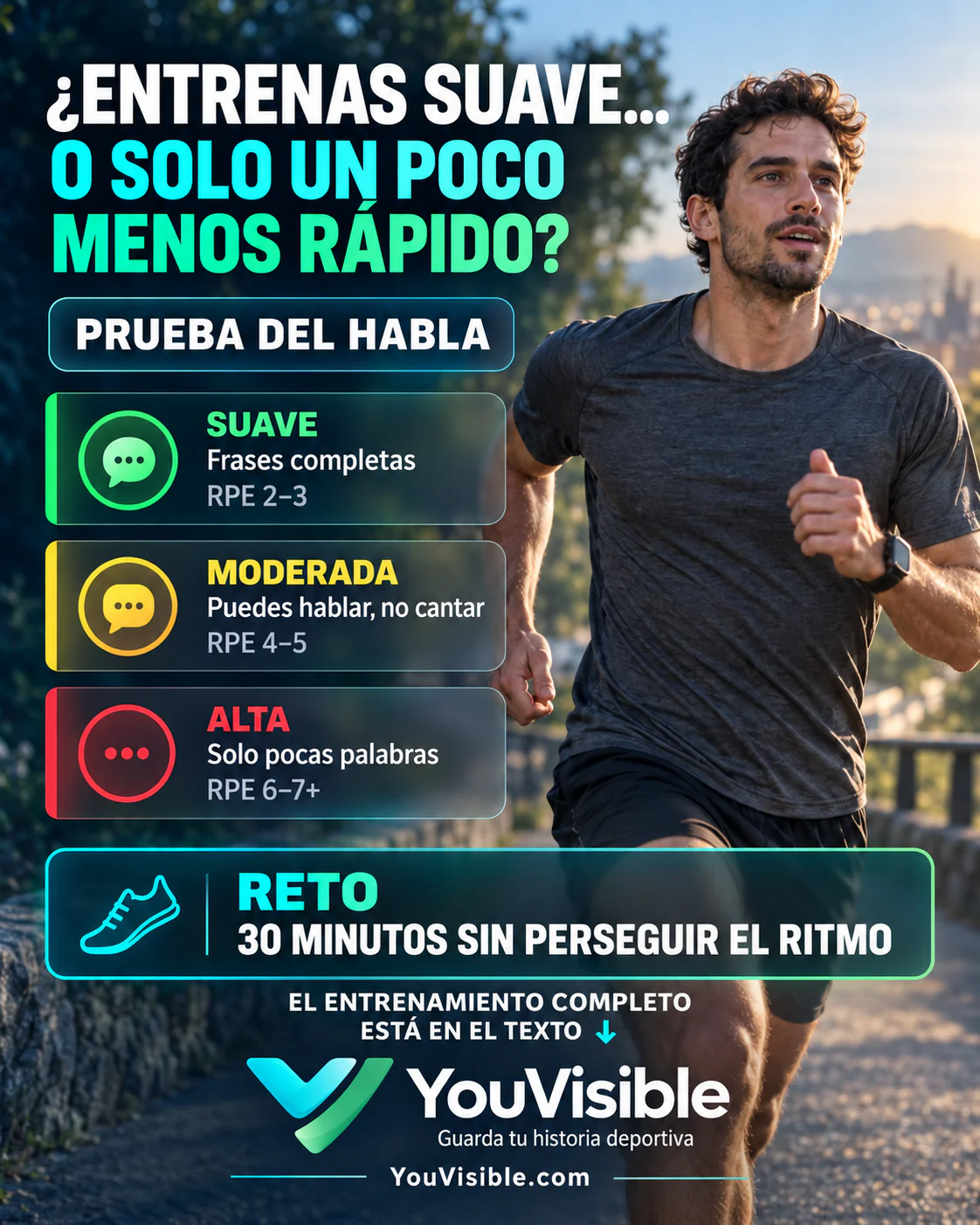
Many runners set out to do an easy run and finish at a medium intensity: too fast for a genuinely easy session, but without reaching a clearly defined hard workout. When that pattern is repeated, most days begin to look the same, breathing is no longer relaxed, and recovery takes more than expected.
You do not need an advanced watch to adjust the effort. Two simple tools can help: the talk test and the rating of perceived exertion, or RPE.
Running slower does not always mean running easy
Slowing down compared with a race or an interval session does not prove that a run is truly easy. A pace that felt comfortable yesterday may demand more today because the conditions—or your readiness for the session—have changed.
Start with the purpose of the workout. If the plan calls for an easy run, the goal is not to hit a particular number. It is to maintain an intensity at which your breathing stays controlled, you can talk comfortably, and you still feel that you have room to continue. Pace is the result of that effort under today's conditions, not a target you must defend.
What is the talk test?
The talk test means noticing how your ability to speak changes while you run. There is no formula: say a sentence out loud and pay attention to whether you can finish it naturally or have to break it up to take a breath.
The CDC describes the talk test as a practical rule of thumb for relative intensity. During moderate activity, a person can generally talk but not sing; during vigorous activity, they can say only a few words before pausing for breath. On a deliberately easy run, look for more breathing room still: you should be able to hold a conversation in full sentences without gasping.
Use the test during the run, not only when you finish. Every five minutes, say a normal-length sentence such as, “I am running calmly today and I could keep this conversation going.” If it comes out smoothly, the intensity is likely consistent with an easy goal. If you need to split the sentence, slow down. If comfortable breathing does not return, walk for a few seconds and check again.
It is an accessible cue for making decisions, not a diagnosis or an individual assessment.
Easy, moderate, and high intensity in practice
These are practical descriptions, not universal training zones. The same speed can represent a different intensity for two people—or for the same person on different days.
| Intensity | Overall feeling | Breathing | Ability to talk | Indicative RPE |
|---|---|---|---|---|
| Easy | Comfortable, sustainable, with plenty in reserve | Controlled and slightly faster than at rest | Conversation in full sentences | 2–3/10 |
| Moderate | A clear effort, but still manageable | Deeper and more frequent | You can talk, but singing would be uncomfortable | 4–5/10 |
| High | Demanding and requiring focus | Strong and difficult to settle while maintaining the effort | Only a few words before taking a breath | 6–7/10 or higher |
The modified 0–10 scale presented by Cleveland Clinic places rest at 0, light effort around 2–3, moderate effort at 4–5, and high effort at 6–7; higher values describe very hard or maximal effort. Here, those figures are practical reference points, not exact clinical thresholds.
How to use the 0–10 RPE scale
RPE stands for rating of perceived exertion. The question is straightforward: How much effort do I feel I am putting in right now? Zero means rest, while ten means the greatest effort you perceive as possible.
The answer is subjective, so interpret it alongside other cues. Cleveland Clinic notes that the rating can account for breathing, muscle fatigue, perceived heart rate, and sweating, and that people can estimate their effort inaccurately. Do not stop at “I think this is a 3.” Check whether you can speak, whether your breathing is controlled, and what context surrounds the session.
A 2023 study by Kwon, Kang, and Chang compared three stages of the talk test with physiological and psychophysiological variables during a treadmill test in healthy participants. The changes were consistent with rising intensity. That supports using speech as a guide, not treating it as a laboratory measurement.
The same effort does not always produce the same pace
Even when RPE remains similar and conversation feels comfortable, pace can change because of:
- Heat: a familiar pace may feel more demanding.
- Elevation: a climb increases the demand even when you slow down.
- Rest: after poorer sleep or recovery, the same run may feel different.
- Accumulated fatigue: previous sessions and daily activities are part of the context.
- Stress: a mentally demanding day may alter how you perceive effort.
- Training level: what is easy for one person may be moderate for another.
Do not chase the pace from an ideal day. Slowing down, shortening your stride, or walking briefly may be exactly what keeps the workout aligned with its purpose.
A practical 30-to-45-minute session
- Warm up for 8–10 minutes by walking briskly or jogging very gently.
- Run for 20–30 minutes at a pace that lets you speak in full sentences.
- Check your breathing every five minutes by saying a sentence out loud.
- If you cannot finish it comfortably, slow down or walk for a few seconds. Start running again when your breathing is controlled.
- Finish with five very easy minutes and notice how the effort decreases.
Do not make up for a walking break by accelerating afterwards. The purpose is to practise control, not to produce an impressive average pace.
Mistakes to avoid
- Treating a planned pace as compulsory when terrain or conditions have changed.
- Waiting until the end to assess effort, when you can no longer adjust the session.
- Confusing “I can say two words” with being able to converse in full sentences.
- Copying somebody else's RPE: the scale describes your perception, not a universal speed.
- Looking at only one signal. Speech, breathing, overall feeling, and context should tell a coherent story.
- Ignoring pain, dizziness, chest pressure, unusual shortness of breath, or other symptoms just to finish the workout.
Today's YouVisible challenge
Run for 30 minutes today without chasing a specific pace. Keep conversation possible, check your speech every five minutes, and adjust your speed when needed. Afterwards, note:
- your effort from 0 to 10;
- what your breathing was like;
- whether you felt you could have continued;
- how you felt before and after;
- which conditions played a part: heat, elevation, rest, fatigue, or stress.
You can record the activity with or without GPS and add your feelings and lessons. To give those notes more context, see how to bring together training and sports wellbeing.
An activity is not only kilometres, time, and speed. It is also feelings, lessons, and progress. Learning what “easy” means for you helps you look beyond pace and build a more useful sports history.
Save your sports history. Share it. Make it visible.
Sources
- CDC — How to Measure Physical Activity Intensity.
- Cleveland Clinic — Rated Perceived Exertion Scale.
- Kwon, Kang, and Chang — “The talk test as a useful tool to monitor aerobic exercise intensity in healthy population”, Journal of Exercise Rehabilitation (2023).
Notice: This article provides general educational information and does not replace assessment, diagnosis, or advice from a healthcare professional. If you have an injury, a medical condition, concerns about your ability to exercise, or symptoms during activity, consult a qualified healthcare professional.