


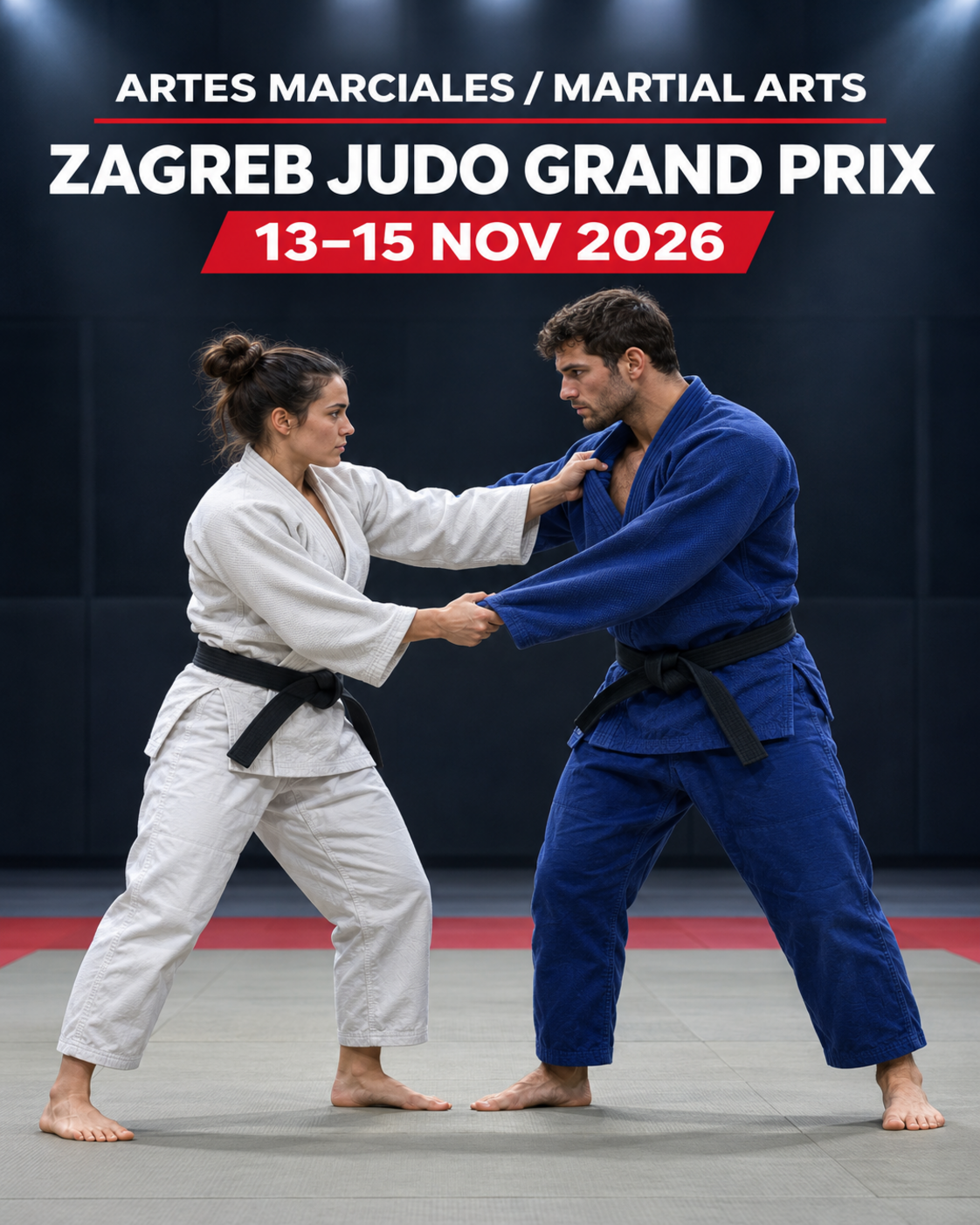
Executive summary
The first visible attack does not always explain why a judo action works. Distance, contact and direction have already been negotiated. A hand reaching part of the judogi may change the opponent's posture; a step can require a new support position; an attack may provoke a response that becomes useful only afterwards.
The Zagreb Grand Prix offers a setting for watching that preparation. Follow the sequence of grips, posture and response before focusing on the throw. This guide does not teach throws, joint locks or submission techniques. Practise with a qualified coach in a supervised judo environment. Understanding an image does not provide the ability to reproduce an action safely, and viewing elite competition should lead to questions rather than unsupervised experiments.
Official information and scope
Information checked on 07/11/2026. The International Judo Federation's November calendar confirms the Zagreb Grand Prix in Croatia on 13–15 November 2026. Use the event information linked from that listing for current details.
The general calendar does not establish individual contest times, categories by day, final draws or spectator arrangements. Nor does an athlete list mean open registration. Confirm the programme, participation conditions and admission with the official organiser before travelling. The following material is observation guidance. Any interpretation of intent remains a hypothesis rather than private information about a competitor. That distinction keeps the analysis useful without claiming more access than a spectator has.
Begin with distance before contact
Watch an exchange from the point where both judoka can approach, rather than starting when a hand is already in place. Ask who needs another step to establish contact and who retains more movement options. Distance changes what can follow even before anything spectacular appears.
Do not turn that observation into a rule that the person moving closer is dominant. Closing space may open an opportunity and expose the athlete to a response. Position, grips and movement all matter. Describe what changed after the approach: posture, support or available space. Avoid inferring lasting superiority from a few seconds of footage. A later exchange may reverse the relationship or reveal that an apparently useful position was difficult to maintain.
Follow one hand, then the other
Trying to watch every action simultaneously can leave you remembering only the finish. Choose one side for several exchanges. Notice whether contact is established, lost and regained, and what the opponent does during that interval. Then focus on the second hand and connect the sequences.
The useful question is not only where a grip sits, but when it makes action possible. Brief contact may provoke an adjustment; prolonged contact may create no visible advantage. We do not provide a catalogue of permitted and prohibited grips, because judgement requires current rules and the full action. Consult the IJF's official documents for regulatory questions and discuss a specific case with your coach rather than relying on a cropped image.
Posture means options, not an ideal photograph
A position can look strong in a still image while being about to change through a step or force direction. Watch whether the judoka can move after receiving pressure and how the supports are reorganised. The ability to respond matters more than a static appearance of firmness.
Spectators do not know precisely how much force is being applied. They can observe a step, turn or change in trunk orientation. Describing those responses avoids invented measurements. If commentary explains an action, use it to guide a second look rather than to claim that you saw details hidden by the camera angle. It is reasonable to understand the broad sequence while remaining uncertain about the exact mechanism.
Direction: reactions reveal some of the preparation
Ask where the exchange appears to be moving and what happens when that direction changes. A competitor may invite one response and use a different opportunity afterwards. That does not make every movement a deliberate trap. Tactical reading must distinguish a plausible sequence from confirmed intention.
A simple note can contain three elements: initial contact, visible response and subsequent action. If one is missing, keep the conclusion open. Describing an opponent stepping back after a grip change before an attack is a sequence. Saying it was planned exactly that way from the beginning requires evidence from the athlete or team. The distinction is especially important when discussing a short highlight that omits the earlier exchange.
Look for adjustment before the fall
Loss of balance can become visible in the need to move a support or reorganise the body. It does not always end in a throw. Watching only the scoreboard can hide preparation that restricts the opponent's options and shapes the next exchange.
Notice whether an action forces a positional change and whether the attacker has continuity afterwards. Do not use this guide to push someone at home or test a response. Execution, falling and protection require in-person instruction. A spectator can learn a great deal by identifying when the situation changes without converting that understanding into physical instructions they are not prepared to apply. This keeps observation connected to learning while respecting the limits of remote explanation.
The first attack may seek information
An attack that does not score may reveal a response, create a reaction or begin a combination. It may also simply fail to achieve its purpose. Avoid assigning a tactical masterplan to every attempt so that all action appears perfectly intentional.
Watch the immediate consequence: separation, renewed contact, continuation or an official interruption. That helps form a more reasonable interpretation. When reviewing authorised footage, return to the beginning of the exchange before judging an isolated attack. Context can explain why a modest-looking action proved useful or why a dramatic entry left no continuation. The outcome alone does not identify every decision that produced it, and a failed attempt can still provide a meaningful question for training.
Refereeing changes the sequence too
Pauses and official decisions affect a contest's rhythm. Understanding an incident requires the applicable rule and preceding action, not an explanation invented from the crowd's reaction. No score does not automatically establish an illegal action, and an interruption alone does not reveal its cause.
Use official documentation and available explanations to investigate. We do not supply penalty lists or timings that may be outdated. At a club, one precise question for the coach is more productive than an absolute conclusion drawn from an edited clip. Acknowledging missing information is part of learning the rules. It also prevents a family discussion from becoming a debate based on two different imagined versions of what happened.
A family observation exercise
Choose one question for a contest: who establishes useful contact, how posture changes afterwards or what follows the opening attack. Change the question for the next contest. You do not need to analyse everything simultaneously or label every choice good or bad.
When a young judoka comments on the action, ask what attracted their attention and what they would like their coach to explain. Avoid turning elite competition into a requirement to imitate a champion or prove toughness. High-level sport can encourage curiosity without defining what a child must achieve in the next lesson. Observation should support their learning relationship with the coach, not create another performance test at home.
Common mistakes and checklist
Typical mistakes are watching only the throw, treating a grip as guaranteed control and assigning intent to every attack. Attempting a televised technique outside supervised practice is another avoidable error.
- I have confirmed dates and the programme through official Zagreb information.
- I distinguish spectator access from sporting participation.
- I will follow exchanges from before the first contact.
- I will describe response and continuation before interpreting intent.
- I will consult current rules about a refereeing question.
- I will take questions to my coach without reproducing techniques unsupervised.
Official sources and a useful record
Revisit the IJF calendar and official documents for last-minute changes. Record your judo activity in YouVisible and share an authorised moment explaining an observation. Respect opponents and image permissions. A precise question about the beginning of a contest can provide more lasting learning than keeping only the final action.