


Executive summary
Following the ball tells you who has possession, but not always where the next advantage is being prepared. In rink hockey, a movement that never receives a pass can open a lane, turn a defender or free the far post. Watching all of that simultaneously is difficult. One question per sequence is more useful than trying to track every change of possession.
The Calafell Continental Cup offers a setting for learning to watch work away from the ball. This guide is for families, skaters and spectators who want to understand collective decisions. It does not describe particular teams' rehearsed plays or claim access to private tactics. Interpretations remain questions that a visible sequence may help answer, with room for uncertainty when the view is incomplete.
Official information: two Final Fours
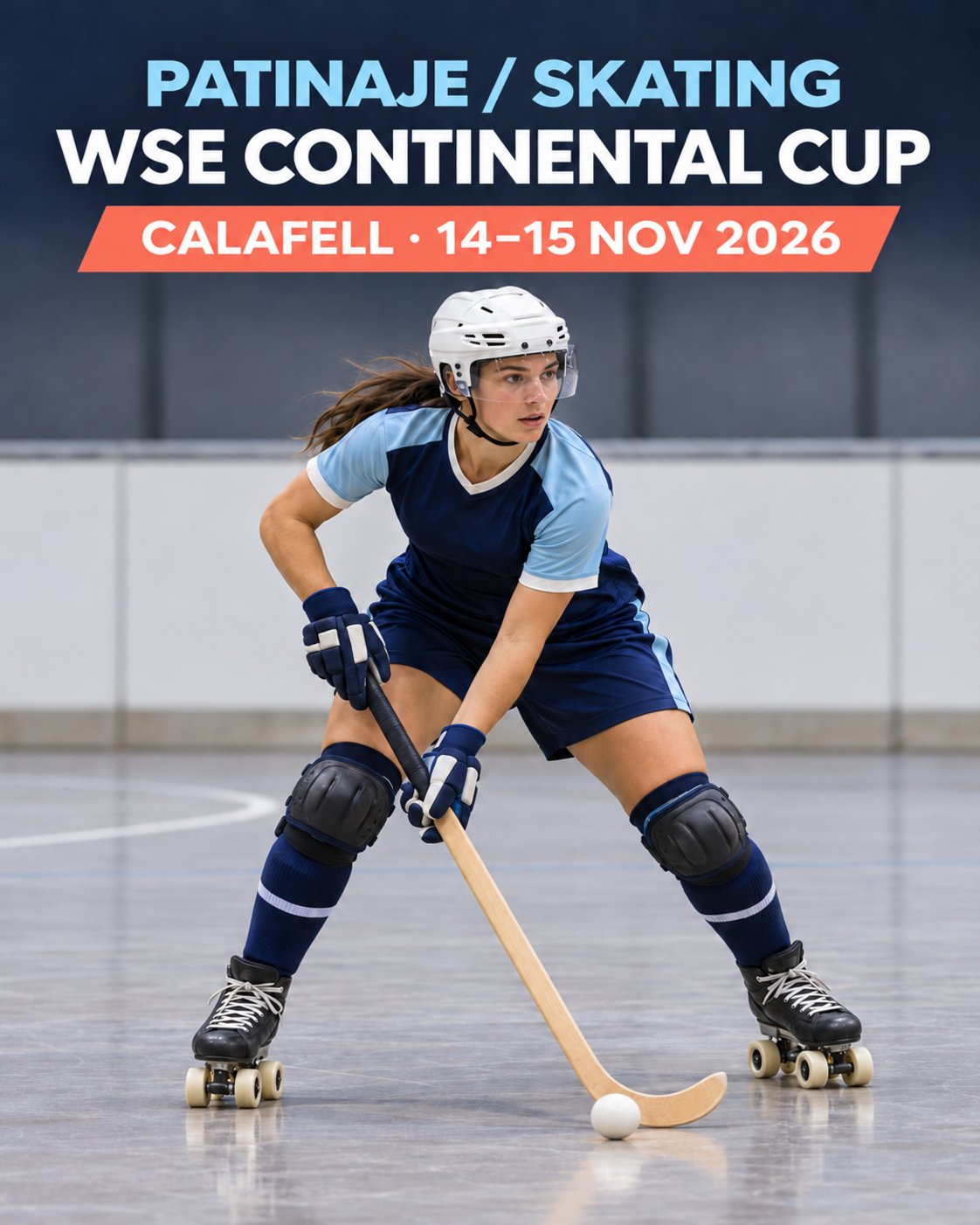
Information checked on 07/11/2026. The official World Skate Europe announcement confirms the women's and men's Continental Cup in Calafell on 14–15 November 2026, at Pavelló Joan Ortell. It lists Saturday semi-finals and Sunday finals.
The same page contains a media accreditation process. That is neither athlete registration nor a spectator ticket. Confirm admission and the current programme with the organiser; we do not claim seats remain. The document retains “Schedule TBD” alongside published times, so check the latest version before planning a visit. We do not silently turn those times into an unconditional guarantee. Separate what is announced from what needs final confirmation.
A passing lane exists before the reception
Choose someone without the ball and follow them through several possessions. Notice whether they move closer, move away or change their angle relative to a teammate. Useful movement does not always produce a reception. It may turn a defender's attention and make room for somebody else.
Ask which option appears after the movement. If no option seems visible, do not immediately call the movement pointless. The defence may have responded well, or the camera may hide part of the action. Describe starting position, movement and resulting option. That sequence provides a more precise lesson than praising only the person who supplies the final pass. It also helps explain why apparently quiet players can contribute to an attack.
Far post: timing matters as much as presence
Watching the far post means checking for an option on the opposite side of the goal from the ball. Arrival alone is not enough. Consider when the player arrives, whether a pass can reach them and which defender must respond. Waiting there throughout a possession may offer less than arriving as the attack changes direction.
Alternate your attention between the ball carrier's preparation and the teammate's arrival. Do not treat every unmade pass as a failure to see. The angle, timing or control may be insufficient. At club practice, turn the uncertainty into a question for the coach rather than reproducing a high-speed action outside a supervised setting. The aim is to understand relationships, not to demand that every visible run receive the ball.
Substitutions organise the play too
A substitution changes who provides support and who can respond if possession is lost. Watch whether the team retains its shape during the change or needs time to reorganise. An apparently simple replacement may require another player to cover space until the new teammate is established.
We do not assert specific substitution conditions without consulting the applicable rules. The useful observation is coordination and continuity, not inventing infringements from the stands. If you want to understand a refereeing incident, consult official rules and any available explanation. A partial broadcast view may not show the precise moment or the whole substitution area. A confident opinion is not a substitute for the missing angle or governing detail.
Defensive recovery: protection before possession
After a turnover, the first question is not always who can win the ball immediately. Look for who protects a route towards goal, who directs the opponent's advance and who restores a supporting position. A player moving away from the ball may be closing a more dangerous option.
Compare the space behind the first defender across several sequences. When several players chase possession, a previously protected lane may open. This is a reading framework, not a conclusion about a team's assigned tactics. Coaches know responsibilities a spectator may not infer. Describing the open space helps discuss the game without blaming one young player for an entire opposition attack. Collective consequences often extend beyond the most obvious individual action.
Screens and positioning: look beyond contact
A screen may influence play before the ball changes sides, but a rules judgement requires the full action and applicable standard. Tactical explanation is not permission to copy contact. This guide does not teach physical blocking or deliberate collisions.
Watch how a position makes another player go around, wait or change their skating line. Then see whether the attacker uses the resulting difference. If the view hides feet, distance or movement, acknowledge that limit. For families, a useful discussion asks which options each participant had rather than turning every contact into a debate about intent or toughness. Understanding what the camera cannot show is part of watching well, especially when a clip begins after the relevant movement started.
Between semi-final and final: a finite window
The published format places semi-finals and finals on consecutive days. What happens after the first match therefore matters, but we do not know the teams' recovery plans. We cannot attribute a rotation to fatigue or claim a player is being saved for the final.
For an amateur club in a comparable format, the practical recommendation is to organise logistics beforehand: checked equipment, clear transfers and room for ordinary needs. Avoid allowing match review to consume the whole interval. Select one or two collective decisions worth discussing and leave the coaching staff to organise sporting work. Families can help by reducing improvised tasks and comments that turn every error into a continuing examination. The interval should remain usable, rather than becoming an extension of pressure from the first match.
A manageable observation method
For a few minutes, follow the support player farthest from the ball. Then switch to the response after possession is lost, and later to substitutions. You do not need to answer every question in every attack. If play is too quick, note a sequence for later review in an authorised recording.
Separate fact from interpretation. Moving towards the far post and taking a defender along describes a visible relationship. Saying that the coach ordered a particular play requires other evidence. Keeping that distinction supports learning without inventing internal instructions. It also lets you enjoy the match without demanding a definitive answer from every observation. Some sequences become clearer only when compared with what happens later.
Common mistakes and checklist
Typical mistakes are watching only the ball, crediting a goal to one person and judging a substitution without considering the space it leaves. Another is confusing media accreditation with general admission.
- I have confirmed admission and the latest official programme.
- I understand that both women's and men's competitions are taking place.
- I have selected one observation question for each period of watching.
- I look for the option a movement creates, even without a reception.
- I distinguish visible action from a hypothesis about intent.
- I follow spectator boundaries and photography or filming rules.
Official source and moments that explain play
Check the World Skate Europe announcement for last-minute changes. If you record your visit or sporting activity in YouVisible, share an authorised moment that explains support, defensive recovery or a collective decision. Obtain permission before publishing images of minors. Explaining the movement that prepared a chance can preserve a richer memory of the match than keeping only the goal.