


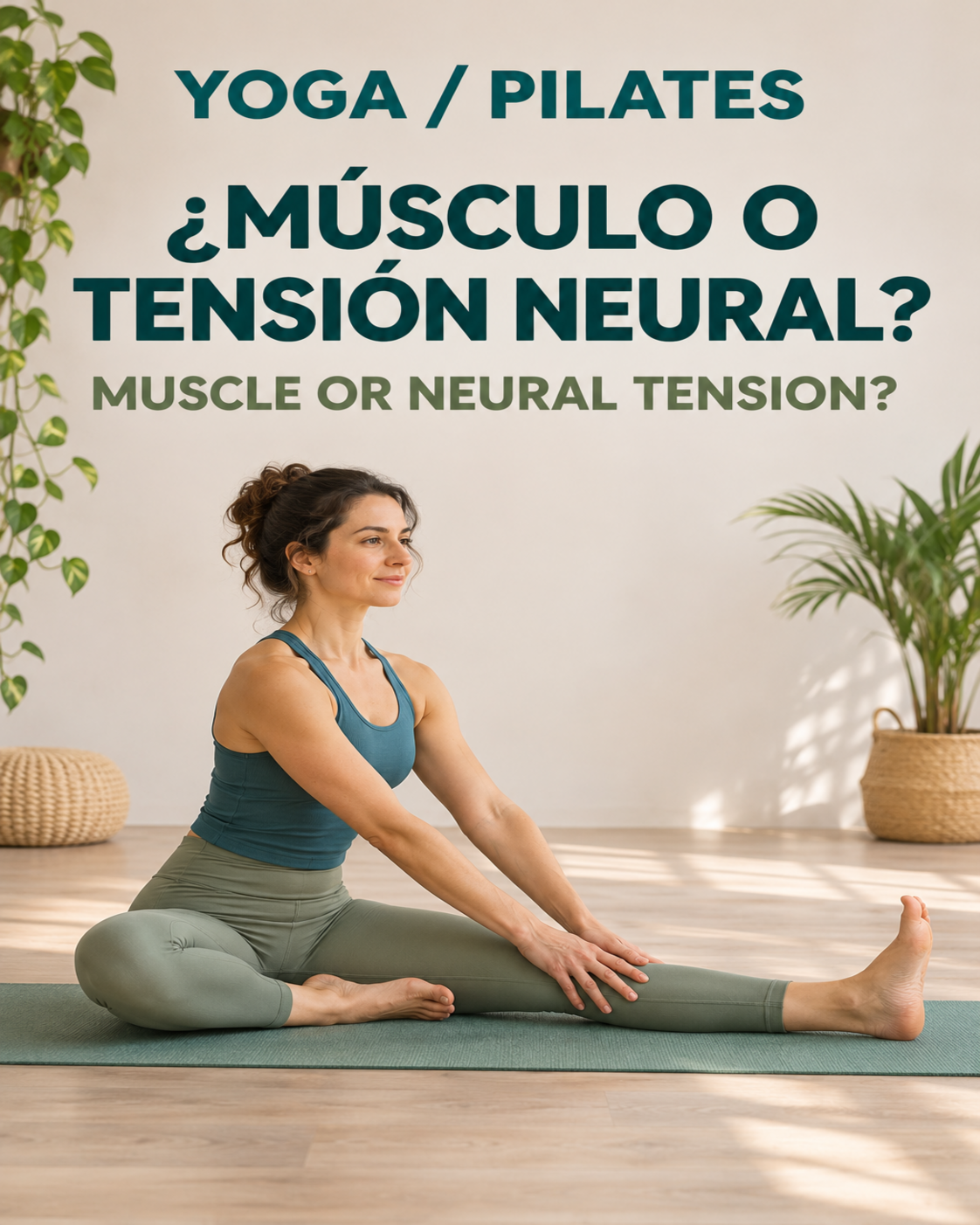
During a forward fold you feel tension behind the thigh. When you push farther, tingling travels towards the foot. “Your hamstrings are tight” no longer helps you decide what to do. The useful task is to leave that sensation, reduce the demand and understand why reaching farther is not always the right goal.
Reach does not describe a single tissue
A forward bend combines movement at the hip, spine, knee and ankle with tolerance of the position and individual characteristics. The nervous system also has to accommodate movement. The gap between fingertips and floor cannot identify which structure limits the action.
A study of neural tension and hamstring flexibility found that changing neck and spinal position altered resistance and range during passive stretching. Eight healthy people took part in a controlled procedure. The result challenges the assumption that every limitation belongs to the muscle; it does not teach you to diagnose a nerve on a mat.
That distinction changes the practical decision: an unusual sensation does not necessarily call for more intensity. Reducing range preserves a movement option and avoids turning class into a test of symptom tolerance.
Which sensations should change your practice?
A muscle stretch may feel like relatively broad, tolerable tension that allows breathing and a controlled exit. There is no perfect sensory map for identifying tissues. Even a familiar sensation becomes unsuitable if it is painful or changes how you move.
Tingling, numbness, burning, electric sensations or symptoms extending towards the lower leg or foot are reasons to stop pushing. They can have different causes. You do not need to prove that they are neural before responding cautiously.
The NHS information on persistent or recurring pins and needles recommends seeking advice when symptoms do not go away or keep returning. An absence of severe pain does not make reduced sensation or changes in strength irrelevant.
Position matters without providing a diagnosis
A sensation may change when you relax the posture, soften the knee or leave a forced position. That shows the task can be modified; it does not prove the location of a problem. Neck, spine, ankle and knee contribute to the same movement configuration.
Do not combine position changes to reproduce an electric sensation and locate a nerve. You do not need to place your neck at an extreme or force the ankle to test a theory. Such manoeuvres belong within clinical assessment when appropriate.
If the sensation disappears after leaving the position, note what happened and avoid immediately repeating the provoking action. If it remains outside the pose or returns during everyday activities, seek assessment. Class is for practice, rather than proving you can generate the same symptom twice.
A straightforward response during class
First leave the position calmly and find a comfortable posture. Tell the instructor what you felt and where, using specific words. “Tingling towards my foot” communicates more than “I am inflexible” and reduces the risk of someone assuming that you need additional pressure.
If you are symptom-free and continuing is appropriate, choose a clearly easier variation without chasing the same reach. Reducing the fold, using support or keeping the knee less extended may be options under suitable guidance. If the sensation returns, stop that exercise instead of adjusting it indefinitely.
Do not hold a position hoping that an electric sensation will become a productive stretch. Do not ask somebody to push your back or pull your leg. A useful adaptation allows comfortable practice; increasing reach is not its defining feature.
Yoga and Pilates offer goals beyond range
In yoga, a posture can be adapted around breathing, stability and transitions without pursuing end range. In Pilates, an exercise can emphasise trunk control or coordination without fully extending the knee. The method's name does not change the need to attend to symptoms.
Tell the instructor if the issue occurred in another class or remains present when walking or sitting. A general cue for the whole group may be inappropriate for you that day. Choosing a smaller variation is a way to retain controllable practice rather than evidence of losing a level.
If you are working with a healthcare professional, use the adaptations you have agreed. Avoid adding therapeutic exercises from videos on your own: selection and dosage depend on assessment that an article cannot supply.
What research into neurodynamics means
A trial of techniques added to hamstring stretching examined interventions over several weeks and found differences in some flexibility measures, without equivalent changes in every test. Its population and protocol limit generalisation.
Research on an intervention does not mean you should apply it to yourself when tingling appears. This article offers no neurodynamic self-treatment and no instructions to “release” nerves. It also does not promise to correct an injury by increasing range.
The editorial interpretation is more limited: when several components influence reach, always responding with more muscle stretching can oversimplify the task. Adapt the movement and seek help when symptoms warrant it.
When to seek assessment or urgent help
Consult a qualified professional for persistent or recurring tingling, pain limiting activity, or changes in strength or sensation. Stop practice when those changes appear; do not test strength through demanding positions.
The NHS information on sciatica lists urgent warning signs including altered bladder or bowel control, reduced sensation around the genital region, or severe and worsening weakness in both legs. Mentioning them does not imply that your stretching sensation has that diagnosis: they are reasons for immediate help.
Make the description useful by noting whether symptoms continued after class and whether ordinary activities were affected. Bring that information to the consultation rather than deliberately provoking symptoms again to create a more complete record. An honest account is sufficient; assessment is the professional's task.
Common mistakes
Comparing how far people reach, calling every limitation a blockage and holding painful positions out of pride all redirect attention away from useful practice. So does assuming a bent knee removes the exercise's value. The task should fit your situation rather than the appearance of a photograph.
Do not turn every change in sensation into an anatomical label. Describing where, when and how it happened helps a professional more than arriving with a fixed diagnosis. Reproducing less tingling after repeated provocations is not an appropriate measure of success.
Checklist before another fold
- Am I free of tingling, electric sensations, burning or numbness?
- Can I breathe and leave the position under control?
- Does the variation actually reduce demand?
- Have I explained the sensation to the instructor without minimising it?
- Are symptoms outside the exercise a reason to seek assessment?
- Am I pursuing useful practice or simply a greater reach?
YouVisible can hold a note about how the session went and which adaptation felt comfortable. A precise record supports discussion with your instructor or healthcare professional. It cannot replace assessment or turn a sensation into a diagnosis.