


Executive summary
Ten Dance is not five Standard dances plus five Latin dances performed without changing anything in between. Couples must reorganise contact, use of space, footwear and attention while maintaining communication as fatigue accumulates. The practical challenge is changing tasks without automatically carrying the previous style's solutions into the next one.
For recreational dancers, the lesson is not to copy a world-level couple's private preparation. It is to recognise what needs resetting and what should remain consistent. For spectators, following that transition reveals quality beyond a spectacular figure. This guide offers observation and preparation questions without inventing intentions or private routines for particular competitors. The examples are prompts for learning with your teacher, rather than a substitute for technical instruction.
Official information for Yerevan
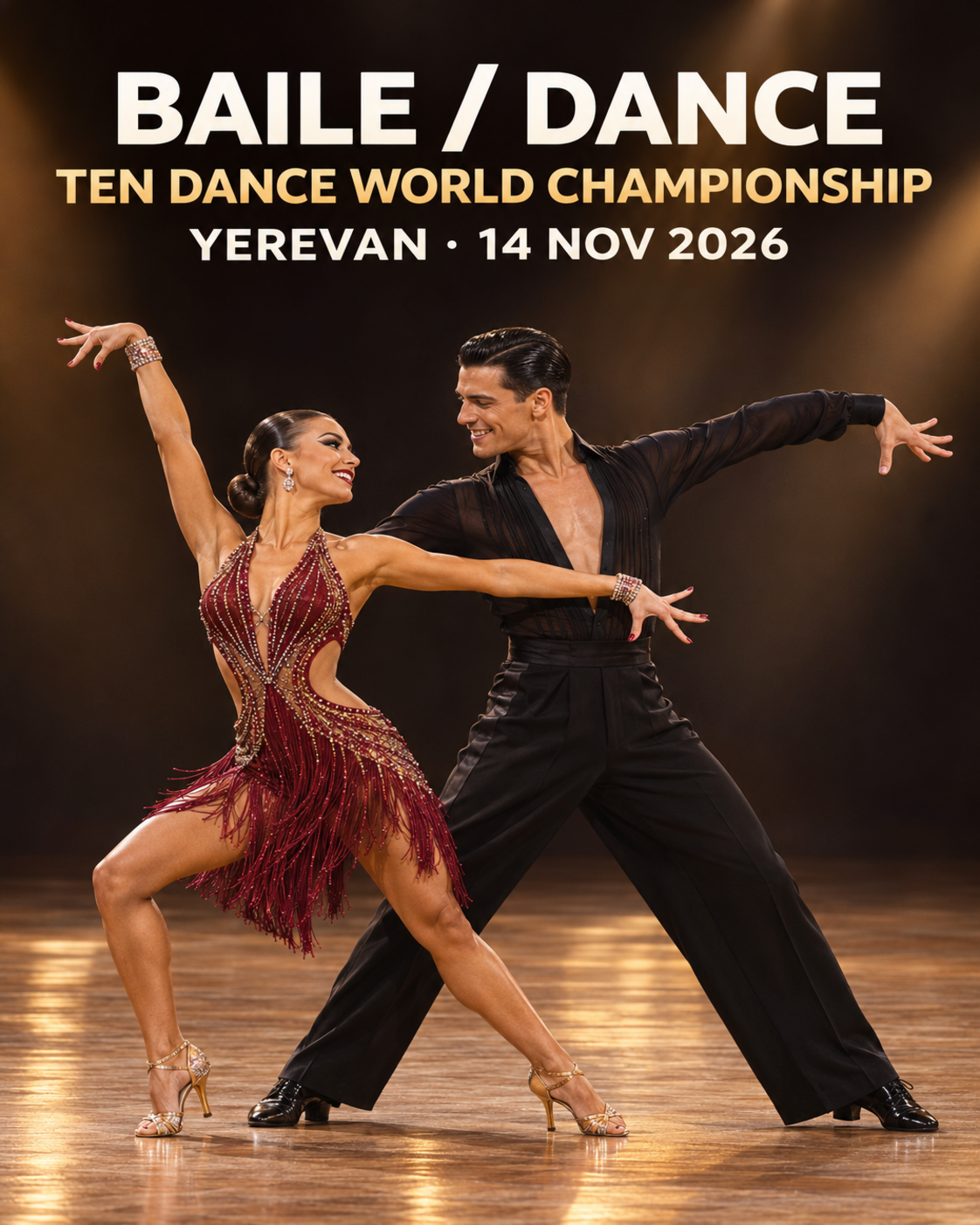
Information checked on 07/11/2026. The WDSF competition calendar confirms the World Championship Adult Ten Dance in Yerevan, Armenia, on 14 November 2026. The Yerevan event page also brings together other competitions. Their dates and disciplines should not be confused with this championship.
Confirm the current programme, exact venue, spectator access and participation conditions with WDSF and the organiser. A championship listing does not establish open entry for every couple. We do not supply unconfirmed intervals, round orders or ticket availability. The suggestions below are editorial guidance for learning from the event, not the competitors' internal schedule or official preparation requirements.
The task changes with the music
Standard and Latin organise the relationship between partners differently. Watch how movement begins, how space is maintained and how coordination returns after a figure. Reducing the distinction to closed versus open misses the decisions within each style that require their own preparation.
For a recreational partnership, name one priority for the switch. It might involve recognising the new contact or finding a shared rhythmic reference. Attempting ten corrections in the moments before starting can make every instruction unclear. Use training time with your teacher to decide which short cue answers your actual need. A useful cue has a shared meaning built through practice; it is not simply a phrase borrowed from a successful couple's interview.
Energy: preserve clarity for the second movement language
An intense first sequence can leave enough strength to continue while reducing your ability to listen to your partner. Reserve includes attention and coordination. Watch whether a shared start remains clear after a style change or whether small disagreements appear before a difficult figure begins.
That observation does not diagnose fatigue from the stands. It does suggest a question for practice: which part of our coordination changes as dances accumulate? Review familiar sequences during planned sessions instead of suddenly reproducing a championship's workload. The purpose is to identify a pattern and discuss it with your coach, not prove endurance by extending a session after its quality has already deteriorated. More repetitions are useful only when they still answer the intended question.
Posture must remain available for movement
A position may look convincing in a photograph yet stop working during travel. Watch whether the couple maintains continuity through direction changes and adjusts space without interrupting the dance. Quality is not immobilising the body inside a shape. It is maintaining an organisation that leaves movement possible.
During a style transition, avoid a vague command such as fix your posture. Express a need that both partners understand and have worked on with their teacher. Improvised instructions about shoulders, neck or hips can compete with one another. A simple reminder helps when it returns the couple to familiar coordination, not when it demands a new position under competition pressure. Any technical change needs an appropriate learning setting.
Contact: when does information become shared?
Look for where a joint decision begins. Sometimes the change is visible in the couple's travel before it appears in the arms. Watching only the final figure hides its preparation. Follow a complete phrase and ask whether both partners seem to have time to respond.
In practice, agree on a way to communicate an issue without blame. Saying that you need more room on entry identifies a task. Saying that your partner always pushes invites an argument. This does not replace teaching about leading and responding. It helps prevent the change of style becoming an urgent negotiation about who caused the last error. Clear communication leaves more attention for the next shared action.
Footwear and equipment can consume attention
Where the rules and programme permit footwear changes, their logistics should be prepared. We do not claim that Yerevan offers a particular interval for doing so. Check the actual schedule and governing rules, then organise equipment without depending on an imagined break.
An orderly bag, checked fastenings and a familiar alternative reduce unfinished tasks. Avoid introducing a major change because it looks appropriate for elite competition. Ask whether it supports a familiar dancing experience and can be managed within the event's conditions. Equipment should release attention, rather than add decisions when pressure is already high. If a change cannot be completed reliably in the available time, discuss a workable plan beforehand with your teacher and the relevant event personnel.
Warm up for the switch as well as the opening dance
Preparing only for the beginning leaves the later transition unexplored. A planned preparation should consider how you will recover references for the second style. That does not mean dancing the whole competition in advance or staying maximally activated throughout every wait.
Ask your teacher which brief elements are useful for you and how to adapt if the schedule changes. Official information defines the available margin; experience helps decide how to use it. From the stands, do not conclude that a couple is poorly prepared because they wait quietly for a moment. Their full plan and preparation outside your view are unknown. Watching responsibly includes recognising the limits of the evidence you have.
A mental reset separates one task from the next
A Standard mistake need not accompany the entire Latin sequence. Agree on a short close: identify one useful piece of information, postpone detailed analysis and name the first task ahead. That is not denying the error. It prevents review from competing with immediate action.
Spectators can look for a shared start, orientation and early continuity. Avoid translating those observations into claims about confidence, relationships or personality. The same visible behaviour may have several explanations. Describing what you actually see keeps the analysis respectful and provides a stronger learning basis than inventing an emotional story. Couples can apply the same discipline when reviewing video together after practice.
How to watch ten dances without losing the thread
Choose one question per block: how the couple uses space, restores contact or starts after a pause. Follow the same couple for a complete phrase before changing your focus. Watching only each couple's most striking figure compares isolated moments that may serve different purposes.
Record actions rather than invented judging marks. Maintaining continuity through a direction change is an observation. Deciding who should win requires much broader criteria and perspective. A family's or recreational dancer's goal is to appreciate more of the performance, not replace official judging from a partial view of the floor. You can learn a great deal without assigning a ranking.
Common mistakes and checklist
Avoid treating new music as the whole task change, improvising long corrections and relying on unconfirmed breaks. Do not assume every problem reflects insufficient energy when a missing shared cue may explain more.
- I have confirmed the exact championship and current programme.
- I distinguish competitive participation from spectator access.
- We have a brief priority for each style change.
- Equipment and any permitted changes are organised.
- We can close an incident without debating it during the next start.
- When watching, I describe actions and acknowledge what remains unknown.
Official sources and a shared review
Check the WDSF calendar and Yerevan listing for last-minute changes. Record your session in YouVisible and, with your partner's agreement, share a moment that explains a transition. A note about the cue that restored coordination can be more useful than keeping only your most difficult figure.