


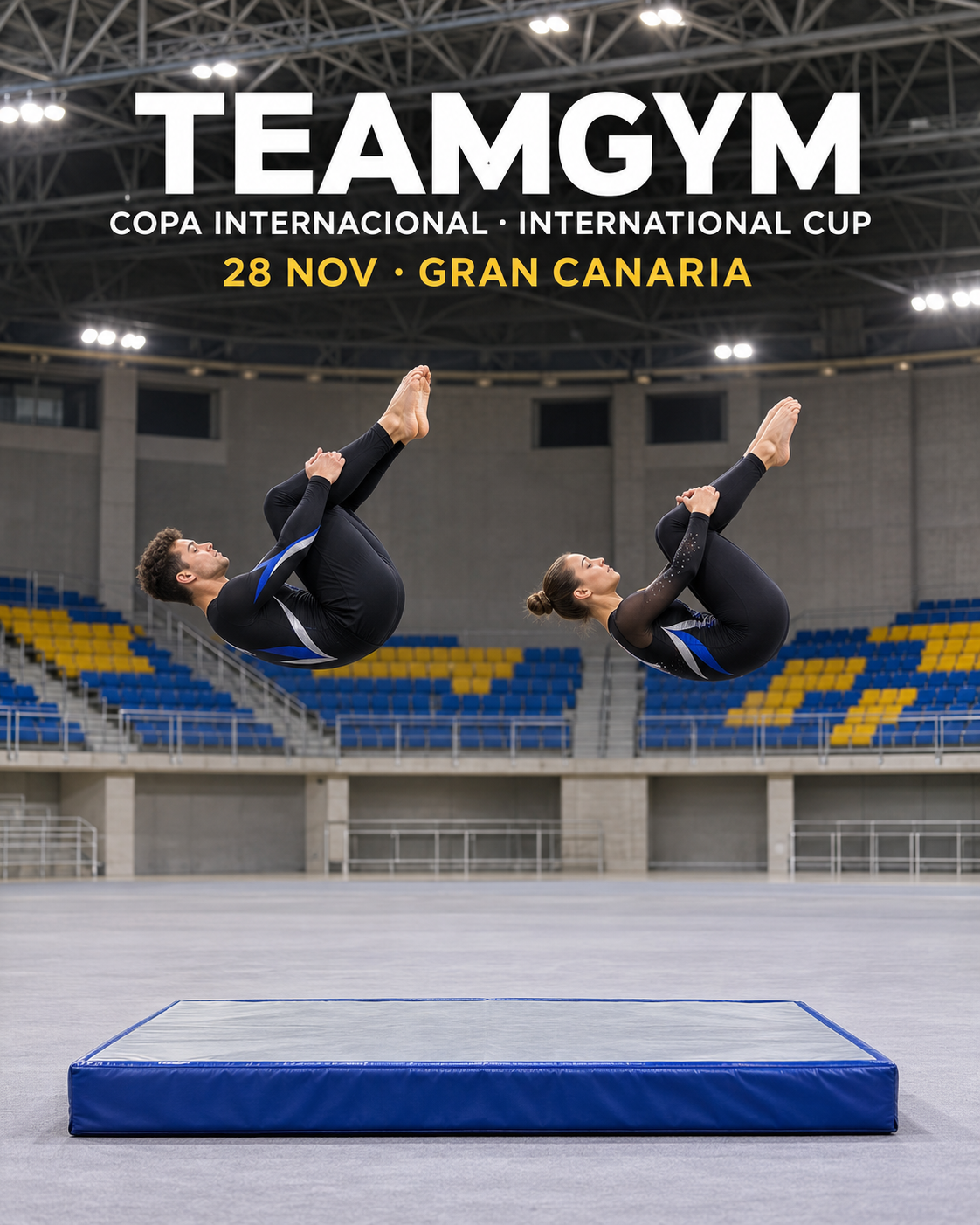
Someone familiar mainly with individual gymnastics may approach TeamGym expecting the same structure with more people. The difference becomes clearer when you watch what is built collectively: a shared floor exercise, acrobatic sequences and difficulty choices that must fit the team's performance. The Blume Cup offers a way to discover that logic without confusing it with an individual artistic gymnastics competition. The relationships between actions are part of the attraction.
El Tablero: date and programme checked
Sources checked on 16/11/2026. The official Blume TeamGym page lists delegation arrival on 25–26 November, a technical meeting on 27 November and competition on Saturday 28 November at El Tablero sports hall, Gran Canaria. The official tournament index confirms that date and venue for TeamGym.
The website proposes 10:00–11:30 training and 11:30–14:30 competition; the organiser's linked bulletin and festival tables contain other blocks. We do not present that interval as a final timetable: confirm your session with Blume before travelling. Delegation package prices are not automatically public admission prices, and we do not claim unrestricted access, availability or facilities without specific confirmation. Build the visit around answers relevant to spectators rather than assumptions from participant information.
The team is the unit you are watching
TeamGym makes more sense when you follow relationships between people. Shared actions, successive sequences and composition need coherence. Identifying the gymnast with the most striking movement is only part of the picture. Notice how the group enters, organises and links its contributions to create a common performance. Attention to the whole can reveal why a smaller action matters.
This guide supports families and interested spectators; it does not replace the cup's category rules. We do not infer composition, mandatory team size or difficulty values from an image. If supporting a team, ask the coach for a short explanation of its goals for the event. That reference may help identify worthwhile work beyond a placing and make the experience easier to discuss afterwards. It also prevents unfamiliarity with the format from turning into unfair assumptions about individual roles.
Floor is a shared proposal
During floor exercise, observe music, formation changes and continuity between movements. Alternate a view of the whole with one small sequence to see how they fit. Not every action must be identical at the same instant; a succession may be intentional and belong to the composition. Looking for the repeated idea helps distinguish design from a moment you simply could not interpret.
Simple questions help: do changes of direction make sense? Is there space for each action? Does the music relate to particular decisions? Do not convert those questions into an invented score. A side seat may reveal a relationship different from the judges' viewpoint. The aim is informed enjoyment while distinguishing what you can observe from what would require technical knowledge to assess. Several spectators may notice complementary aspects of the same routine without any of them needing to act as an unofficial judge.
Tumbling: follow the series and its continuation
Tumbling involves acrobatic sequences on a specific track. New viewers can watch preparation and completion as well as the airborne movement. When gymnasts perform in succession, notice continuity between entries instead of reducing the experience to counting rotations. Following the whole intervention gives a clearer picture than waiting only for the most dramatic skill.
We do not offer execution instructions or an element catalogue. Speed and height alone do not establish the quality of a series. Notice direction, control and exit while remembering that your angle may hide details. If something does not unfold as expected, wait for the official result rather than reconstructing a deduction from the stands. You can admire effort without claiming an assessment you cannot verify. That approach also leaves room to appreciate a controlled performance whose difficulty is less obvious at first glance.
Trampet has its own apparatus and sequence
Trampet includes an approach and take-off under its own conditions and should not be confused with individual trampoline competition. Watch the relationship between run-up, apparatus entry, airborne phase and landing. Recognising that sequence helps you follow the performance even before learning the names of the skills shown by each team member. Different tasks deserve their own attention.
Landing equipment and support personnel do not make a movement suitable to try outside training. Safety depends on preparation, setting and supervision, not simply the apparatus in a picture. Explain to interested children that the performance results from progressive learning. They do not need to reproduce a jump to establish whether the sport interests them. Watching can lead to questions about finding an appropriate club rather than an immediate physical experiment in a corridor or living room.
Synchronisation and collective rhythm
Some sections invite you to watch coincidence; others use an organised sequence. Coordination also includes leaving appropriate time and space for the next person. A team can maintain continuity while members perform different tasks. Before interpreting a difference as a mismatch, look for a recurring pattern that explains the relationship. The intended effect may become clearer over several interventions.
For families, this perspective values people who are not at the centre of the most spectacular instant. Maintaining a shared reference and fulfilling a role are real contributions. Avoid saying someone is merely accompanying the group because their action looks less difficult. Without the plan and category conditions, that interpretation can be unfair and conceal exactly what makes a team event interesting. A useful discussion considers how an intervention supports the next one rather than ranking every person independently within the team.
Difficulty should reflect preparation
From outside, attempting the hardest skill may always seem the best choice. A team's difficulty decision also needs execution and consistency. A more ambitious action does not guarantee a stronger result if it disrupts continuity or exceeds available preparation. Coaches and the rules determine the specific assessment; this guide does not recommend changing elements shortly before competition.
Relatives can ask what the group is developing instead of demanding a skill seen in another team. Learning processes differ. A competition may show a stage of progression without losing its value. Comparison need not become pressure to accelerate learning or attempt a movement before the necessary conditions are in place. Recognising a sensible choice can be part of supporting the team, even where it does not produce the most memorable isolated moment for a spectator's camera.
Organise safety and preparation beforehand
Participants should follow club instructions for documentation, warm-up, clothing and reporting. Late changes or discomfort need communication with the coach rather than concealment to avoid disappointing the team. A health concern requires appropriate assessment and adjustment where necessary. Collective responsibility should not become pressure for an individual to hide something important about their condition.
Companions can help by reducing logistical uncertainty: know where to meet, bring agreed items and respect reserved spaces. Do not enter a technical area for a better recording angle or to speak to a gymnast preparing. A pause also does not give children permission to play on apparatus. The visit works more comfortably where audience and team understand their own responsibilities and respect each other's space. Clear arrangements beforehand reduce the need for last-minute interruptions when concentration matters.
Plan a visit within the wider festival
Blume includes competitions and other activities across different venues. TeamGym at El Tablero does not imply that every rhythmic session or exhibition happens there too. Review discipline, hall and date for each listing. When combining activities, allow for travel and unresolved schedules rather than assuming everything is nearby or connects without waiting. One carefully chosen block can be more satisfying than a rushed attempt to see everything.
Ask about spectator admission, conditions for minors and accessibility where needed. A participant package is not automatically an equivalent general ticket. Allow time to eat and rest, and avoid a return connection tied tightly to an unconfirmed finish. The cover is illustrative: it does not document a particular element in this cup or establish how apparatus will be installed. Practical confirmation should come from current organiser instructions, not from the scene used to introduce the article.
Share what you learned to notice
Afterwards, ask the team which section felt most connected and which preparation decision helped. Listen before comparing placings or highlighting only one skill. That account can explain collective work more clearly than a series of isolated movements.
Through YouVisible, share context that introduces TeamGym through relationships, progression and the people practising it. Blume can leave a lasting idea: in a team competition, what allows one contribution to connect with the next deserves attention too. Learning to see those links can make future events more enjoyable long after the results of this particular weekend are forgotten.