


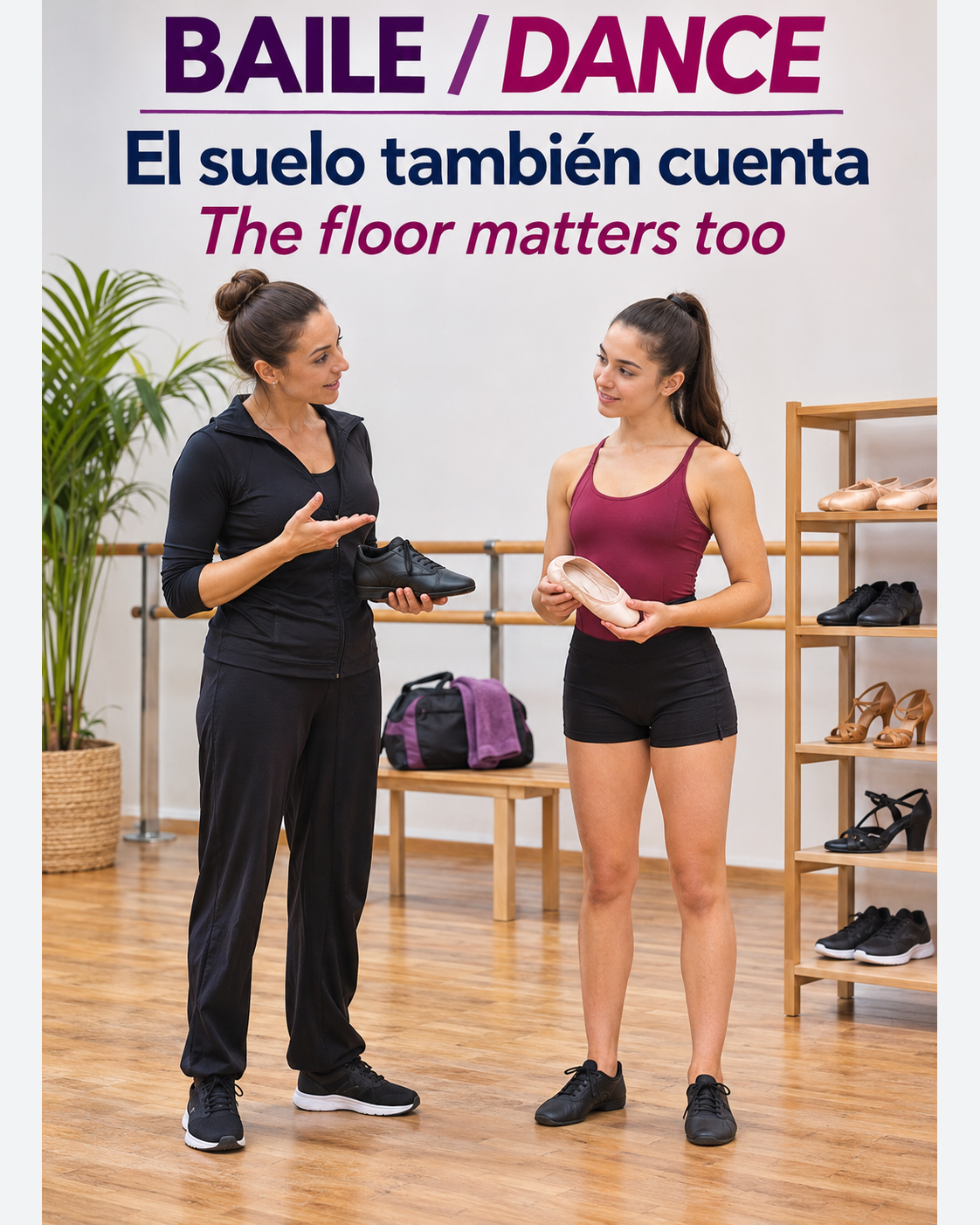
You know the sequence and recognise when the turn should happen, but today your foot seems stuck to the floor. You try adding momentum and the movement becomes uncomfortable. In another studio the opposite happens: you slide further than expected and need extra steps to stop. Before blaming everything on technique, review the combination of surface, footwear and task.
Useful grip is not simply the greatest amount available. Dance involves supporting yourself, changing direction and, depending on the style, allowing some rotation or sliding. The same shoe may behave differently on different surfaces. Understanding that relationship helps you request a specific adaptation instead of forcing a routine as though the environment had not changed.
The relationship matters more than the label
The One Dance UK guidance on footwear in dance education highlights the interaction between footwear and surface. Its barefoot recommendation belongs to the school setting it describes and does not automatically apply to every class, gym or dance style. Decisions must suit the activity and environment. Source checked on 19/11/2026; editorial date 18/11/2026.
Our practical suggestion is to begin the conversation with an observation: “My foot does not follow the turn”, “I travel further than intended” or “this part of the floor responds differently”. That is more useful than declaring a surface bad without explaining the movement or the footwear involved.
A shoe being designed for sport is not enough information on its own. Different activities may need different characteristics. Ask the instructor what the room permits and what the dance style requires. Neither a brand nor a general training label buys a guarantee of suitability for every task you might attempt.
Explore the setting without testing your limits
When entering a new space, observe its condition and listen to the centre's instructions. Report water, dirt, a raised section or a clearly uneven area. Do not dance across it to see whether you can manage. Cleaning or repairs belong to the person responsible for the facility rather than an improvised participant solution.
For familiarisation, begin with simple movements and direction changes you already know, at a comfortable intensity and under the teacher's guidance. Do not start with the fastest turn in the routine. The aim is to understand the combination's response, rather than prove that you can adapt regardless of the conditions.
If movement is unpredictable, request an alternative before increasing speed or range. That might mean replacing a turn with steps, reducing travel or practising another part of the phrase. A group class can retain its purpose without requiring every participant to perform exactly the same version throughout the session.
If the foot stays fixed, do not add twisting force
Consider a fictional example. Diego wears his running shoes to a first dance class involving frequent changes of direction. During a turn he feels that the sole is not moving with him. His first instinct is to rotate his trunk harder. A more useful response is to stop that variation and describe the problem to the instructor.
This does not mean those shoes are unsuitable for every activity or that any uncomfortable turn indicates an injury. The issue is a particular combination during a particular task. The teacher can explain accepted footwear and offer a version compatible with what Diego can control on that day.
Keep the observation in context. Does it happen everywhere or in one area? Has the footwear changed? Does it appear only when you try to move faster? These questions support a practical decision. You do not need to calculate a friction coefficient to recognise that forcing the turn is not solving the difficulty.
Sliding needs a response beyond confidence
Now imagine Clara arriving in socks because she has seen dancers turning that way in videos. Her room and activity are different from those shown. During her first travelling step she cannot stop where expected. Continuing faster to build confidence would add difficulty to a response she does not yet control.
Socks, bare feet and different shoes are not interchangeable solutions. One Dance UK's document also discusses socks and slipping risks within the setting it addresses. Confirm the centre's rules and the teacher's instructions before deciding how to participate. An appropriate option in one class may be inappropriate in another.
Do not apply water, powder, resin or other substances to the floor or your soles to correct a grip sensation independently. You may alter a shared surface and create a different problem for someone else. Any necessary intervention should be decided by the people who understand and manage that particular space.
Adapt gym dance classes too
During dance fitness and other music-based classes, the group's momentum may encourage you to continue even when a transition is not working. Mention beforehand if you are new or wearing different footwear. Position yourself where you can see alternatives and where your travelling movements will not invade other participants' space.
A version without a turn may preserve the musical and coordination task. You do not need to solve the problem by moving your head faster, adding momentum or copying an advanced variation from another participant. This decision concerns your interaction with the floor, rather than a contest to reproduce every option on offer.
If pain or another sensation changes how you place your foot, stop the task and seek guidance. An editorial modification cannot replace individual assessment when that is needed. Equally, avoid using a demanding class to test unfamiliar footwear without time to explore its response and understand the conditions in the room.
Talk before the music starts
If you are returning after a break or trying a new studio, arrive with time to ask questions. Explaining that the surface is unfamiliar avoids improvising during a fast sequence. Agree a brief signal for requesting the version without a turn. Afterwards, describe which transition worked better and what footwear you used. That context helps the teacher adapt the next class without turning one participant's experience into a rule for everyone in the room.
Questions to ask before buying
Tell the instructor which style you practise, which surface you use and which movements are difficult. Ask what characteristics matter and what options are permitted. Price and appearance do not resolve compatibility by themselves. Avoid buying a model solely because it works for someone performing a different task in another studio.
Check fit and condition too. Footwear that shifts around your foot or shows uneven wear deserves attention, even if it used to feel comfortable. We are not prescribing a universal replacement interval: usage and manufacturer instructions matter. Individual needs may also require professional advice rather than a general recommendation for a particular shoe.
Before your next class, organise one simple check: observe the floor, confirm the footwear and rehearse a familiar transition without rushing. Then decide whether to continue, request a variation or ask for help. Dancing thoughtfully means noticing how your support responds, as well as remembering which step comes next in the music.