


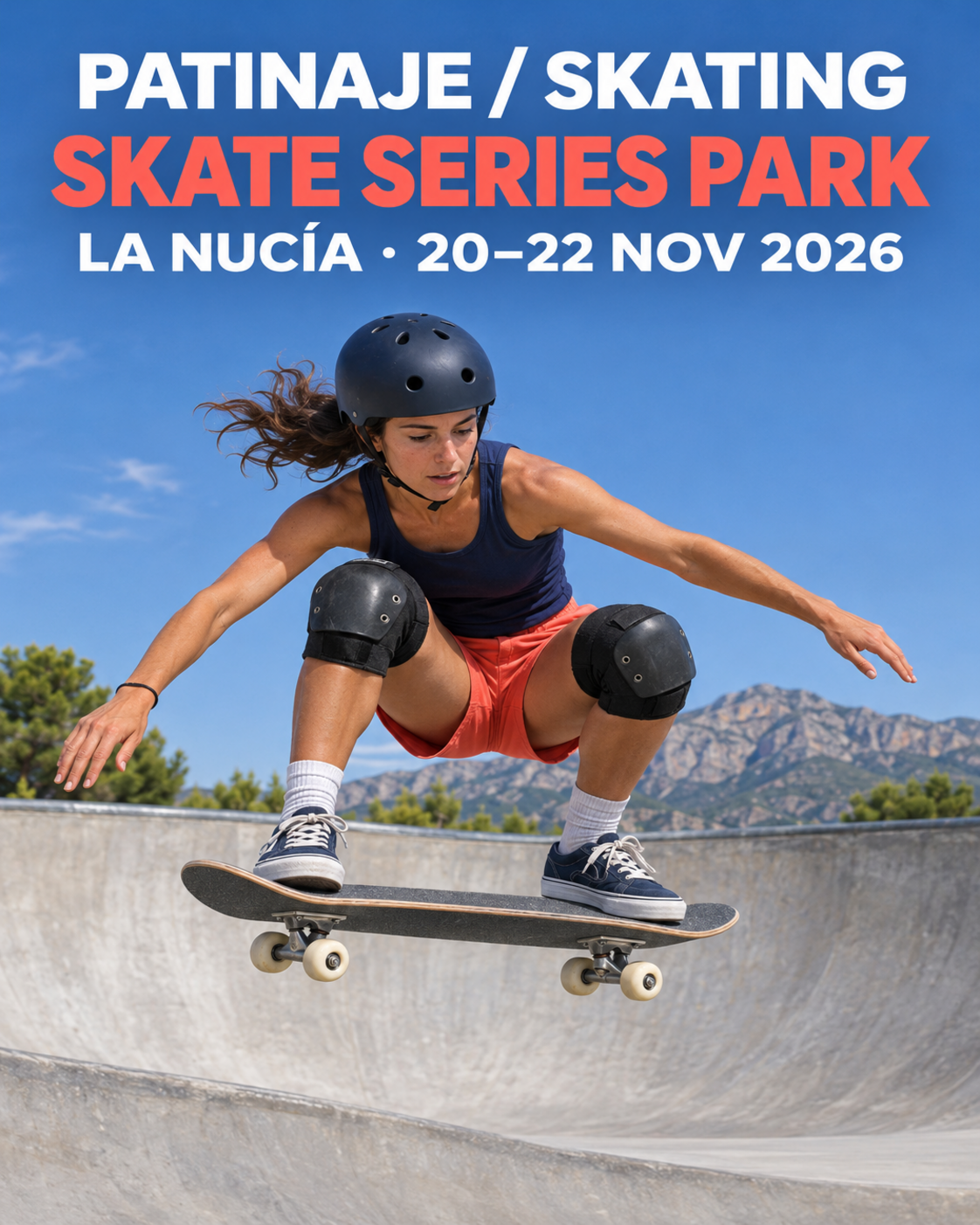
A park run is defined by its connections
A trick can land successfully and leave you without speed for the next feature. A less spectacular option may place you at the right entry and give the rest of the run a clear structure. Building a park line means considering those relationships. It requires more than ordering difficult tricks and hoping the bowl resolves everything between them.
The La Nucía final provides a setting for observing speed, use of space and continuity. This guide offers general preparation decisions to discuss with a coach, rather than instructions for learning risky manoeuvres without supervision. Families can use the same questions to understand a performance beyond its single most spectacular moment.
Official event facts and technical documents
Editorial date: 10/11/2026. Documentary verification: 11/11/2026. The official La Nucía Skate Series Park listing announces the Spanish Iberdrola Skate Series Park Championship on 20–22 November 2026, in La Nucía, Alicante. It identifies male, female and under-12 categories. Check your own participation and programme instead of assuming every category has identical arrangements.
World Skate publishes Street and Park judging criteria for the Los Angeles cycle and competition rules. They provide technical context. We do not invent a local run duration, attempt count or scoring formula. Confirm the applicable competition format with the organiser and coach before making a detailed plan.
Map entries and exits rather than trick names
For each section, ask where speed comes from and where the exit leaves you. An isolated manoeuvre does not show whether you can connect with the next wall. Use a simple sketch when helpful and discuss the relevant areas with your coach. A drawing supports the conversation; it does not guarantee an empty course or establish a safe entry by itself.
Look for continuity. Do you need a last-second direction correction, an improvised push or a different target because the exit does not fit? Adjustments are not automatically mistakes. They help identify where a connection needs work and where the planned line depends on a condition you rarely achieve in practice.
Useful speed arrives in the right place
More speed does not always improve a run. Too much at an entry can make placement harder; too little can remove the next option. Develop approach references under supervision at a familiar level of difficulty. We do not prescribe universal measurements or encourage unfamiliar heights and transitions beyond your current abilities.
Observe what happens after the trick as well. If completing it consumes all your attention and you cannot identify the exit, the line remains unresolved. A coach may reduce complexity to study the connection. Practising only the central trick can conceal the fact that entry or exit is the limiting part of the sequence.
Read the park before fixing the run
During permitted familiarisation, identify connections, orientations and circulation areas. Respect turns, staff and required protective equipment. Footage from an earlier session cannot replace present surface and usage conditions. Familiarity with another bowl also does not establish that the same references will work in this one, even when features look similar.
Build an initial line around skills you already have. Then review whether it uses space coherently and leaves room to respond. There is no need to visit every corner simply to demonstrate awareness. A coherent run can focus on mastered connections. An overambitious route may force you to improvise before you have established any continuity.
Select risk using evidence from practice
Ask which manoeuvres are sufficiently consistent and what a failure at that point would change. Landing something once is not enough information to place it in the main competitive run. Review the whole sequence too: an early mistake may remove the planned entry for everything that follows, even if each later trick is familiar.
In an editorial example, the harder of two options repeatedly interrupts the next connection. We cannot declare which will receive a better score. Compare execution, continuity and current capacity with the coach. A competitive choice does not need to prove courage or answer something another skater posted online. It should make sense within your own preparation.
A backup trick needs a possible entry
Naming a simpler manoeuvre does not create a useful backup for every situation. The alternative must fit the position, speed and direction available after an adjustment. Practise recognising that context and deciding when to select the backup. If it needs an entry you have already lost, it cannot solve the immediate problem.
Keep a small number of understandable alternatives. One for a connection that falls short and another for an occupied area may help when they are trained and appropriate. Do not improvise an unfamiliar manoeuvre because the main option is unavailable. A backup preserves continuity within existing resources; it does not create a new ability halfway through a run.
After an error, read the situation again
An error can change speed, orientation and available space. Recognise those conditions before chasing the original sequence. If continuation is allowed and safe, choose a known connection. Avoid trying to recover everything through a more dangerous action driven by frustration. The next sensible choice may differ from the one planned before the mistake.
A fall with pain or possible injury calls for assistance and staff instructions. An editorial guide cannot decide whether someone is fit to return to competition. During preparation, separate technical execution, line selection and the subsequent response. They are different parts of learning, and adding difficulty does not address every one of them.
For younger athletes and families
Ask which connection the athlete was practising and which alternative they had prepared. That conversation respects the work more than asking only whether the hardest trick was attempted. Age does not make pressure an appropriate teaching tool. Rest, protective equipment and permission to record remain part of supportive participation at every level.
After a run, allow the athlete to explain what they perceived. A small adjustment may have been a deliberate choice to retain control. Avoid comparisons of bodies, character or personal worth. A result describes a particular performance. It does not summarise potential or require someone to progress at another skater's pace in the next session.
Mistakes and final checklist
Avoid collecting tricks without exits, adding risk under pressure and preparing alternatives that need speed you will not have.
- I have confirmed my category's programme and rules.
- I recognise the main entries, exits and connections.
- The line uses manoeuvres already trained.
- I have a viable backup and a few clear decisions.
- I know when to stop and request help.
- My review will describe sequences and decisions.
Use YouVisible to organise preparation and share an authorised recording of the whole line. Seeing what happens between tricks helps explain progress without making every session an obligation to accept more risk.