


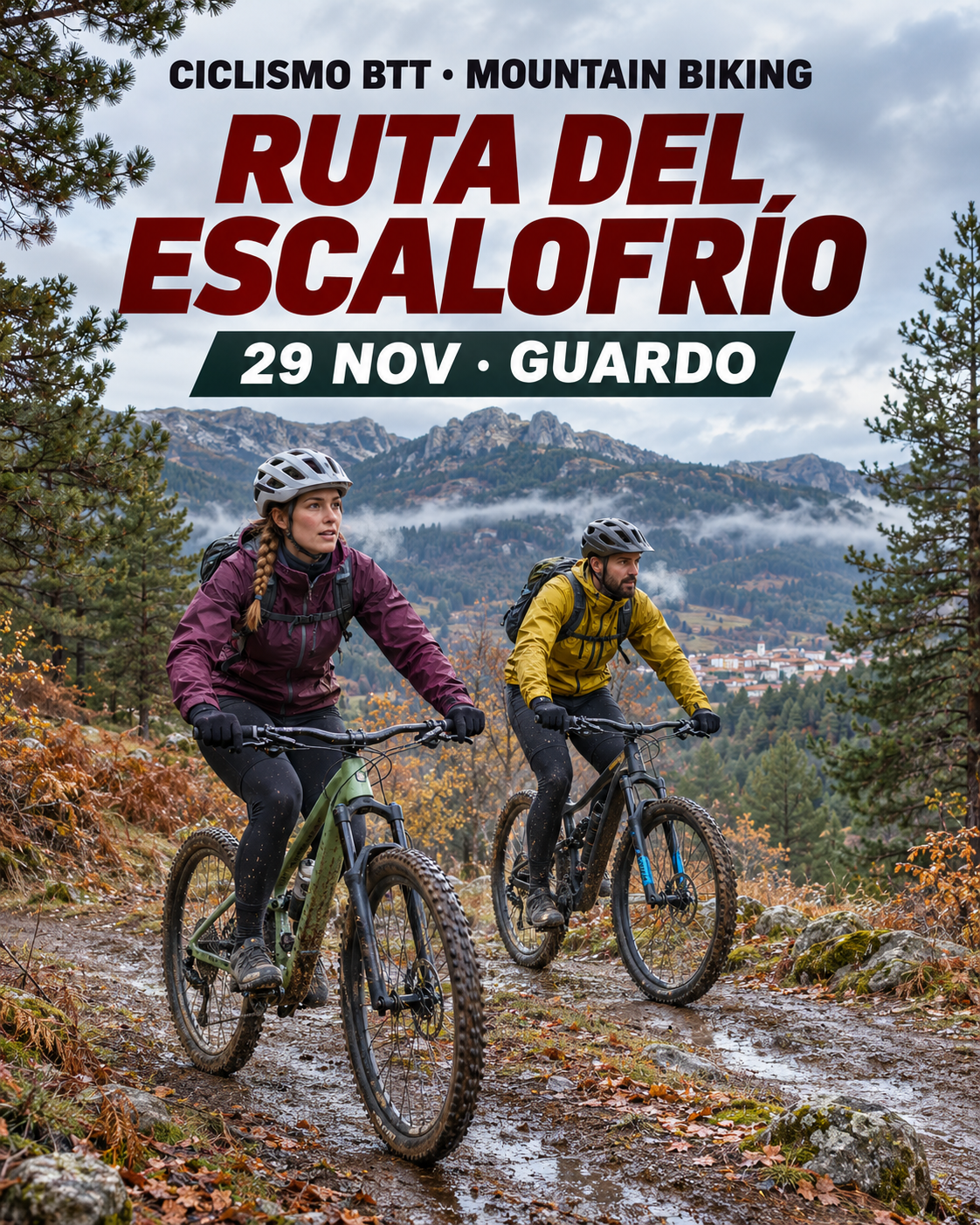
Choosing between thirty-five and forty-eight kilometres looks straightforward until you add cold hands, difficult ground and a climb that arrives after your concentration has started to fade. The Ruta del Escalofrío offers two courses, but distance alone does not describe the day. A useful choice considers how long you can preserve control, energy and the ability to deal with small problems on the bike.
The Guardo announcement checked
Sources checked on 16/11/2026. Guardo council announces the Club MTB Guardo's XIV Ruta del Escalofrío for Sunday 29 November, starting at 09:30 from Plaza del Ayuntamiento. The short course is listed as 35 km with 800 m of ascent; the long course as 48 km with 1,300 m, with a €20 entry price.
The Runvasport platform displays both options and a deadline of 26 November at 22:00. A displayed form does not guarantee remaining places or acceptance. Published number collection is at the town hall on Saturday 28, 19:00–21:00, and Sunday 29, 07:00–09:00. Check final instructions and your own entry before travelling rather than treating the advertised window as a reservation.
Compare ascent and reserve capacity
The longer option adds thirteen kilometres and five hundred metres of climbing. Do not translate that difference into an exact duration using your road cycling average. Mountain biking can involve slow climbing, technical passages or mechanical stops that substantially change elapsed time. The more useful question is how much capacity you will retain for accurate riding near the end.
Look for a recent outing with comparable distance and ascent, preferably on ground that also required attention. If you barely managed it, that is weak evidence for choosing something longer. The short option still involves eight hundred metres of climbing and needs preparation. Choosing it may produce steadier effort and a better day without requiring an explanation framed around giving something up. Select the course you can manage, including its less convenient final sections.
Judge technical control when tired
A descent that feels easy early on can become more demanding when your arms tense and braking becomes less controlled. Remember how you ride after several hours. Do you look ahead or stare at the front wheel? Can you brake progressively? Do you leave enough space to see the ground and choose your line independently?
These are editorial decision criteria, not claims about particular sections of the route. We do not invent gradients, obstacles or sectors without an official map. Ask about technical demands and any authorised points for choosing between courses. If switching during the ride is prohibited, your decision must be made beforehand. Following the group ahead is also unreliable if its course or experience differs from yours. Your safest line may be different even where you share the same destination.
What thermal self-sufficiency means
Thermal self-sufficiency means having reasonable protection when you slow down or stop as well as when you are working hard. Clothing that feels comfortable uphill may be insufficient while waiting in damp layers. Think about hands, feet and torso, and how to reach another layer without restricting movement or letting loose fabric interfere with wheels and drivetrain.
This does not predict a particular temperature, rain or mud on event day. Check the forecast near Sunday and adapt your kit. Test gloves with the controls: preserving the dexterity to brake and shift matters more than simply wearing the thickest available pair. Persistent shivering, confusion or lost dexterity are reasons to seek warmth and help, not challenges to overcome by pedalling harder. Tell someone rather than assuming the symptoms will disappear on the next climb.
Prepare the bike to reduce decisions later
Check brakes, tyres, drivetrain and fastenings early enough to repair problems. Avoid making a major untested change the evening before. Suitable tyre pressure depends on your tyres, weight and conditions; use your established checks or ask a workshop instead of copying a universal number from a general guide.
Carry repair equipment you can actually use and review the event's mandatory requirements. Owning a tool does not mean you can solve a problem with cold hands. Practise a basic task at home if you have always delegated it. An organised ride does not automatically provide mechanical help at every point, uninterrupted phone coverage or immediate collection. Ask what support is planned and what procedure applies if you have to stop. That answer should influence what you carry and whether the longer course suits you.
Plan familiar food and drink
The council advertises refreshments, but that does not establish their exact locations, contents or suitability for dietary needs. Check anything essential with the organiser and carry a familiar alternative. Avoid waiting for an obvious energy dip before remembering that there is still riding ahead. Your plan should remain workable if reaching the next stop takes longer than expected.
Our recommendation is to use food and drink you already tolerate in training, packed so they are accessible with gloves. The event is an unhelpful setting for experimenting with supplements or unfamiliar fuelling strategies. If you need to stop to eat, move out of other riders' path and follow instructions. Cold conditions can make thirst less noticeable; that is a reason to pay attention rather than force arbitrary amounts of fluid. Individual requirements still vary.
Two honest ways to assess the choice
Imagine a rider comfortable with thirty kilometres who rarely accumulates much ascent. The key comparison is not merely the extra five kilometres of the short route: it is the climbing and total time outside. Asking whether that demand matches current preparation may be more sensible than assuming either option is automatically accessible.
Another rider regularly completes forty-five mountain kilometres but finishes with stiff hands and braking mistakes. Extra distance does not solve that limitation. Choosing the shorter course while reviewing equipment and technique could make more sense. These are hypothetical examples, not personal assessments or predictions. An entry should reflect current capacity, including weaknesses that show up late, rather than the riding you wish you had trained for. Discuss uncertainty with someone who knows your cycling and can assess it directly.
Include companions and the journey home
Separate your participant plan from the plans of relatives waiting for you. Avoid promising a finish time based on your best average speed. Agree a meeting point and how to communicate a change without assuming reception throughout the route. Confirm access, facilities and companion arrangements separately; an entry for a rider does not answer every visitor question.
Collecting your number on Saturday may spread the administration across the weekend, but it does not guarantee shorter queues or change identification requirements. On Sunday, allow time to check the bike, dress and locate the start calmly. Plan the journey home too: finishing tired, getting cold while packing and immediately driving should not be an improvised sequence. Accessible dry clothing can make the change from riding to travelling more manageable.
Choose a course that still makes sense afterwards
Before confirming an option, answer four questions: what recent experience supports it, how you ride with fatigue, how you will stay protected during a stop and what you will do after a mechanical problem. Use the rules linked through Runvasport to resolve missing conditions. Do not assume you can lengthen or shorten the route outside official arrangements.
Afterwards, share your experience through YouVisible with the context that made it useful: the course chosen, how it felt and decisions that worked. Explaining why an option suited you can help other cyclists more than presenting the longest course as the only worthwhile way to enjoy Guardo.