


You follow another skater and the pace feels more comfortable than when skating alone. You move a little closer to benefit and discover that you are correcting every push to avoid touching their skates. A potential saving has introduced another demand: coordinating with movement you do not control. Drafting is more than finding a small gap.
For a recreational group, the first question is whether everyone can maintain a predictable pace, see what is happening and respond with room available. Aerodynamics may belong in organised sporting practice. It does not justify attaching yourself to strangers, closing gaps at any cost or transferring a racing formation onto a shared leisure path.
Research does not establish a safe following distance
An original study of energy expenditure and inline-skating drafting compared conditions in eight recreational skaters. Following another skater reduced energy expenditure, while coordination difficulties limited the benefit, particularly at higher speed. The experimental separations are neither public-path safety recommendations nor a guarantee of personal savings. Source checked on 19/11/2026; editorial date 18/11/2026.
That distinction matters. An experimental condition describes what researchers tested, rather than what every group should reproduce. The controlled setting and participants' skills shape the task. A published number does not tell you how closely you can follow somebody on a public path with unpredictable users and changing conditions.
The original instructional video from Rollerblade's speed team presents drafting as a sporting skill. Our recreational preparation focuses on cooperation and predictability. It does not copy a fast formation or convert a racing tip into permission to skate closely together in any available setting.
Choose the place and companions first
Initial practice needs an authorised, broad, clear space appropriate to the group, preferably a closed circuit with qualified supervision. A busy area, descent, wet surface or path with crossings is unsuitable for experimenting with close following. The possibility of a pedestrian appearing changes the task completely and should change your decision.
Everyone should already control their path and stop appropriately before adding the demand of following another person. Wear a suitable helmet and protective equipment, check your skates and agree what happens if somebody wants to stop. Equipment may reduce some consequences; it does not make a poorly organised formation safe by itself.
Consent matters too. Ask before following someone and explain your purpose. An unfamiliar skater has no obligation to adjust their pace, announce manoeuvres or accept becoming part of your practice. Without an agreement, retain your own outing and your own space rather than treating somebody else's movement as an available training resource.
A group needs a predictable pace
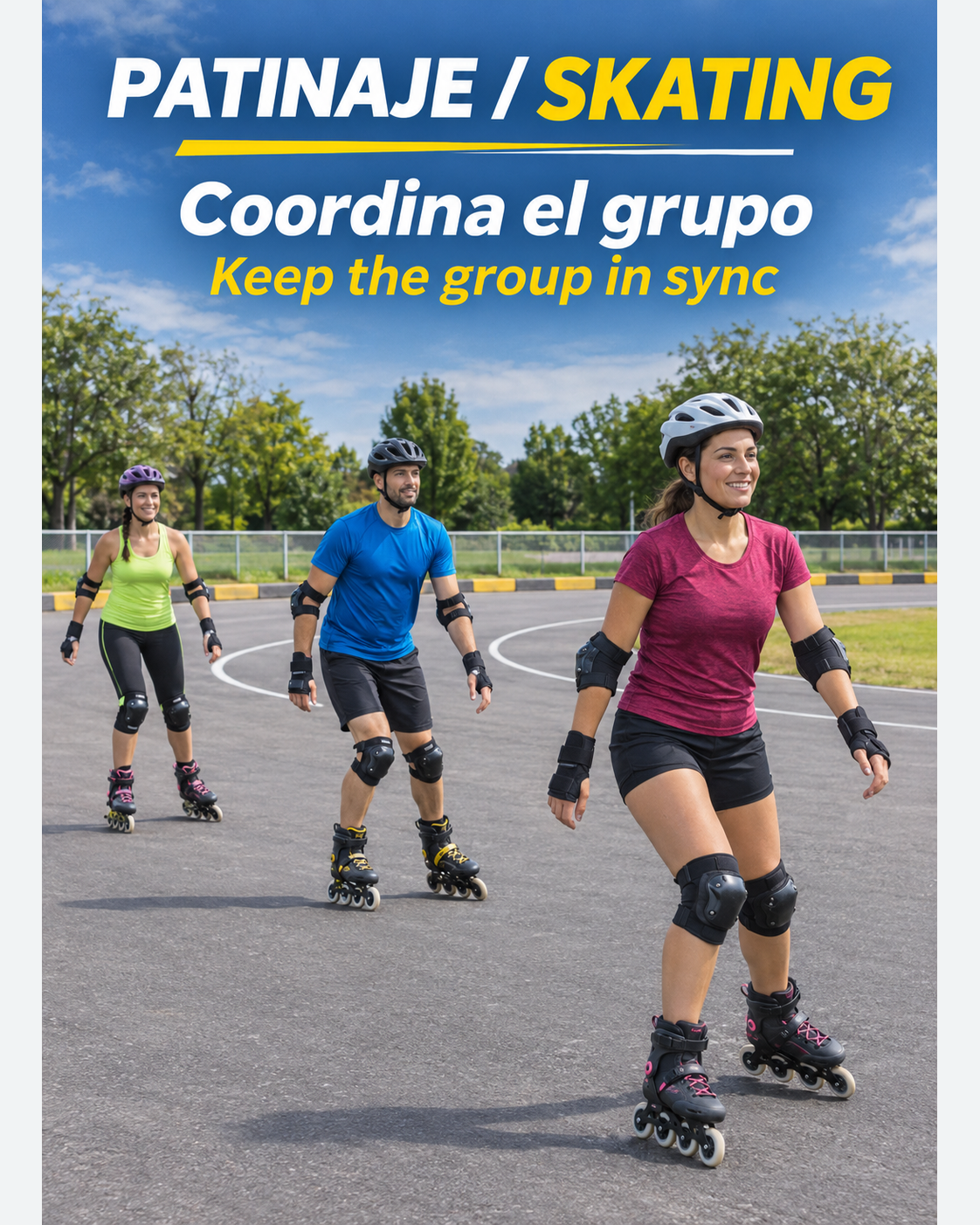
In a fictional example, three friends want to practise together on a permitted circuit. Their first task is not moving closer: it is maintaining a comfortable, consistent pace with generous separation. Each person should be able to look beyond the back in front and recognise the continuation of the available space.
If the leader accelerates with every change of support, those following spend effort and attention closing gaps. If the leader slows without warning, the correction reaches the final skater late. Choose a pace that supports learning and agree clear warnings understood by everyone before the group starts moving together.
Separation must reflect ability, speed, surface and response capacity. We are not providing a universal distance or suggesting that you gradually reduce it towards a numerical target. Practice can finish with wide gaps and still be useful if the group has learned to move in a more predictable way.
Following does not replace observation
Looking only at the skates ahead limits the information available. Attend to the route and group signals while retaining awareness of the person you follow. If you must stare continuously at their wheels to prevent contact, that arrangement is too demanding for your present level of control and should be simplified.
Do not cross paths to search for an imagined pocket of reduced resistance or make sudden sideways movements. Participants may use different push techniques and movement widths. Better organisation may require more room or less speed, rather than forcing everyone to copy the leader's exact rhythm and range of movement.
Communicate discomfort early. “I need a bigger gap” or “I am leaving the group” are useful messages when agreed beforehand. The group should make it possible for someone to separate without treating the decision as failure or requiring them to recover the lost position immediately to preserve the formation.
Agree changes of leader before attempting them
Changing the lead adds another task. Do not introduce it while the group is still struggling to maintain a simple pace. With supervision, establish where it can happen, which signal will be used and how paths remain clear. If the space cannot accommodate a predictable manoeuvre, keep the order or stop somewhere safe to reorganise.
A recreational changeover need not resemble a racing finish. There is no prize for doing it closely or maintaining a speed that forces improvisation. The initial aim is for everyone, including the least experienced participant, to anticipate the change and preserve enough room to respond without sudden corrections.
Agree how to finish as well. Ending practice should not mean an unexpected stop by the person in front. Choose an exit point and a gradual reduction compatible with the space, the venue's rules and the skills everyone already controls. Rehearsing an orderly finish is part of practising together, rather than an afterthought.
Fatigue changes the shared task
Someone may still be talking comfortably while beginning to make more corrections to their path. Another may feel obliged to continue to avoid breaking up the group. Include pauses and obvious opportunities to say that the exercise has become too demanding. Do not wait for contact before recognising a shrinking margin.
A possible benefit from following does not mean you can sustain any chosen pace. If staying attached requires desperate pushes or reduces your awareness of the surroundings, lower the demand. A recreational purpose should be explainable without using “not getting dropped” as the only criterion for continuing a session that is becoming unpredictable.
Keep an individual option available
Before starting, agree that anyone may continue separately without having to justify a particular effort score. Choose where to meet afterwards and how to signal that someone is finishing. Nobody should need to follow more closely than they control simply to retain companionship. In recreational practice, leaving the formation calmly is a sign of good organisation rather than a secondary outcome. An outing remains shared even when participants do not all skate in line for the same amount of time.
What to review afterwards
Ask whether the pace remained steady, whether warnings were understood and whether everyone could separate when needed. “We slowed on the second lap and stopped chasing gaps” describes a specific lesson. You do not need to calculate an energy-saving percentage to decide whether the session produced useful progress for the group.
At your next group skating practice, begin with agreement and predictability. If those are still unreliable, retain more space and simplify the task. Drafting is a sporting possibility; cooperation is the condition that lets you explore it without turning other people into moving obstacles you constantly need to avoid.