


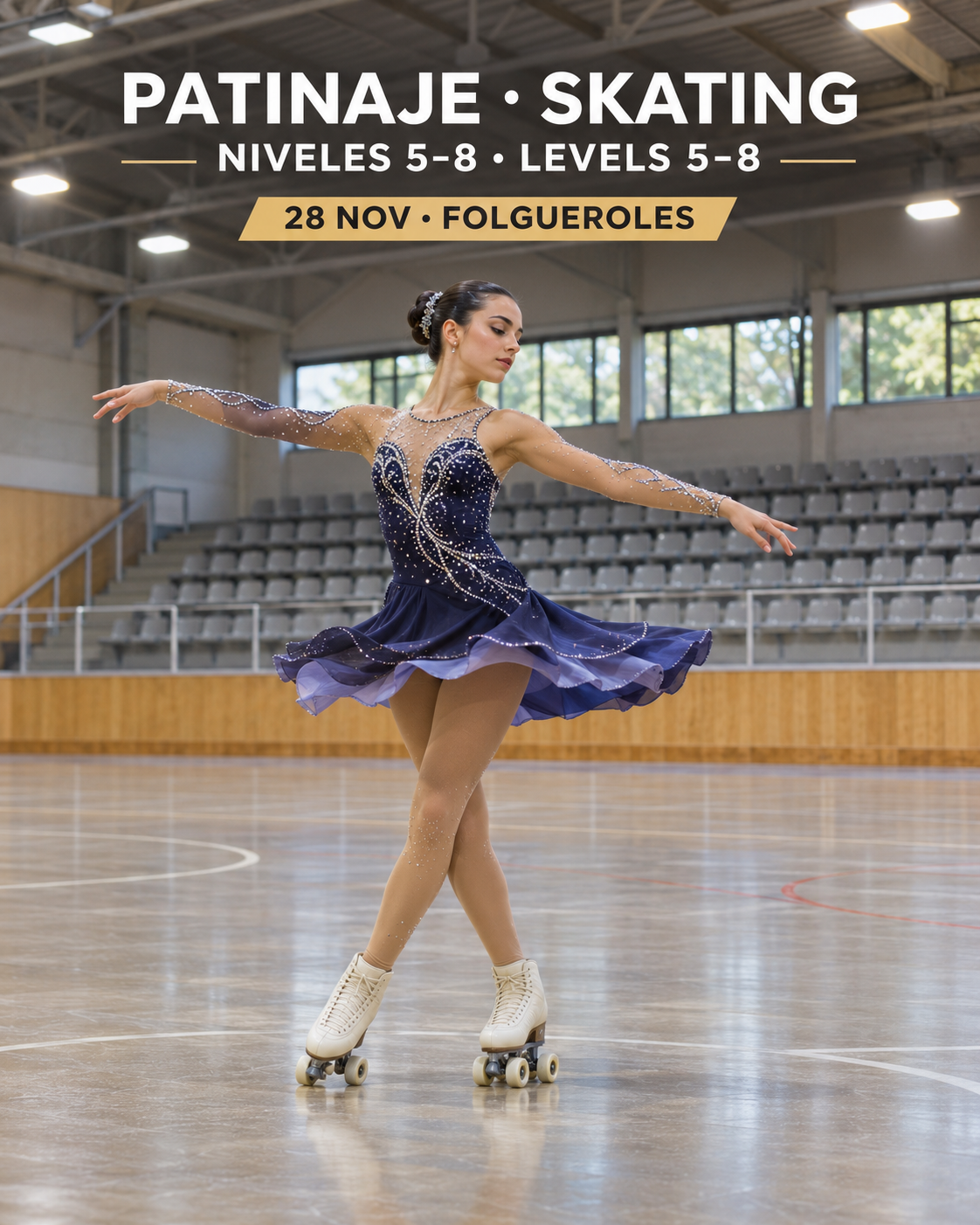
At a first artistic roller skating competition, you might expect a series of jumps grouped mainly by age. A levels event asks for a different reading: participants are placed within a technical stage defined by the applicable system. Understanding that idea helps spectators watch patiently and support someone without comparing every routine with the person who has just left the rink. The event can become a useful introduction to progression as well as performance.
Folgueroles: prioritise federation information
Sources checked on 16/11/2026. The CPA Badalona announcement says Saturday 28 and levels 5–8. However, the Catalan skating federation lists TB27-09 at Folgueroles on Sunday 29 November, levels 5–7, at Les Alzines. Its official v1-1 timetable, dated 29 October, confirms those details.
We prioritise the federation document: blocks start at 09:00 and 15:30, subject to change. The federation document is the reference for planning the day. The club announcement is not demonstrably updated. The supplied cover retains 28 NOV and levels 5–8, illustrating the initial announcement; use the federation's 29 November information for travel and reconfirm your group. General admission conditions and price remain unverified. Do not treat a published sporting timetable as proof of public access.
A level is a technical reference
Levels organise learning progression according to the criteria of the system being used. They are not simply birthday groups and do not reveal a person's whole sporting history. Participants at the same level may have different ages, learning rhythms and previous experience. Those differences do not make one development path more legitimate than another or establish how quickly someone should progress.
This general explanation does not replace the specific rules for levels 5–7. We do not invent mandatory elements, scores or promotion requirements for this competition without the applicable document. Relatives can ask the coach which goals the skater is working towards and how the programme fits them. That offers a more useful reference than interpreting a level number as a complete ranking of ability. It also gives families language for discussing learning without making the competition the only measure of progress.
Read the published running order
First identify the document's date, venue and version. Then find the level, group and person you are following. Avoid relying on an isolated screenshot: corrections to groups or order can make it outdated. Keep the original reference and review club communications near competition day. A message explaining a change may be as important as the initial timetable.
Distinguish athlete reporting time, warm-up, block start and individual turn. Arriving at the approximate performance time may mean missing necessary earlier arrangements. Do not calculate an exact minute by multiplying the number of preceding skaters by an assumed routine duration. Breaks, rink preparation and incidents can alter progress. That does not make the published document useless; it means the timetable should guide preparation with reasonable margin rather than be treated as a personal appointment guaranteed to the minute.
Movement matters before the major element
Begin by watching how the skater moves between actions. Notice continuity, direction and control of speed. You do not need every technical name to recognise whether travel connects the music and positions or seems like hurried movement towards the next element. Looking between highlights makes the whole programme easier to understand.
This is an audience observation guide rather than a judging manual. A movement that looks small from your seat may demand precision, and some decisions remain unclear without knowing the planned content. Avoid turning each impression into an imagined score. Watching a complete passage from preparation to exit often reveals more than focusing only on its most eye-catching instant. It also gives you something specific to discuss afterwards without claiming authority over technical decisions made by officials with a different view.
Spins have an entry, axis and exit
Follow three accessible moments in a spin: preparation, control during the action and the continuation afterwards. Speed attracts attention but does not explain everything. Notice whether the exit is recognisable and whether the following movement begins intentionally. You do not have to count rotations from a distance or claim that a particular technical value has been awarded.
Your seat may conceal relevant support or angles. A limited view is a poor basis for disputing a score or recording obsessively in search of mistakes. If interested, ask a coach afterwards or use official educational material. Learning more about skating does not require every relative to act as a parallel judge throughout the day. Curiosity can remain useful even when the correct answer is that you could not see enough to assess a detail.
Landings and the return to continuity
Where an action has an airborne phase, watch what happens on returning to the rink: stability, direction and continued movement. A landing belongs to a sequence rather than a still photograph. After an error, notice how the skater reorganises, finds the music and continues the programme. Recovery can reveal concentration that an isolated clip would miss.
Observation is not an invitation to practise jumps at home or coach technique from the stands. Learning needs suitable space, equipment and supervision. If someone falls and appears to need help, respect the event procedure. Supportive audience behaviour should not pressure a skater to get up immediately or continue before their condition is clear. Applause can acknowledge effort without becoming a demand that the routine must finish regardless of what has happened.
Presentation and music without stereotypes
Presentation includes how the proposal connects: music, attention, gestures and links between elements. It should not be reduced to costume, smiling or body appearance. Ask which passage held your attention and why, while respecting different expressive styles. There can be several thoughtful responses to the same programme rather than one universal emotional reading.
With younger skaters, avoid comments about weight or comparisons with other bodies. Describing a visible decision, such as a clear entry or recovering after lost balance, offers more concrete support. You also do not need to interpret every expression from outside. A serious face may reflect concentration, while a smile does not prove everything felt easy. Let the athlete explain their own experience afterwards instead of treating your reading from the stands as the definitive account of the day.
Prepare the family day with the club
Confirm documentation, clothing, equipment, food and reporting time. Follow team instructions for checks or organised warm-up rather than assuming an open area for practice. A competition hall is not a space where any companion can enter the rink to help. Knowing who handles each task avoids well-intentioned interruptions at an already busy moment.
Plan sensible breaks and a reunion for those waiting. Avoid promising a return based on a schedule that can change. Ask in advance about accessibility, seating or particular admission needs. A club invitation to offer support does not replace current federation confirmation of public entry, capacity or price. Keeping that distinction prevents a journey built around information the source does not establish. It also leaves room to change plans without blaming a participant for delays outside their control.
What to say after the programme
Start by asking what felt best and what the skater would like to remember. Listen before comparing routines or analysing results. A visible mistake does not summarise preparation, and a good placing does not explain everything learned. A family conversation need not become an immediate technical assessment.
Through YouVisible, share the context of the level and what you learned as a spectator, respecting personal information and image permissions, especially for minors. Folgueroles can reveal how much there is to enjoy in continuity, small adjustments and the patient work that makes a competition appearance possible. That perspective remains useful after the results have been put away.