


Difficulty contributes when it can be performed
A harder routine can look like an obvious improvement on paper. Adding an element also changes entries, exits, fatigue and the ability to finish with control. When execution loses stability, the more ambitious option may stop being the best competitive choice at that point in an athlete's development. The additional content needs to make sense inside the whole performance.
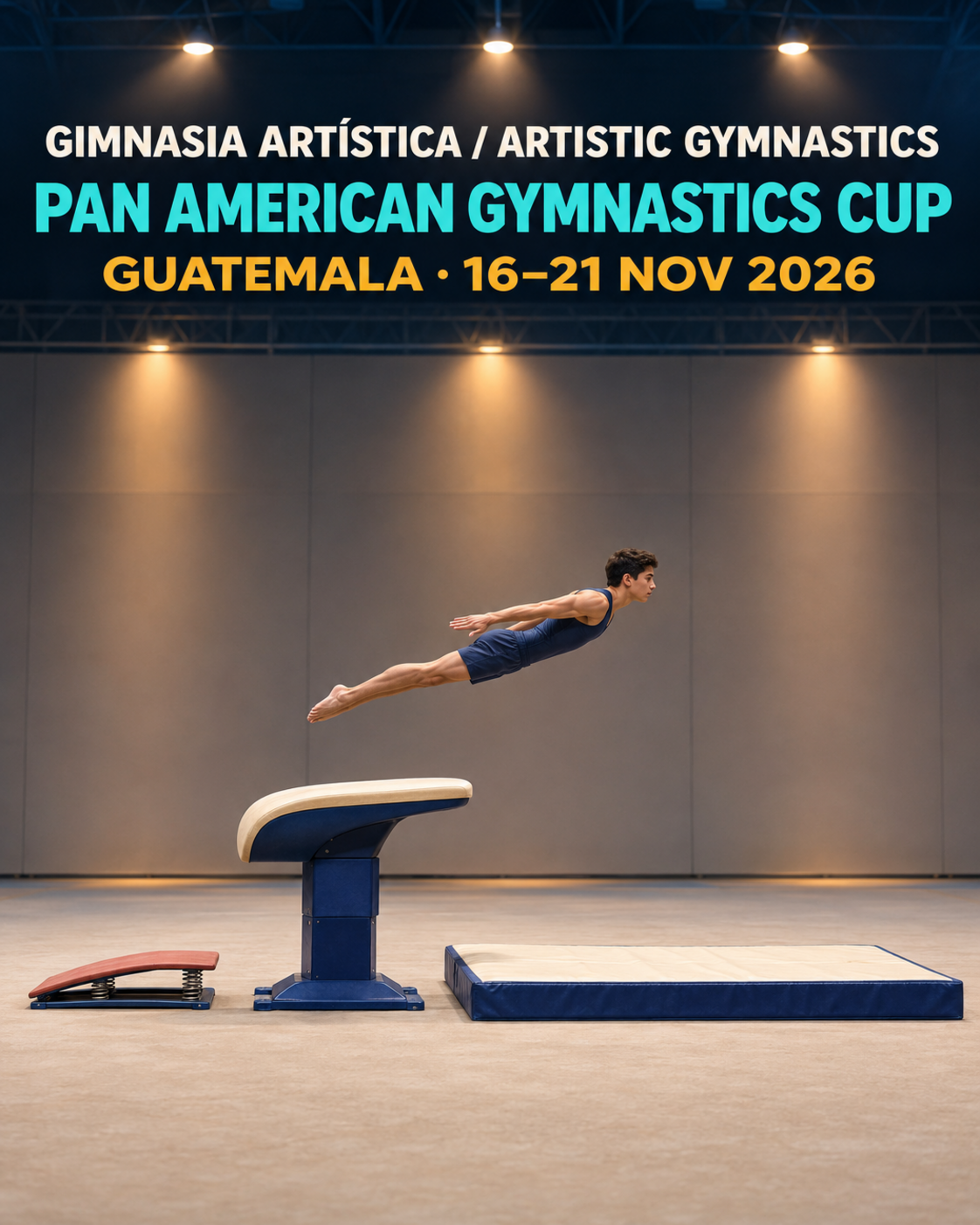
Guatemala's Pan American Gymnastics Cup provides a junior context for examining that choice. This guide does not prescribe elements or teach acrobatics. It offers questions for coaches, athletes and families about consistency, landings and development. Technical choices belong in a supervised environment with the applicable regulations and attention to the athlete's wellbeing.
Official event facts and references
Editorial date: 10/11/2026. Documentary verification: 11/11/2026. The official World Gymnastics listing, event 18690, announces the Pan American Gymnastics Cup on 16–21 November 2026 in Guatemala City. It identifies men's and women's artistic gymnastics in development and junior categories. Consult the event directives for the specific ages, apparatus and participation conditions.
The World Gymnastics codes and rules provide a reference for difficulty and execution. We do not apply a universal deduction table or assume identical requirements in every category. The safeguarding guidance supplies a framework for respect and protection. A competition date does not authorise accelerated progression or make pain a normal requirement for participation.
Compare complete routines rather than isolated elements
A new skill can succeed in a specific practice and still be unready for a complete routine. Ask how it begins, what demands precede it and what remains available afterwards. The relevant comparison includes continuity, subsequent elements, the ending and the ability to repeat the exercise appropriately, rather than the appearance of the new skill alone.
Consider an editorial example: one version adds difficulty but repeatedly disrupts the dismount. We cannot predict either score. We can identify that the evaluation must consider both aspects of the performance, instead of only the added value on a content list. The coach should connect those observations with the code and directives applicable to that athlete's category.
Consistency requires several observations
One excellent execution establishes that something was possible on that attempt. It does not, alone, establish competitive readiness. Review a suitable sample of sessions and conditions with the technical team without turning consistency into an obligation to repeat until exhausted. How the element is achieved matters, as does its continuity within the whole exercise.
A simple editorial tool is to note what changed between attempts: entry, orientation, rhythm or tiredness. There is no need to publish statistics or invent a magical success percentage to authorise difficulty. Records should support an individual progression. They should not replace technical judgement or become a number used to pressure a minor into attempting something they cannot currently manage.
Difficulty and execution answer different questions
Difficulty concerns content requirements and value under the applicable code. Execution concerns how that content is performed. A proposal can increase one dimension while losing in another. Ask the coach to explain the intended benefit and the cost observed across the routine in language the athlete and family can understand.
We do not calculate a hypothetical score without knowing category, requirements, recognition of elements and deductions. Nor do we claim that simplifying is always preferable. Compare real, practised options appropriate for the athlete. A simpler routine that has not been properly prepared does not become stable merely because it contains less difficulty than another version.
Landing belongs to the element
A landing is not a detail added after the important part has finished. With the coach, observe whether the athlete arrives oriented, retains control and can continue as required. Do not demand apparent stillness through pain or an unsafe strategy. Safety and technical analysis need qualified supervision, not a universal cue taken from a short article.
As a spectator, you can describe visible steps, adjustments and continuity. You cannot diagnose an injury from the stands. A landing that looks clean in one frame does not establish that the progression is appropriate. Respect information from the athlete and team without demanding another attempt to prove your interpretation or make a recording look more convincing.
Fatigue can change the selection
Review where the most demanding section occurs and what happens when it is reached within the routine. A skill practised fresh can feel different after other tasks. The answer is not necessarily more repetitions. It may involve reorganising content, reducing complexity or delaying an addition until preparation provides a more suitable foundation.
Imagine an editorial example: the opening remains stable but the finish loses references after a new sequence is introduced. Examine demands and connections before attributing the change to insufficient determination. We do not recommend a maximal last-minute trial to make the choice under pressure. Preparation should provide relevant information and leave a practised alternative available before the event approaches.
A prepared alternative preserves choices
A more stable version must be trained and meet competition requirements. Removing an element the evening before is insufficient if nobody has reviewed what changes around it. The coach needs to verify continuity, content and regulatory suitability. The athlete should understand what they will perform and why that version has been selected.
Agree how the decision will be made if conditions change, without turning every pre-event sensation into a public negotiation. The plan must allow doubts and pain to be communicated. Having an alternative does not mean expecting failure. It provides a concrete option when the initially preferred routine stops being appropriate for the athlete or the circumstances of that day.
Junior development extends beyond the next competition
An addition can be promising for the future without being ready for this event. Delaying it does not erase learning. Medium-term development includes recovery, skill acquisition and a respectful relationship with practice, alongside competitive results. Calendar pressure cannot replace suitable progression, and a single week should not become the only measure of a young athlete's trajectory.
Families can ask which objective is being developed and which observations inform the decision, without demanding bravery or comparison with another gymnast. Fear, punishment and appearance judgements should not be normalised as performance tools. Safeguarding concerns belong with the responsible federation procedures or competent authority. Sporting ambition does not remove the right to be heard and protected.
Review the decision as well as the score
After competing, separate the plan, the execution and the lesson. A good score does not prove that every earlier risk was justified. A difficult performance does not automatically establish that the selection was irresponsible either. Context matters. Ask whether expected references were maintained and what new information emerged during the exercise.
Keep a record that guides the next training block. Avoid publishing mistakes to ridicule or pressure an athlete, particularly a minor. An authorised video can show continuity and progress without turning details into body comparisons. Technical work deserves a precise conversation and an environment where learning remains possible after an error, a change of plan or a disappointing result.
Mistakes and final checklist
Avoid choosing by an element's isolated value, confusing one success with consistency and judging preparation exclusively through the final score.
- I have checked the category's directives and requirements.
- We compare complete routines that have been practised.
- We observe entries, continuity and landings.
- Selection considers fatigue and a prepared alternative.
- Pain, fear and concerns can be communicated without punishment.
- Junior objectives include development beyond this week.
Use YouVisible to organise preparation and share authorised technical progress. Explain which decision supported a more stable routine. Learning to choose is part of sporting performance too, even when the most useful choice is to wait before adding difficulty.