


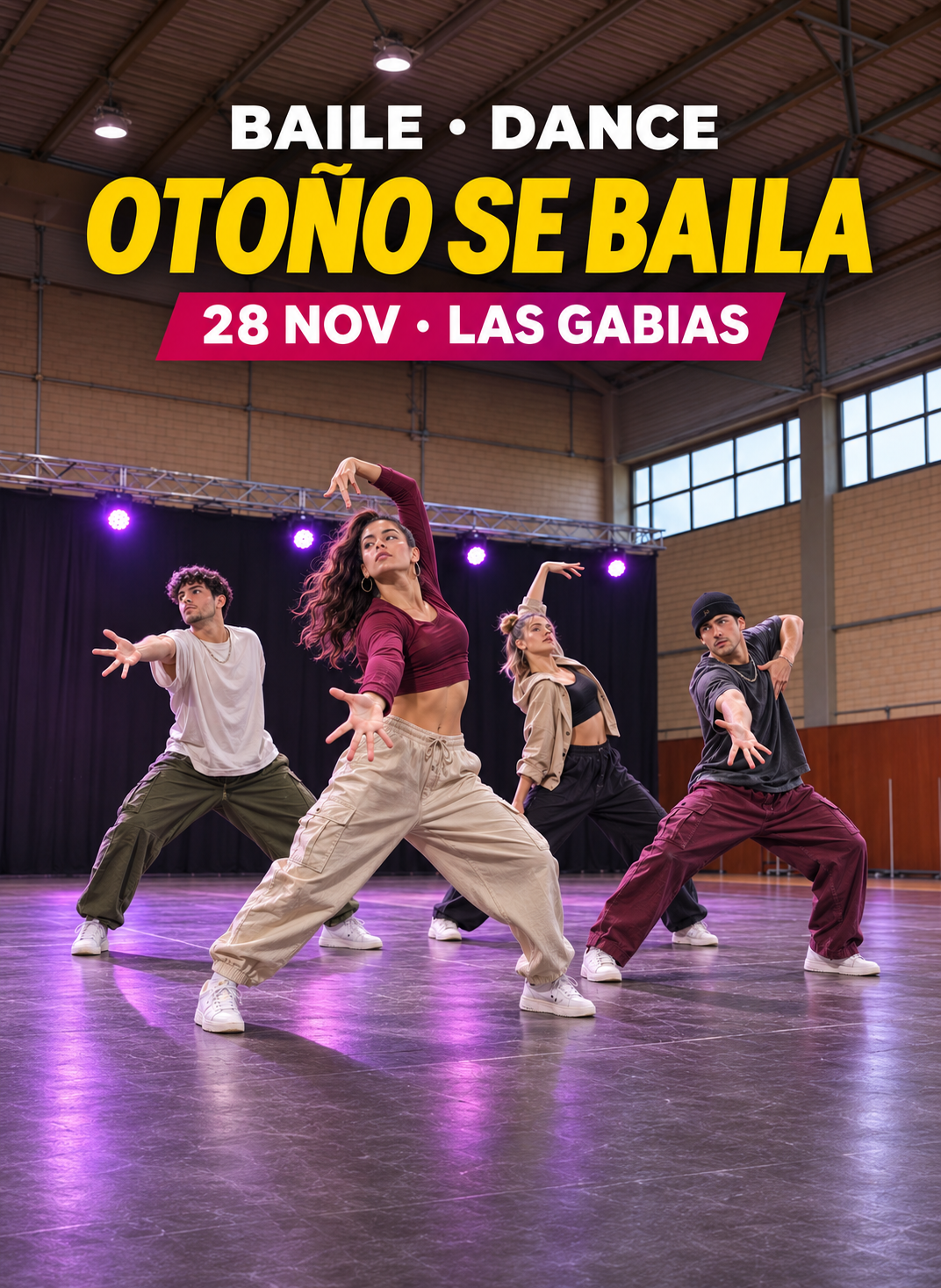
The most spectacular movement often attracts the first glance at a dance final. A choreography also depends on how a group reaches that moment, listens to the music and reorganises afterwards. Whether supporting someone or discovering dance for the first time, you can enjoy much more by observing concrete choices rather than trying to predict the winner. The result becomes one part of a richer experience.
The announced Las Gabias final
Source checked on 16/11/2026. The Granada provincial authority announces the Otoño se baila final on Saturday 28 November, from 16:30, at Las Gabias Municipal Sports Hall. Its programme includes amateur and professional urban dance groups, individuals, pairs, a junior category and battles.
The advertised entry deadline was 8 November, so registration is not presented as open. The announcement links the initiative with Artibamol, the provincial authority and the council. Before travelling as a spectator, confirm admission, capacity and running order. A starting time does not establish door opening or when a particular dancer appears. We do not assume free entry, reserved seating or a broadcast merely because the event has an institutional announcement.
Musicality means noticing what movement answers
An accessible starting point is to choose something in the music and watch how the dancers respond. It might be an accent, a pause or a changing phrase. Movement need not mark every beat: you may also notice sustained actions or contrasts between quieter and more intense passages. Listening makes the visual choices easier to understand.
This editorial guide does not reproduce the championship's scoring sheet. It offers simple questions: does an action seem connected to something you hear? Does a change arrive with intention? Can you distinguish moving quickly from moving in relation to the music? You can recognise these connections without technical vocabulary. If a choice is unclear, watching another phrase before judging often reveals more than an immediate impression based on a single gesture or the crowd's response.
Synchronisation does not require constant sameness
Some group actions aim for coincidence, while others deliberately travel through the dancers in sequence. A movement beginning in one corner before reaching the rest may be intentional. Before calling it a mistake, check whether the idea recurs and whether the whole group retains a clear relationship with the music. Different timing can be part of the design.
For a shared action, notice its beginning, direction and ending as well as arm positions. Two people may reach a similar shape at different times. That observation reveals rehearsal work hidden behind a final picture. Avoid comparing bodies or expecting identical appearances: the useful question concerns coordination of the proposal rather than whether every performer has the same physical characteristics. A diverse group can create clear relationships without erasing individual movement qualities.
Space helps tell the story
Notice where your attention goes when a formation changes. A group may open the centre, create a diagonal or come closer without bunching together. Spatial choices affect what the audience sees, but understanding them does not require turning the performance into geometry. Ask whether travel supports the idea and whether each dancer appears to know where their movement leads.
A side seat gives a different view from a central one. It may hide one relationship and reveal another transition. Avoid treating your viewpoint as the only possible reading. If supporting a particular dancer, watch the surrounding group too. Collective organisation explains choices that look puzzling when your eyes follow just one person for the entire piece. A second viewing, where permitted and available, may reveal connections missed while concentrating on a friend or relative.
Give transitions their own attention
Between striking pictures there are steps, changes of direction and encounters that preserve continuity. Notice whether these links seem intentional or resemble waiting for the next major moment. A well-resolved transition can be easy to miss precisely because it makes the next action feel natural. Discovering it can change how you appreciate the whole performance.
Choose one transition and discuss afterwards how the group changed without losing the music. Do not turn that observation into shouted coaching for a child. A spectator's partial information cannot replace the teacher's work or the dancer's experience on stage. If something slips, it can also be interesting to notice how continuity returns without the group stopping. Recovery is part of what you observe, even where the intended version was different from what eventually happened.
Interpretation is more than smiling or looking intense
Interpretation can appear through gaze, movement quality, pauses or relationships between performers. It does not require exaggerated facial expression and need not be cheerful. Ask what feeling the piece communicates and which choices help create it. A personal response can be worthwhile even when another viewer experiences something different. Discussion does not require agreement about a single correct emotion.
Avoid automatically equating energy with speed or loudness. A restrained sequence can demand precision and hold attention. For families, describing a particular moment is more useful than saying someone had more attitude. Talking about observable choices helps appreciate different styles without reducing them to a contest of likeability or which group drew applause first. It also gives younger viewers language for expressing curiosity rather than simply repeating a verdict about winning and losing.
Battles and prepared choreography ask different questions
In a prepared piece, participants can organise music, sequences and relationships beforehand. In an improvisational battle, responding to the moment becomes more prominent: listening, proposing and reacting shape the experience. This does not require assuming everything is entirely new or that nobody uses trained material. Improvisation is also practised, and familiar resources can support an immediate response.
The announcement mentions audience involvement in battles, but we do not invent a voting mechanism from that statement. Follow instructions given at the event. Avoid shouting directions that make the music harder to hear or putting personal pressure on one performer. Encouragement can strengthen the atmosphere without turning the dancers' work into an argument between competing groups of supporters. The audience contributes best when it respects both the performance and the conditions under which it happens.
Support younger dancers without examining them
Before leaving, ask the club what the participant needs and when to report. That time may precede the performance and differ from public admission. Prepare clothing, familiar food and a reunion plan following the team's instructions. Do not assume supporters can enter preparation areas or that event staff will resolve arrangements normally handled by the club.
Afterwards, let the dancer describe the experience before offering analysis. Ask which part they enjoyed or what they wanted to communicate. A result cannot summarise weeks of rehearsal or fairly compare different development paths. If someone needs quiet or feels disappointed, there is no obligation to resolve it immediately with optimistic phrases. Listening and respecting their pace are also useful forms of sporting support, especially when the performance has been emotionally demanding.
Watch, record and share respectfully
Check photography and video rules before using a phone, particularly where minors perform. Public attendance does not automatically establish permission to share images, and recording should not block another family's view. Watching a complete piece without a screen may reveal spatial relationships more clearly.
Through YouVisible, describe what you discovered about music, collective work or your own way of watching. Use material you have the right to share and respect the people shown. The final can leave something useful beyond the result: dance becomes easier to appreciate when you recognise the choices connecting its most visible moments, as well as the moments themselves.