


The session you remember has more than one part
Think back to a recent class or outing. You probably remember getting started, settling into the main activity and finishing in a different way. A hike might include an easy approach followed by a climb and a careful passage over uneven ground. A dance class moves between preparation, learning and putting things together.
Those changes belong to one experience. Yet a single undifferentiated activity can make them difficult to recognise later. Blocks provide a way to keep the session together while giving its meaningful parts their own identity.
The aim is not to produce an elaborate log. It is to make your future self's job easier. Whether you exercise for enjoyment or help keep a child's sporting memories, ask: which parts will I need to recognise when today is no longer fresh in my mind?
What a block means in YouVisible
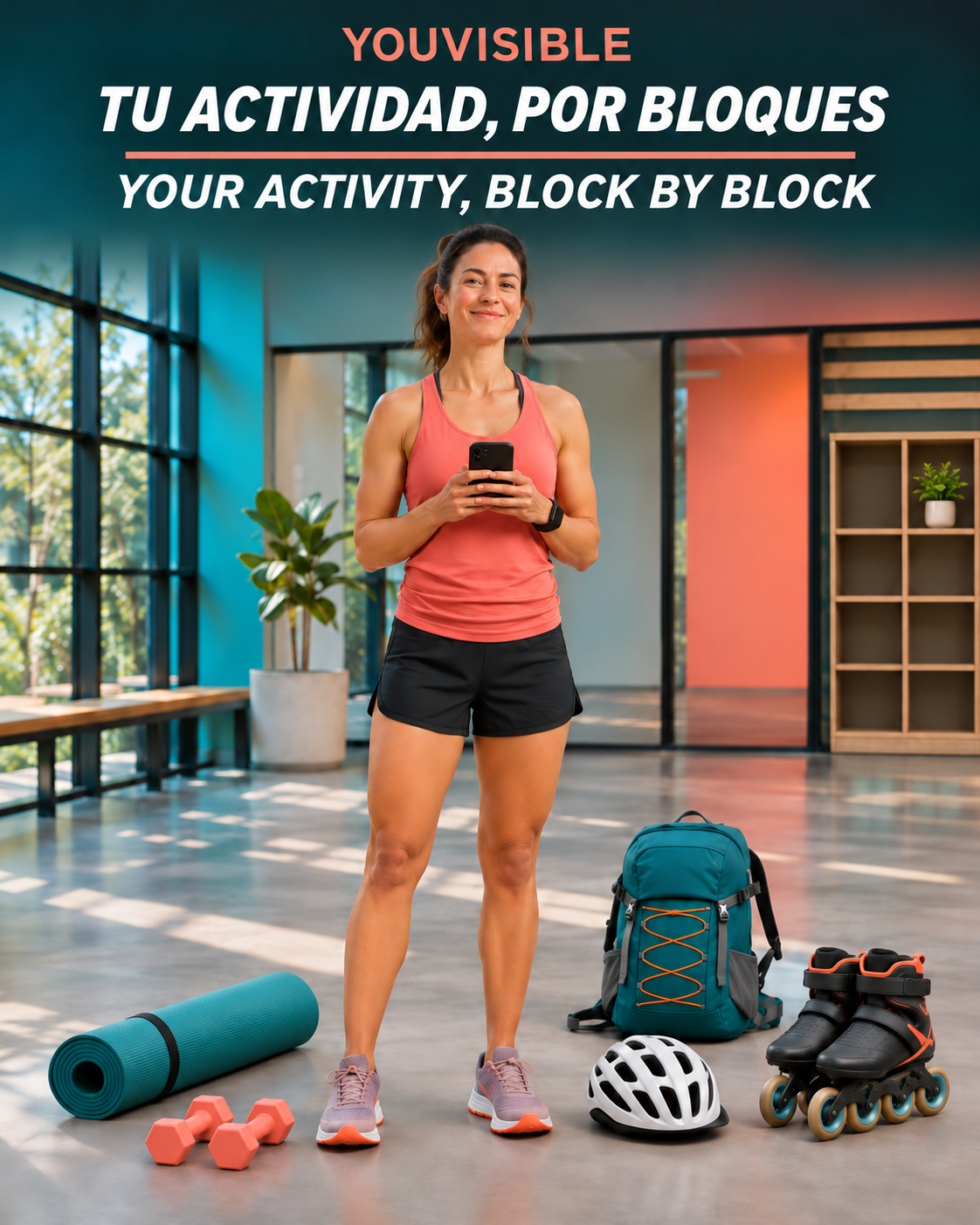
YouVisible supports blocks within an activity. A block has a title and can have a description, allowing a particular part to be identified without turning it into a separate session. The official account pricing page includes activities and blocks among the platform's capabilities.
For example, “Climb through the pine woods” says where one part fits. “Turning practice” identifies a task. A short description can supply the extra context that would make the title unwieldy.
Treat the examples below as naming and organisation ideas. They are not button labels or a promise that a particular template appears in the app. They are also not exercise prescriptions: choose a structure that represents your session and whatever guidance you are following.
Keep it together, split it off, or leave it alone?
There are three different decisions here. A block says, “This is a distinct part of the session.” A separate activity says, “This was another session.” A routine pause or transition may need no additional structure at all.
A practical rule is one shared purpose within one session: consider blocks; a different occasion, a separate objective or an independent activity: consider a separate record. Time alone does not settle the question.
An activation period, a run and an easy finish can form one outing. A morning gym visit and an evening dance class are separate activities, despite sharing a date. A deliberately combined session may change tasks while retaining a clear common purpose.
Stopping to tie a shoelace or change equipment usually does not create a meaningful new chapter. Deciding whether to pause recording is a different question from deciding whether to create a block. You do not need to document every interruption simply because you noticed it.
Names that still work after six months
“Block 1” tells you the position, but nothing about the content. “The usual bit” assumes a memory that may have faded. Start with an action, a purpose or a recognisable setting: “Mobility before strength”, “Climb to the ridge” or “Choreography: linking the chorus”.
Imagine reading the titles without the rest of the activity. Can you tell what happened? If not, replace an abbreviation or vague word with a plain description. Keep the title short enough to scan; use the description for a detail that needs explanation.
Consistency helps when reviewing similar sessions. If an easy return serves the same purpose each time, a familiar name makes it recognisable. In family sport, choose wording the child will understand too, rather than a code meaningful only to the adult keeping the record.
Seven ways to give a session a readable shape
Hiking and mountaineering: let the terrain explain the chapters
An outing could contain “Approach to the trail”, “Climb to the pass”, “Technical rocky section” and “Return to the car park”. These names distinguish changes in the experience without treating every junction as a new activity.
Leave out a technical section if there was none. A gentle family walk might need only an outward leg and a return, or no subdivision at all. The terrain you actually encountered matters more than completing a tidy list.
Cycling: separate the intention behind each part
Consider “Warm-up leaving the village”, “Main work on the climb”, “Cornering skills” and “Easy ride home”. The blocks explain why different parts of the ride had different purposes, without listing every change of speed.
A relaxed continuous ride may need fewer distinctions. Only call a section skills practice if that was its purpose; an ordinary descent does not become a technical drill because it appears between two other blocks.
Running: a clear beginning, middle and end
“Activation before running”, “Main run through the park” and “Cool-down” can be enough. Name the middle section after what you did, whether that was a steady run or a specific practice you had planned.
If the main part changed, a brief explanation is often more helpful than creating a new block for every adjustment. The finished activity should tell the story of the outing you had, including a shorter or different middle section when necessary.
Gym sessions and their specialties: group related tasks
“Preparation mobility”, “Main strength work”, “Accessories” and “Easy finish” describe roles within a session. They do not require a separate chapter for every repetition or change of equipment.
Where useful, make a name more specific: “Main strength work: pushing movements” explains more than “Work”. Other gym specialties will have different structures. Keep the principle of grouping related tasks, while choosing labels that fit the class or practice you actually followed.
Yoga or Pilates: keep the flow recognisable
“Preparation and movement awareness”, “Central sequence” and “Final relaxation” can preserve the shape of a class without breaking every posture apart. Continuity may be an important part of what you want to remember.
Give the central sequence a more descriptive name if it had a clear focus. Record the practice itself without assigning therapeutic outcomes to it. A session history does not need to become a treatment claim or a set of instructions for somebody else.
Dance: show what was being learned
A class might use “Warm-up”, “Turning technique”, “Chorus choreography” and “Cool-down”. The names distinguish getting ready, practising a skill and joining movements into a sequence.
There is no need to divide every song if the songs supported the same work. For a children's class, recognisable references can help the family understand what happened without needing the group's private abbreviations or remembering a conversation with the teacher.
Skating: distinguish practice from application
Try “Activation on the rink”, “Braking technique”, “Promenade route” and “Quiet finish”. If the session centred on a routine rather than a route, name that routine and its purpose instead.
Use the setting you actually skated in. A technical session in a bounded space does not need to imitate a road outing. Its structure can explain the practice perfectly well without adding a journey that never happened.
Common mistakes, and the judgement behind avoiding them
- Making the activity too fragmented. If the list is harder to understand than a spoken account of the session, some parts may belong together.
- Choosing names that expire overnight. A private joke or “the second one” loses meaning once the immediate context disappears.
- Giving every rest its own block. A routine break does not always need a separate identity. Keep it when it changes the story, rather than by default.
- Combining unrelated sessions. A morning walk and an evening class do not become clearer when forced into one record.
- Borrowing another sport's structure unchanged. Pilates does not need to read like a bike ride. Borrow the organising idea and adapt the actual parts.
Good organisation is selective. There is no ideal block count for everyone, and an activity with fewer blocks is not less carefully recorded.
A five-minute preparation method
- Minute one: state the purpose. “Practise the class choreography” gives the session a clearer boundary than “do some sport”.
- Minute two: identify meaningful changes. Look for shifts from preparing to practising, or from one setting to another. Ignore minor interruptions for now.
- Minute three: name the parts. Choose plain actions and recognisable references. Read the titles in order: together they should describe the session you expect to have.
- Minute four: add one useful instruction where needed. A description can clarify the intention of a part. Avoid repeating the title or adding details you will never need again.
- Minute five: simplify. Check that transitions have not become unnecessary tasks and separate sessions have not been merged. Keep the structure flexible enough to accommodate what happens.
You can sketch this out before opening the activity. The exercise is about making decisions, not spending the whole five minutes on your phone. Once you start, the organisation should support the experience rather than continually interrupt it.
How this fits activities with and without GPS
GPS can preserve a route. Blocks explain the meaningful parts of a session. A map does not necessarily tell you why you stopped to practise something, while a class without a map still has a beginning, a focus and an ending.
The official athlete page covers activities with and without GPS. This does not mean every mode and sport has identical fields, timing options or controls. Apply the organising principle using the options available in your activity, without expecting an indoor class to behave exactly like a recorded route.
YouVisible also supports associating moments, including photos and videos, with particular blocks. A picture of the terrain can belong with the relevant section; a practice video can sit with the part it shows. A brief description can preserve an important change. None of this requires adding media to every block.
Finish with a short reality check
Before considering the record complete, ask:
- What happened? Do the names describe what you actually did?
- What changed? Was a planned section replaced, shortened or given another purpose?
- What deserves a note? Is there a decision, incident or detail that will explain the session later?
- What can be left out? Are repeated explanations and routine transitions adding anything useful?
The value of blocks is not a fuller spreadsheet of sport. It is a clearer memory of the activity you lived. With YouVisible, a thoughtful structure can help you return to a session and recognise its story, without filling every part with data.