


An apparently obvious comparison
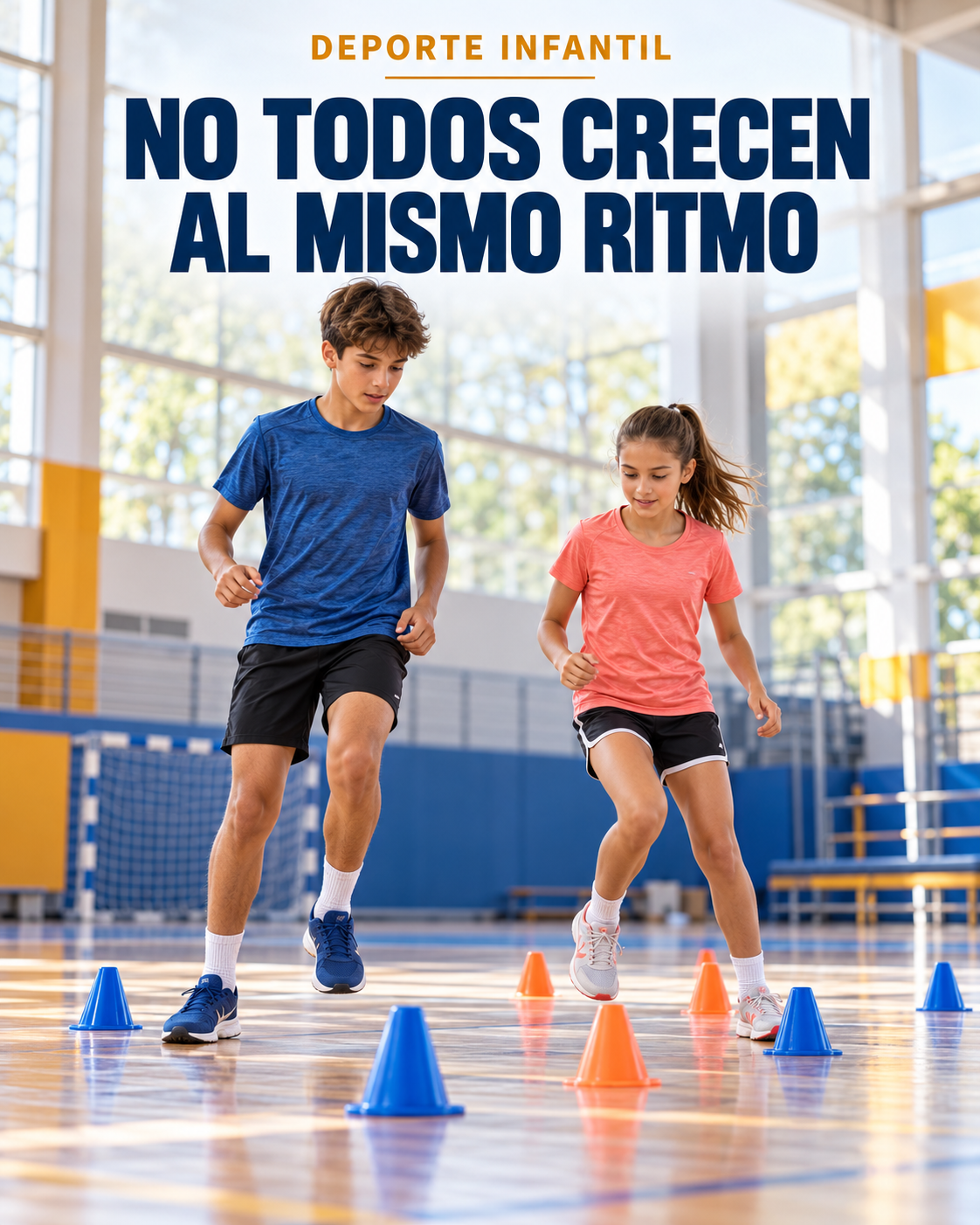
Two children play in the same age group. One is taller, faster and stronger, wins physical contests and gets more playing time. They seem the obvious standout. The other controls the ball well, performs skilful movements and understands where to be, but struggles when contact comes into play.
From the sidelines, the conclusion seems straightforward. Yet there is a useful question to ask: are we seeing talent, or simply a temporary physical advantage? Both children may have sporting ability; today's result cannot separate all the ingredients behind it.
For parents, guardians and grassroots coaches, this perspective makes it easier to support children without treating every match as a verdict on their future.
The three clocks of youth sport
Chronological age means the years and months since birth. Relative age describes a child's position within the period used to organise age groups. When a category follows the calendar year, teammates can be almost a year apart.
Biological maturation is the individual pace at which growth and puberty progress. Sharing an age does not mean sharing the same stage of physical development.
Being born earlier in the selection year and maturing earlier are different things, although their advantages can combine. Height alone cannot tell you a child's maturity status. Malina and colleagues' review explains this variation and the limitations of assessment. It is not a framework for families to classify children at home.
Today's performance is not tomorrow's potential
Size, strength and speed can bring real advantages now. They do not automatically establish a greater ability to learn or a brighter sporting future. A fuller picture considers:
- What the child can manage physically today, including contact and reach.
- How they make decisions before and during an action.
- How they learn and respond to a coaching correction.
- The technique they retain when physical differences matter less.
- Their motivation, creativity and understanding of the game.
- Their progress across several seasons, with comparable learning opportunities.
A drill with less contact might reveal anticipation that a match conceals. That adds information; it is not a definitive talent test.
Güllich and Barth's systematic review distinguishes junior from adult outcomes when examining entry into talent development programmes. It cannot promise that later maturation will make someone a better athlete. The future remains open for both children.
How relative age can influence selection
Imagine two players born in January and December of the same year, in a category using a calendar-year cutoff. The January-born player has had almost twelve extra months of life, potentially including practice and other experiences. An early advantage may attract more attention, selection and opportunities to learn. Those opportunities can then reinforce the initial difference.
This helps explain why children born early in a selection period can be overrepresented in certain teams. Hill and colleagues examined relative age and maturation separately in an English football academy and identified selection biases involving both.
This is a statistical pattern across groups, not an individual destiny. A December birthday does not determine a child's sporting future, and January does not guarantee an advantage in every situation. Check the actual cutoff too: categories do not always follow the calendar year.
When the body changes quickly
Rapid growth can change arm and leg lengths, body proportions and the centre of mass. Some adolescents need time to adjust familiar movements to a changing body. Temporary experiences may include:
- Less precision in previously comfortable skills.
- Feeling awkward or less coordinated.
- Changes in speed, jumping or balance.
- Greater tiredness with a previously manageable workload.
- Discomfort that needs attention.
These changes are neither inevitable nor identical for everyone. A difficult week does not prove a growth spurt is happening. Listen to the child and share meaningful changes with the coach so tasks, demands and recovery can be reviewed.
Hall and Erskine's narrative review examines associations between growth, maturation and injury in football academies. An association does not show that growth is the only cause of injury. Pain needs consideration in its own right; saying “it's just growing” does not explain it.
What this looks like across sports
In football, winning a physical contest and choosing a good pass are different abilities. Notice whether a player finds support and recognises space even when contact costs them possession.
In basketball and volleyball, current height can shape positions and opportunities before growth is complete. Taller children should also practise handling skills and decisions, while shorter children need chances to learn other roles.
In padel, power and reach can hide differences in positioning, anticipation or shot selection. A winning shot does not tell the whole story of a point.
In martial arts, size and strength deserve particular care when organising partners and tasks, alongside experience, control and rules. The coaching team is responsible for safe organisation; families should not improvise their own pairings.
A family checklist without body comparisons
Choose a few questions to revisit calmly. They are not an interview to conduct after every session:
- Do they enjoy training and want to return?
- Do they understand sporting situations better?
- Do they learn after a correction?
- Do they try new solutions?
- Can they maintain reasonable technique under greater pressure?
- Do they have opportunities to participate and learn?
- Does the coach distinguish technical ability from physical advantage?
- Can they explore different roles, or have they been labelled too soon?
- Have recovery, sleep or discomfort changed?
A note such as “looked up before passing today” gives more useful context than comparing their body with a teammate's. Include what the child sees as progress. Their experience matters even when the score stays the same.
Having a useful conversation with the coach
Arrange a suitable time away from the tension of a match. Describe what you have noticed without assuming motives, then ask:
- Which technical or tactical skills are they developing?
- What do you notice beyond their size or speed?
- Might they be adjusting to changes in their body?
- How are learning opportunities shared?
- Could they try other positions or responsibilities?
- What progress would you like to see over the next few months?
The aim is to understand the plan and work together, rather than demand immediate playing time. Ask for a concrete example and agree when to review progress. A coach can describe changes in movement and performance; this conversation is not a way to diagnose maturation.
What a healthy learning environment offers
A good club avoids permanent labels such as “talented” or “not good enough”. It reviews progress over longer periods, explains its criteria and does not select exclusively for size, strength or immediate results. It provides meaningful learning, adapts tasks when physical differences are large and allows children to explore positions and responsibilities.
It also respects rest, growth, school, friendships and life outside sport. Corrections address actions without attacking the person, protecting self-esteem. Children need adults who support their development, with expectations appropriate to childhood.
The review of bio-banding describes grouping by physical development as an occasional complementary approach. It cannot remove every difference or solve selection on its own. Estimates based on body measurements have margins of error: their use requires professional judgement and context, not family calculations.
The 2024 IOC consensus supports whole-person development in elite youth athletes. Its setting differs from recreational sport; it does not justify bringing Olympic demands into everyday children's activities.
Common family mistakes
- Comparing height or body shape with teammates.
- Treating a spell on the bench as permanent evidence of limited talent.
- Adding training to “catch up” with a maturation difference.
- Specialising early in a position because of current size.
- Using online calculators to estimate puberty or adult height.
- Saying within earshot that a child has “become too small”.
- Turning every squad selection into a verdict on their future.
Replace labels with questions about specific experiences. If a child wants more activity, listen to their reasons and coordinate with their coaches. Developing at a different pace is not a debt to repay through extra training.
Evidence limits and reasons to seek help
Much of the research on these selection biases, and on growth and injury, comes from male football academies. Findings should not be transferred automatically to girls, recreational sport or every discipline. The suggestions here are educational guidance, not tools for predicting careers or diagnosing maturation.
Consult a qualified healthcare professional for persistent or worsening pain, limping, swelling, night pain, a marked loss of energy, difficulty recovering or any symptom that continuously disrupts everyday activity. Do not wait for an assumed growth spurt to explain discomfort, or push through a session to test it.
Scientific sources
Verified references; volume year, with advance publication where different:
- Malina RM et al. (2015). Biological maturation of youth athletes: assessment and implications. PMID: 26084525. DOI: 10.1136/bjsports-2015-094623.
- Hill M et al. (2020; online 2019). Relative age and maturation selection biases in academy football. PMID: 31366286. DOI: 10.1080/02640414.2019.1649524.
- Güllich A, Barth M. (2024; online 2023). Effects of Early Talent Promotion on Junior and Senior Performance: A Systematic Review and Meta-Analysis. PMID: 37921913; PMCID: PMC10978645. DOI: 10.1007/s40279-023-01957-3.
- Bergeron MF et al. (2024). IOC consensus statement on elite youth athletes competing at the Olympic Games: essentials to a healthy, safe and sustainable paradigm. PMID: 39197945. DOI: 10.1136/bjsports-2024-108186.
- Malina RM et al. (2019). Bio-Banding in Youth Sports: Background, Concept, and Application. PMID: 31429034. DOI: 10.1007/s40279-019-01166-x.
- Hall ECR, Erskine RM. (2026; online 2025). The Association of Growth and Maturation with Injury in Academy Soccer Players: A Narrative Review. PMID: 41239044; PMCID: PMC12913351. DOI: 10.1007/s40279-025-02340-0.
Next month: watch the whole film
Over the next month, notice learning, enjoyment, decisions, adaptation and recovery alongside goals, points, wins, size or minutes played. Review a few notes and listen to the child before drawing conclusions. In youth sport, one season is a photograph; a child's full development is a film.