


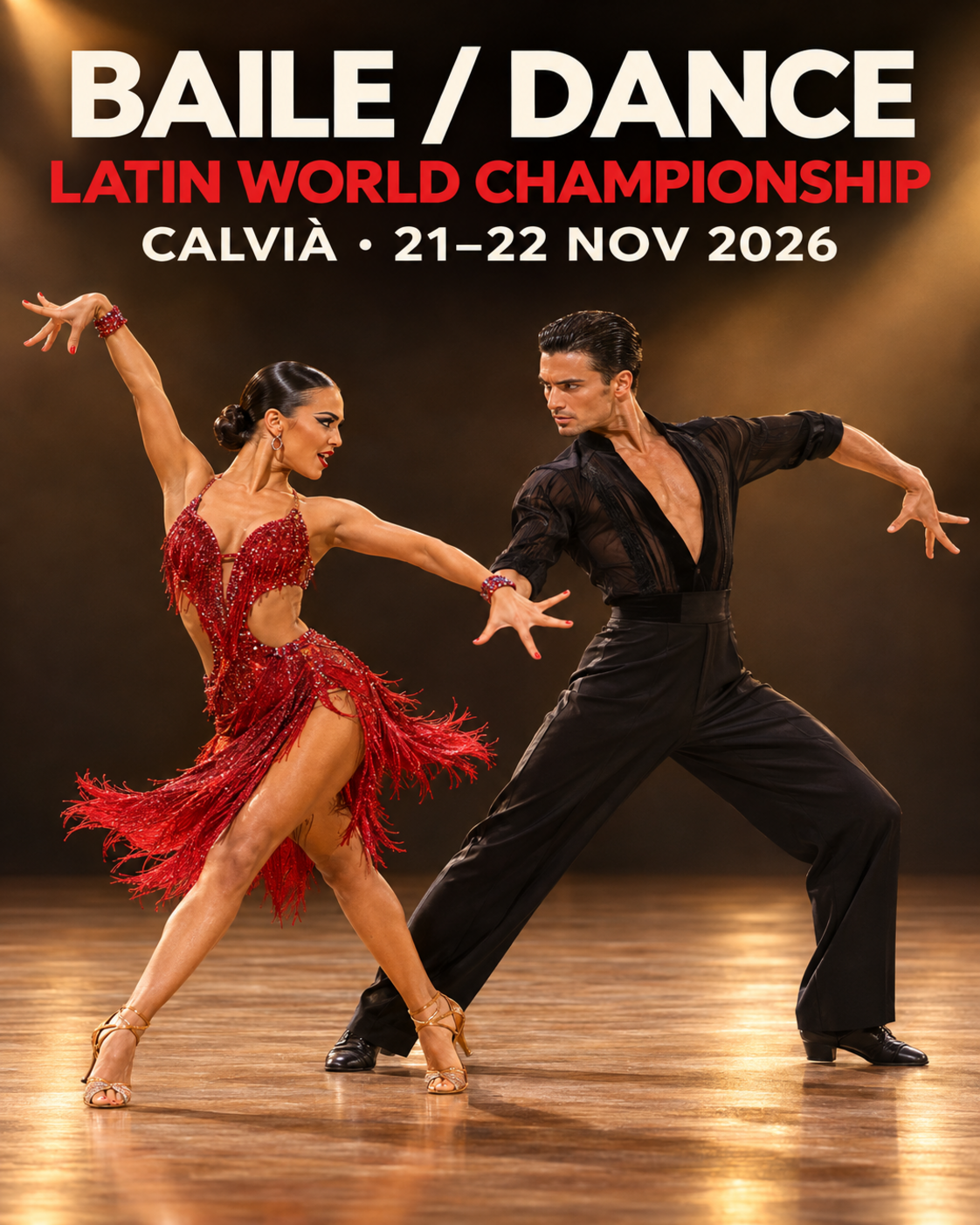
Space is part of the dance
A couple can know its choreography and still have nowhere to perform it. Another trajectory crosses the intended route, a blockage appears and the next figure is no longer viable. Floorcraft means reading that space early enough to preserve safety, connection and musical character. It does not require unstructured improvisation or defending a line at any cost.
The Calvià Latin Worlds provide a setting for observing those decisions. This guide offers questions for competitive couples and people training in DanceSport. It does not assign intentions to particular competitors or invent an informal right-of-way rule. Adaptations should be prepared with the teacher and checked against the relevant category's requirements.
Official facts and programme
Editorial date: 10/11/2026. Documentary verification: 11/11/2026. The WDSF Calvià listing includes the Latin Adult World Championship on 21 November 2026 and PD Latin Worlds on 22 November 2026. The broader gathering also includes activities from the 20th. Its overall dates should not be confused with each championship's date.
The official championship announcement identifies Palau d’Esports Melani Costa in Calvià, Mallorca. Check access, participation and the latest programme before travelling. The WDSF rules repository supplies the regulatory reference. The following ideas are training recommendations, rather than a complete reproduction of official judging criteria or a prediction of marks.
Decide before the opening disappears
A late adaptation requires solving space, balance and communication together. Look for advance signals: another couple finishes towards your area, the available route narrows or the next movement needs more amplitude than remains. Ask whether you can start the figure and still retain an exit, instead of assessing only its first position.
Consider your partner's movement as well as the space currently occupied by your own feet. An opening may fit the beginning but not the continuation. Reading a spatial sequence helps prevent every blockage from becoming an unavoidable surprise that can only be answered through abrupt braking. The aim is earlier information, not a guarantee of an empty floor.
Share observation without sharing blame
Both partners contribute information, although their views differ. Leading does not remove the other person's role in communicating a hazard, and following does not require resolving every problem through force. With your teacher, practise understandable signals for reducing amplitude, waiting within the music or selecting an agreed continuation.
A signal needs enough time for the partner to respond. Pulling an arm or changing direction abruptly can create more disruption than it solves. Afterwards, ask what each person saw. “Another couple was in my exit” adds useful context. “You always block me” turns an observable situation into a judgement that offers little direction for the next rehearsal.
Peripheral awareness without abandoning the task
Looking around does not mean continuously moving the head or losing the character of the dance. The aim is spatial awareness inside a learned performance. Peripheral information may signal proximity while gaze and orientation continue to serve their technical and expressive purposes. Those functions need to be developed together rather than treated as competing instructions.
As an editorial exercise, rehearse a familiar section within a defined space while the teacher manages additional predictable trajectories. Practise detecting occupation before entering it, rather than provoking collisions to learn to tolerate them. Match speed and complexity to experience. A busy room of beginners is not an appropriate setting for adding improvised fast obstacles without supervision.
Priority comes from rules, not habit
Do not assume a universal right to maintain any trajectory because you started it first. Obligations depend on the regulations and context. Ask how situations are interpreted in your category and consult the applicable rules when there is a real question. Shared safety remains a practical responsibility even when you believe your reading is correct.
Avoid assigning fault from a short clip. It may omit preceding movement, another couple or a change outside the frame. Describe what is visible first: where space contracts and how both couples respond afterwards. A tactical interpretation remains a hypothesis until the available information is sufficient to support it. Audience reaction alone cannot settle the issue.
Prepare continuations rather than disposable choreography
Couples can agree specific alternatives for recurring situations: reduce travel, repeat a permitted structure or connect with another section. Review technical and regulatory suitability with the coach. An option useful in one dance or level is not automatically suitable in another, and preparation should include how both partners recognise the change.
Imagine an editorial example: the wide exit is occupied and you have rehearsed a compact continuation that keeps the pulse. Selecting it does not require mentally restarting the entire routine. What matters is sharing the change point and knowing how to reconnect. A huge list of difficult alternatives can increase hesitation instead of giving you useful flexibility.
Keep music and connection during adjustment
When a blockage requires less travel, try to retain a shared musical reference and clear communication. Expression does not depend solely on covering more floor. With your teacher, identify which aspects of character remain available when the geometry changes. This can make an adaptation recognisable as part of the dance rather than an interruption outside it.
Adding difficulty to conceal the change is not the default solution. A simple coordinated recovery may have more continuity than an ambitious figure started without room. That does not guarantee a higher score: judges assess the performance within their framework. We are discussing a trainable decision, not promising how a panel will evaluate a particular round.
Recover after a blockage
Following an interruption, first establish that both partners have balance and space to continue. Avoid trying to reclaim all the missed travel immediately. That reaction may create a second conflict just as you recover from the first. Return to a familiar reference and identify the next suitable point in the sequence.
During review, separate detection, communication and response. Perhaps the hazard was seen early but there was no agreed signal. Perhaps the signal arrived but the alternative was too complicated. Distinguishing these stages gives the next session a purpose. Repeating the complete routine and hoping the problem disappears may not address the decision that actually failed.
Common mistakes and checklist
Frequent errors include looking only at the initial opening, confusing priority with permission to force a passage and changing figures without allowing the partner to understand. An adaptation is also not automatically a personal or aesthetic failure.
- I have checked my category's programme and rules.
- I observe both entry and exit of the next figure.
- We share a brief signal for reducing space.
- We have a small set of practised, permitted alternatives.
- We can recover pulse and connection without anxious acceleration.
- Our review describes visible actions without blaming each other.
Use YouVisible to arrange a rehearsal and share an authorised sequence with a specific spatial question. Respect other couples and their image permissions. Learning needs context rather than publicly blaming whoever appears near a blockage.