


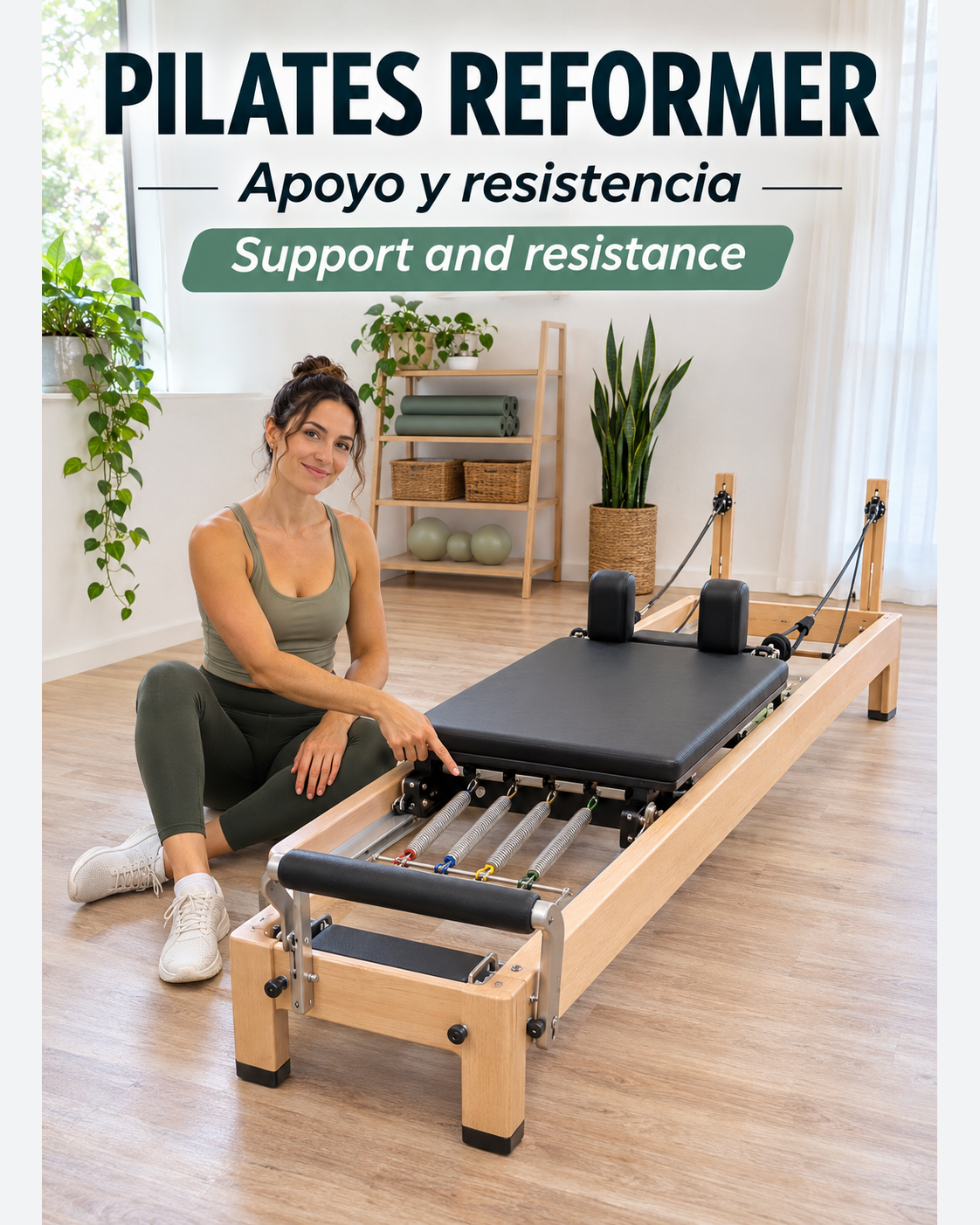
The teacher adds a spring and the exercise becomes easier to control. During another movement she removes one and you need to pay closer attention. If you approach a reformer expecting springs to behave like plates on a barbell, these decisions seem contradictory. The difference lies in what the spring is doing and how it interacts with your body during that particular task.
Understanding that relationship does not require programming a class or adjusting a machine independently. It helps you ask better questions, follow instructions purposefully and stop comparing your ability with the colour used by the person beside you. Resistance forms part of an exercise; on its own it is not a personal difficulty rating.
Resistance and difficulty measure different things
The teaching guidance from Pilates Anytime on reformer springs explains that greater tension does not always make an exercise harder: depending on the movement, it can also provide support. Colour references differ between manufacturers as well. Source checked on 19/11/2026; editorial date 18/11/2026.
The practical question is what you must control, which part moves and what role the chosen setup serves. You do not need to calculate forces to understand that the same apparatus may oppose one action while assisting another phase. “I use fewer springs” does not fully describe the work you are performing.
A reformer does not remove the importance of position, experience and coordination. Two people may need different adjustments while pursuing a similar purpose. A useful comparison is whether you can perform the instructed task with control and within your capabilities, rather than whether your spring combination looks more demanding from across the studio.
Ask what the exercise is intended to teach
Before beginning an unfamiliar movement, request a brief explanation of the objective: “Are we trying to move the carriage or prevent it travelling too far?”, “What should remain steady?” and “How do we finish the repetition?” These questions make the setup understandable without replacing the person responsible for teaching the class.
In a fictional example, Elena finishes an exercise and explains that she can move the carriage out but cannot return it smoothly. Her instructor observes and chooses an adjustment. That might involve the spring setup, the range, the position or the variation. It is not automatically a problem solved by Elena simply trying harder.
The same conversation applies when a variation seems too easy. Explain what you can control and which objective you cannot recognise. Do not add springs independently while others are moving, or because you assume more always represents progress. Confirm the intention and the safe adjustment procedure before changing anything on the apparatus.
The return belongs to the repetition too
It is easy to concentrate on moving the carriage away and pay less attention to bringing it back. Yet the end of a repetition offers valuable information about how you organise the movement. If finishing requires a bump, a jerk or an unexpected correction, describe what happened before repeating the task.
Our observation suggestion is to discuss three moments with the instructor: the start, the travel and the return. You need not memorise an anatomical checklist. Ask whether you are maintaining the intended range and finishing where agreed. These references help identify a task that you cannot yet manage consistently and predictably.
Do not confuse smoothness with performing everything extremely slowly. The tempo should suit the exercise and the professional instruction. Likewise, do not force a larger range to demonstrate mastery. A deliberately chosen range may serve learning better than travelling further while losing control of the equipment or your position on it.
Colours do not transfer reliably between studios
You change studios and find springs with different colours or a different feel. Last week's combination is not a guaranteed equivalent. Identify the model and ask how the studio communicates its settings, particularly if you are following a recorded class demonstrated on equipment different from your own.
The manufacturer's Contrology Reformer manual illustrates how settings belong to particular equipment and instructions. We do not transfer its combinations to other reformers or turn an example of support into a universal prescription. The manual for your own equipment and suitable in-person teaching provide the relevant practical direction.
If you notice a damaged spring, questionable attachment or unusual behaviour, report it and stop using the apparatus until the responsible person has checked it. Do not improvise a repair or replace components using an editorial explanation. Understanding a component's purpose is different from being qualified to inspect or repair it safely.
Independence begins with communicating observations
In a group class it may feel as though you must resolve everything without interrupting. A short sentence helps: “I cannot control the return”, “this position does not let me follow the instruction” or “please check the setup before I begin”. Provide specific information rather than turning a sensation into a diagnosis.
If pain, tingling, dizziness or another sensation compromises your safety, stop the movement and ask for help. Do not use a different setting to conceal symptoms and continue. Adapting may mean choosing another task or leaving that exercise out, according to your circumstances and any professional assessment you need.
You do not need to seek instability for a session to count. A less predictable task is not automatically more valuable. If your goal is learning a sequence, a variation that lets you attend to it may be preferable to spending all your attention preventing an unexpected movement of the carriage.
Before following a recorded class
Pause whenever a setup instruction is unclear. Confirm that the class and equipment suit your experience and that you have safe operating instructions. Do not try to catch up with the recording by skipping a check. If the manufacturer's directions and available professional guidance cannot resolve the setup, choose a different familiar practice. A continuously playing video does not create an obligation to keep moving when you are still learning how to use the apparatus.
Keep a small record without collecting colours
After a class, note the objective you learned, the explanation your teacher gave and one sign of control. For example: “I practised finishing the return without rushing; check the setup with the instructor when repeating it.” This preserves the intention while recognising that another session may call for a different decision.
Avoid building a personal ranking in which each spring colour represents a level. Equally, do not compare different machines as though they were identical. If a class uses names or combinations you do not recognise, ask before starting. Repeating an instruction you do not understand does not make you more independent in your practice.
At your next Pilates session, choose one question: “In this exercise, is the spring asking me to work, helping me, or doing both at different moments?” Listen to the answer and observe how it changes your practice. Understanding the task makes the setup more useful; collecting extra springs without understanding their purpose does not demonstrate progress.