


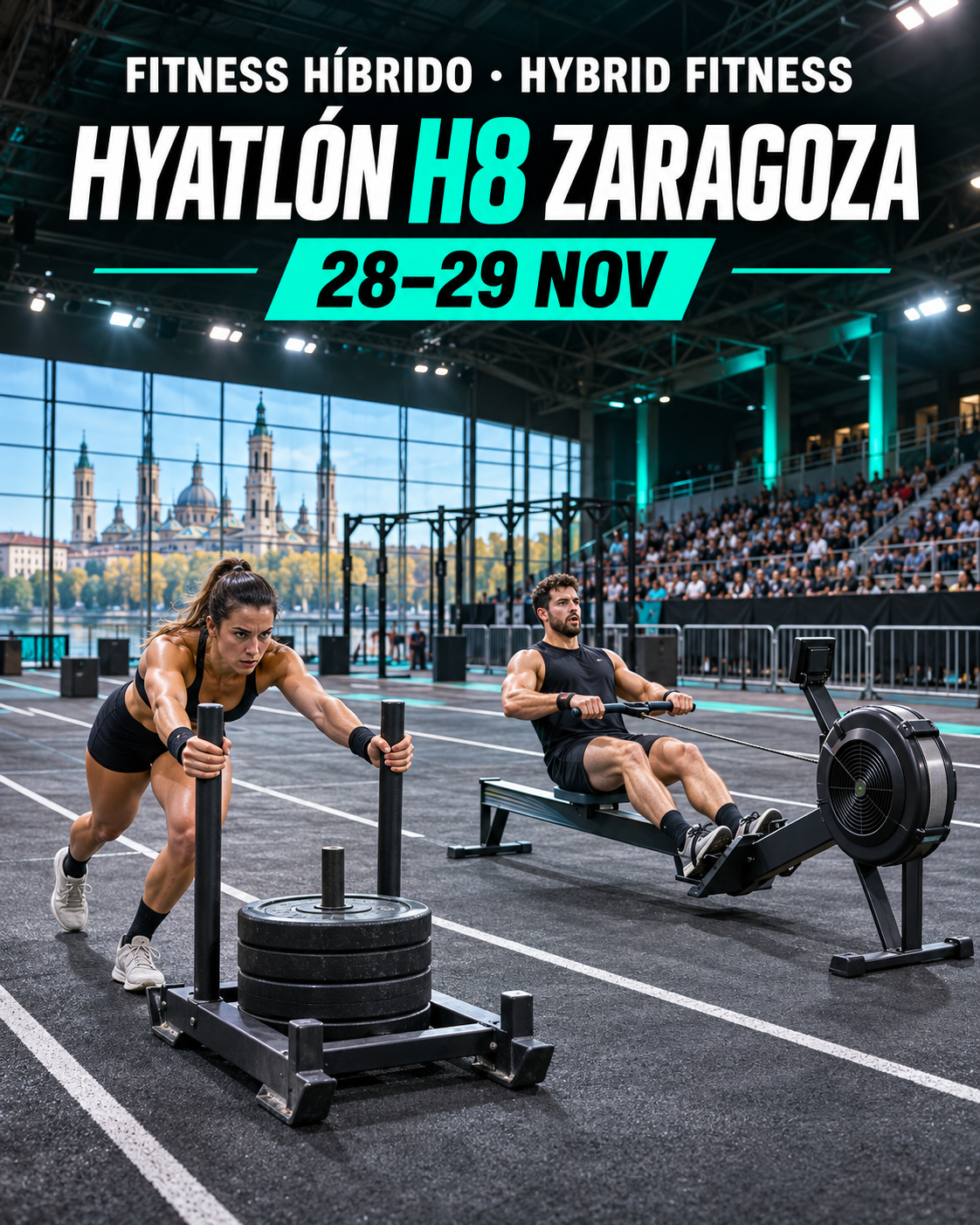
Running a good kilometre and moving a sled separately do not answer the question an H8 presents: what happens when you have to run again afterwards? Useful preparation for Zaragoza means understanding that sequence and arriving with a plan that allows adjustment. Spectators can also understand the competition by watching how participants change between tasks rather than reducing it to who moves the most weight.
Zaragoza information checked
Sources checked on 16/11/2026. Feria de Zaragoza confirms Hyatlón on 28–29 November, in Hall 4. The official Zaragoza page places Individual on Saturday and Doubles and Relays on Sunday. An adapted format is also listed; its conditions need their own review rather than assumptions based on another category.
The registration platform publishes a deadline of 16 November at 23:59. At consultation it retains categories and registration links, which do not certify places or acceptance. Because the deadline falls on the editorial date, we neither guarantee entry nor claim an extension. Check the live position directly and, if already entered, follow the instructions for your particular format and assigned start.
Understand the eight stations
The Hyatlón H8 format combines eight one-kilometre running sections with SkiErg, sled push, sled pull, burpee broad jump, RowErg, farmers carry, sandbag lunges and wall balls. Consult the applicable distances, repetitions, loads and standards in its documentation. Exercise names shared with another event do not make the rules interchangeable or establish identical categories.
The practical challenge is connecting tasks. After pushing, comfortable running may take time to return; after carrying weight, grip may affect another action. These are examples to observe, not predictions for every athlete. Do not automatically import a strategy, category or penalty from a different series. Understand this event through its own conditions and resolve uncertainties before competing rather than discovering during a station that your assumed standard was different.
Running changes the stations and vice versa
An overly hard opening run can make a familiar station more expensive. The reverse also matters: continuing after movement quality has deteriorated can make the next kilometre harder. The practical aim is a sustainable sequence rather than treating every segment as though it ends the entire competition. Individual strengths are useful only within the demands you actually face.
Our editorial recommendation is to review combined sessions you have already completed with appropriate supervision. Ask what happens in the minutes after a station, not only how quickly you finish it. Without previous experience linking tasks, the approaching event is a poor reason for a last-minute maximum simulation. A sudden week of overload cannot replace preparation and may leave you carrying fatigue that was not part of your plan. Familiar, manageable practice offers clearer information.
Choose Individual using complete evidence
Individual requires assessing your ability to handle the full workload of the category. A separate strength result or a quick running session does not describe continuity. Consider whether movements remain valid while breathing hard and whether you can return to running without turning every station exit into an extended recovery. Those observations matter alongside isolated performance numbers.
Check actual loads and requirements before confirming a category. Avoid choosing Elite because it matches your sporting self-image or Open because the name sounds easy. A coach familiar with the format can help interpret technical uncertainty and recent preparation. The decision should reflect present capacity, including limitations you have actually observed, rather than an ambition you have not yet trained. Registration is an administrative step, not independent evidence that the full event is appropriate for you.
Doubles requires coordination before effort
A shared format still requires understanding which work is shared and how changes are performed. Read the specific rules for moving together, dividing tasks and changing within stations. Do not invent a split based on another competition or assume one person can compensate for every limitation of the other. Both athletes need an accurate picture of their responsibilities.
Agree simple signals and a response if either person needs to reduce intensity. Different abilities can work together when both understand the plan. Problems arise when one accelerates without checking the other can follow, or every change is negotiated under fatigue. Practising communication during ordinary sessions is useful without recreating the whole competition at maximum effort. Include a way to acknowledge a problem calmly so a missed signal does not turn into repeated confusion.
Relays and adapted categories
For Relays, confirm team composition, order, change areas and each member's responsibilities. Sharing tasks means delays or misunderstandings affect others too. Keep the team instructions and establish who must be ready at each stage. Do not calculate arrival at the venue solely around the section you personally expect to complete; check the organiser's reporting requirements for the whole team.
Adapted categories require precise information about eligibility, classification, assistance and official modifications. They should not be described as a generic easier version. Each athlete needs conditions relevant to their circumstances. Supporters should ask about accreditation and authorised areas. The existence of a category does not establish that every form of assistance or device is accepted without review. Resolve those details directly rather than relying on how a similar event handled them previously.
A transition starts before leaving the station
Think of transition as a short sequence: complete the task validly, identify the exit, reorganise breathing and resume at an effort you can sustain. A few slower seconds may work better than a surge followed by a lengthy interruption. This is an editorial planning principle, not a universal timing target or a fixed number of recovery steps for everyone.
Pay attention to signs and officials while moving. If uncertain about direction, resolve the question rather than following someone on a potentially different sequence. Prepare administrative details too: number, assigned start and permitted equipment. A thoughtful transition cannot correct an unfinished station or omitted lap. Understanding the route and complying with instructions are part of managing the effort, so include them in preparation rather than treating them as details to learn once racing begins.
Watch from the stands with useful questions
To follow someone, identify the format and wave once published. Notice changing pauses, how running resumes and whether movements remain controlled. Avoid interpreting every pause as weakness: it may be deliberate or follow an official instruction you could not hear from your seat. Looking at the sequence gives a more useful picture than judging one isolated moment.
With children, observe a transition and discuss how the task changes. Avoid presenting the event as an invitation to copy loads or difficult movements at home. Check spectator entry, capacity and conditions with the organiser. A venue listing does not establish free admission, parking or particular facilities. An athlete's start time is also separate from public door opening. Plan the visit around confirmed information rather than an assumed all-day access arrangement.
Arrive prepared and leave with context
Before the weekend, confirm your wave, rules, entry status and travel. Use familiar equipment and food. Pain or worrying symptoms are reasons to seek professional assessment and adapt the plan; wanting to complete eight stations does not justify ignoring them.
When sharing through YouVisible, describe a transition you learned to manage or how your team coordinated work. That helps others discover hybrid fitness through decisions, preparation and people as well as a finish time. Zaragoza can offer a clearer understanding of present resources without turning each station into a separate test of pride. The useful lesson may be how well the whole sequence held together.