


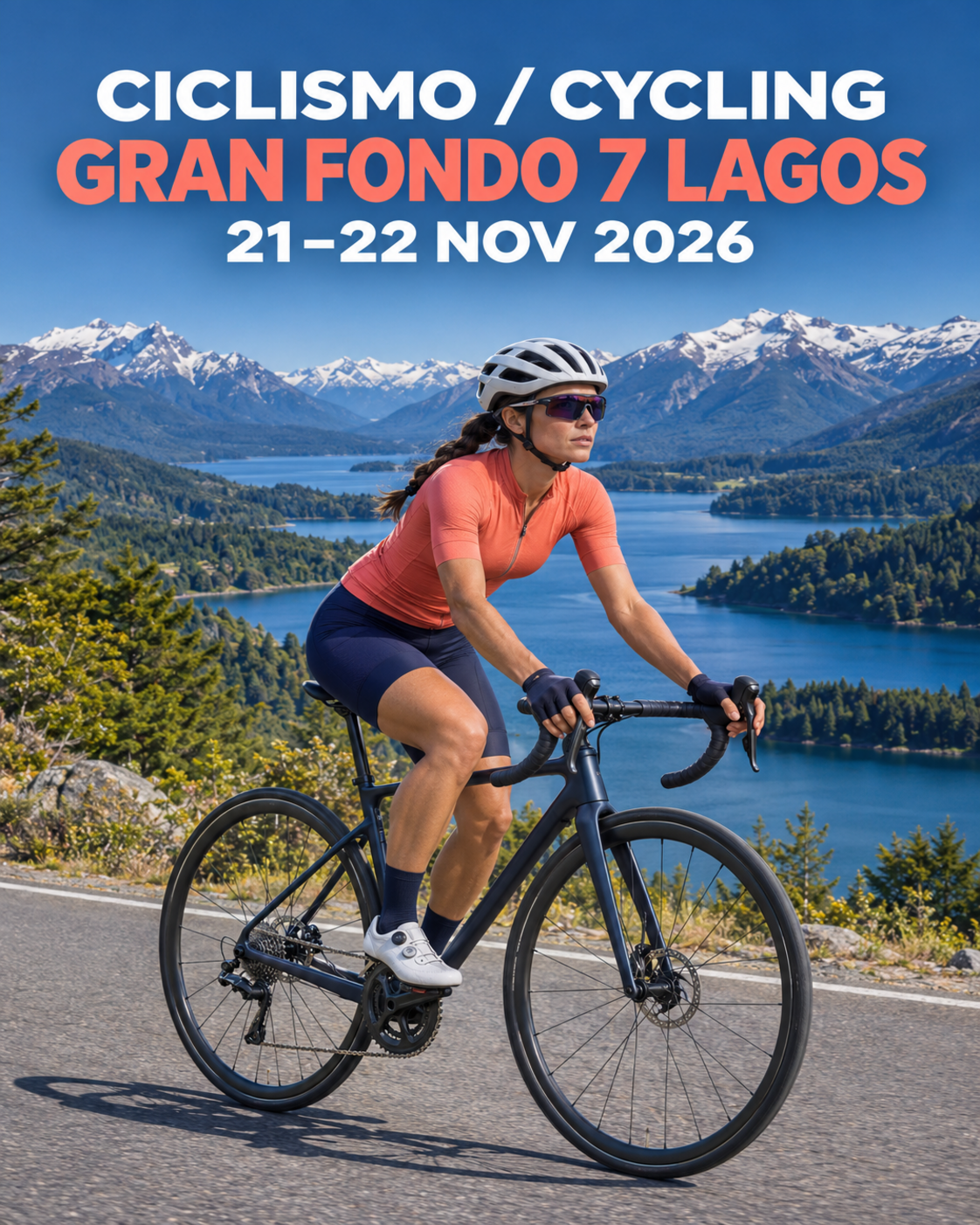
The first climb is a decision, not a test
The bunch accelerates away and the race seems to be disappearing before it has begun. At Gran Fondo 7 Lagos, answering every change on the opening climb may leave you unable to sustain the remaining 110 km. The useful question is what effort you can repeat later, after hours of riding, when short climbs still remain.
This guide discusses pacing, groups and preparation for amateur cyclists. Its recommendations are general, without prescribing individual power targets or nutrition quantities. The official route supplies the context. The group situations below are editorial examples rather than predictions of the race or guarantees about a finishing position.
Official event facts: 21–22 November
Editorial date: 10/11/2026. Documentary verification: 11/11/2026. The UCI Gran Fondo World Series listing confirms 21–22 November 2026, with the fondo finishing in Villa La Angostura, Argentina. It describes 110 km starting in San Martín de los Andes, a sustained opening ascent and two shorter climbs towards the finish. That distribution supports keeping capacity in reserve; it cannot predict your performance.
The organiser's registration regulations also identify 110 km. Check the requirements for your own format, assistance arrangements and current communications there. An available registration form does not guarantee a place, and rules for one format should not automatically be applied to every other category.
Time trial: three official distances remain inconsistent
The check finds 6 km on the UCI listing, 10 km in the organiser's schedule and 12 km in article 3 of the registration regulations and the official PDF regulations. These figures are not interchangeable. We have not located a clarification reconciling all three versions.
We therefore do not select a time-trial distance or estimate a finishing time for it. Participants should request explicit confirmation of the current course and check the final technical communication. This article concentrates on the 110 km fondo, where the sources agree. An apparently newer page is not, by itself, evidence that the discrepancy has been officially resolved.
Start with an effort you recognise
During the opening minutes, seek an intensity familiar from your longer training rides. Repeated chasing, or being unable to drink calmly because every acceleration requires your maximum effort, is a reason to reassess. Noise, excitement and the gradient can make an excessive effort feel like the normal price of participation.
With a power meter, use personal references you have already practised. Without one, notice breathing, tension and whether you can maintain an organised pedal stroke. We do not provide a universal percentage. A number on a display is also not an instruction to continue through concerning symptoms. The practical aim is to avoid being pulled into an opening effort you cannot sustain.
A useful group has an affordable entry cost
Company can offer continuity and shelter from wind, but reaching a group has a cost. Is the gap closing steadily, or do you need another intense effort every time you think you are almost there? A nearby wheel may be accelerating at the same time as you. Its distance alone does not reveal how accessible it is.
For an editorial example, imagine seeing a bunch ahead while another forms around you at a sustainable intensity. Joining the second may preserve options for later. We cannot know which group will finish faster. Judge the decision against the cost you can manage, rather than a promise that chasing must eventually pay off.
Every gap is not an emergency
If you lose contact, stabilise the bicycle and your effort first. Read the situation before changing direction. An improvised chase may stack up accelerations while reducing attention to other riders. Accepting a temporary separation still allows a strategy: you can reorganise and find an effort compatible with the remaining course.
Within a group, keep a predictable line, communicate hazards and avoid sudden movements when reaching for food or a bottle. These are general riding recommendations. Event regulations determine the actual traffic, assistance and competition rules. Do not infer that the whole road will be closed simply because you have entered an organised race.
Nutrition: prepare access and familiarity
Planned food is of limited use if it is unreachable or you only remember it when exhausted. Before the start, review what you will carry, where it will sit and which products you tolerate. An individual plan belongs with a qualified sports nutrition professional; race excitement is not a reason to try unfamiliar quantities or supplements.
Feed-station availability does not guarantee the product, timing or ease of access you imagine. Check current information and prepare a suitable alternative within the rules. On technical sections or among closely packed riders, bicycle control comes first. Look for an appropriate moment to eat or drink instead of making a rushed movement under pressure.
Clothing and temperature also demand attention
We do not assign temperatures to the race without a forecast close to the day. Prepare suitable protection and practise storing a layer while retaining control. A climb may feel warm, while the following descent changes that sensation. Those changes can affect what you need even when the course direction is familiar.
The mistake is not simply carrying an extra layer. It is improvising how to handle it inside a compact group. Check zips, pockets and water access beforehand. If conditions require a change of plan, follow the organiser's communications and accept that an original target can stop being reasonable during the day.
Keep decisions available for the final climbs
Arriving with capacity left allows choices: maintain effort, follow a short change or let a wheel go. Arriving after repeated costly chases may remove those options. Saving energy does not guarantee a better placing; it can help preserve your ability to respond in an organised way when the profile changes again.
Notice whether you can change gear in time and maintain a predictable line as the gradient increases. If you attack every rise and lose continuity before its top, consider a more controlled entry. The final tactic should reflect your actual condition rather than an ideal plan made while standing comfortably before the start.
Mistakes and final checklist
Avoid mistaking the front group's pace for your sustainable effort, postponing food through excitement and silently choosing one of the three time-trial distances.
- I have confirmed my format and current documents.
- I understand the unresolved 6, 10 and 12 km discrepancy.
- My opening effort reference has been practised.
- I can let a group go when chasing costs too much.
- Familiar clothing and food are accessible.
- I am keeping attention for the final changes in gradient.
Use YouVisible to organise preparation and share official information and pacing decisions with riding partners. A shared plan is useful when it leaves room to adapt instead of requiring everybody to answer every acceleration.
Also check the general UCI Gran Fondo rules for traffic and assistance requirements rather than assuming a complete road closure.