


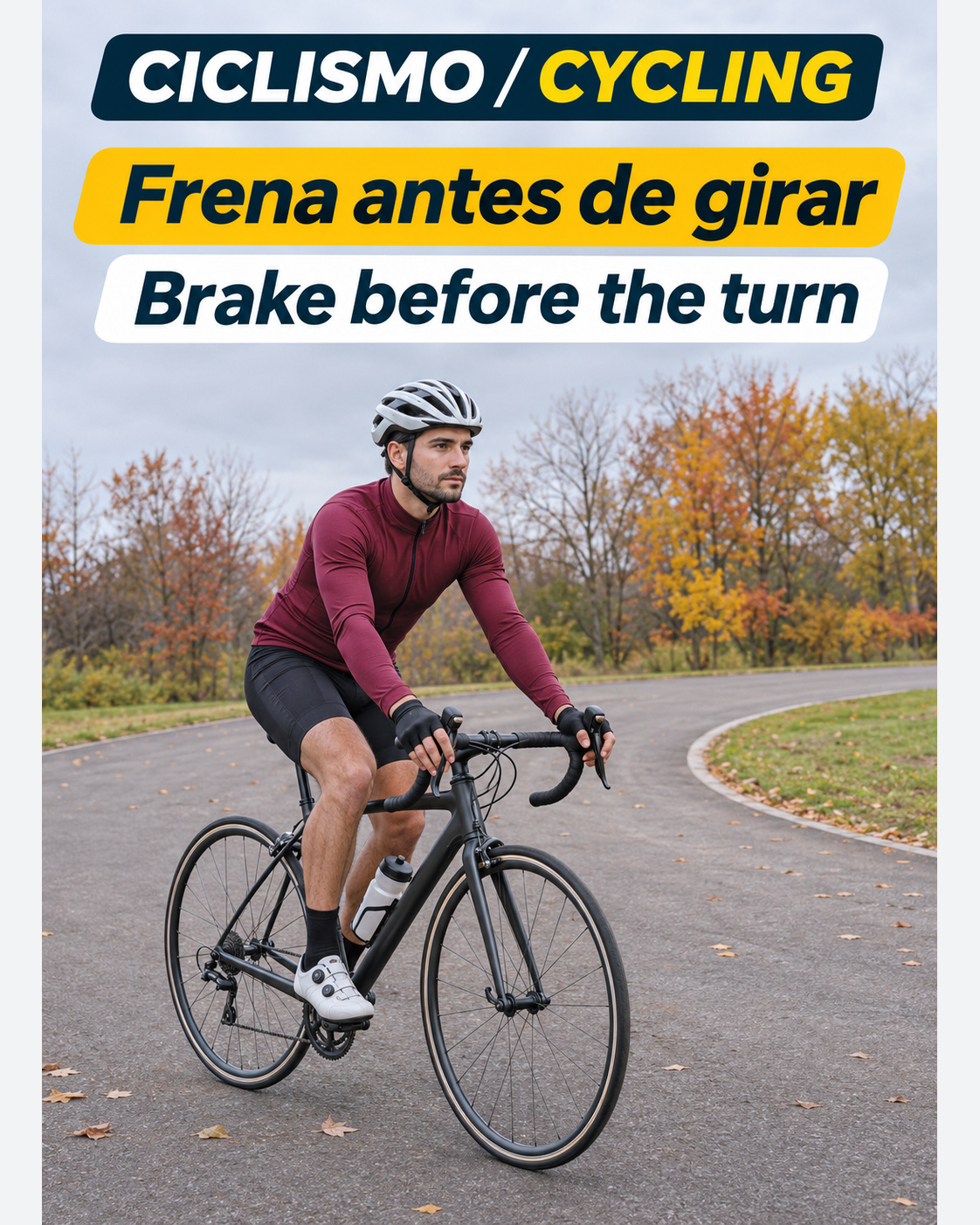
A familiar bend appears after a straight section. On a dry day you usually enter without much thought; today there is moisture, leaves near the edge and a patch of tarmac reflecting the light. You try to slow down once you are already turning and discover that your margin depended on a decision several metres earlier. The useful skill is preparing the entry so you do not ask more of the tyres than the surface can provide.
This is about choosing your speed before a bend, leaving room around other people and retaining the option to stop or change your plan. It applies to recreational road cycling and everyday journeys. Other cycling disciplines require their own instruction and practice conditions; confidence on one surface does not automatically transfer to another.
Braking and turning share a limited margin
A tyre must transmit forces to the ground both to reduce speed and to change direction. Demanding both abruptly leaves less room for error when grip is uncertain. No universal speed guarantees a safe turn: surface, visibility, gradient, bicycle and individual skill all matter.
The federation guidance from British Cycling on braking places speed reduction before the change of direction. The Giant owner's manual explains progressive brake application. These are learning principles rather than promises of traction on every surface. Sources checked on 19/11/2026; editorial date 18/11/2026.
For recreational riding, our practical recommendation is to slow early whenever you cannot assess the entry and exit clearly. Choose a pace that allows a calm decision. An unfamiliar bend is an unsuitable place to experiment with how much grip might still be available beneath your wheels.
Read the surface before deciding your speed
Notice changes that may alter the bicycle's response: gravel, paint, metal covers, leaves, water or a different patch of road surface. You do not need a scientific measurement of friction before deciding to allow more room and travel more slowly. Uncertainty itself is a reason to adapt.
Look along your intended path while continuing to monitor the nearby environment. Staring only at a leaf can hide information about a vehicle, pedestrian or the direction of the road. Avoid choosing a racing line that crosses into an opposing lane or somebody else's space. Public-road rules and consideration for others govern the manoeuvre.
If the surface does not allow a reliable decision, stopping somewhere safe and dismounting may be appropriate. Ice, flooding or a descent beyond your ability cannot be solved simply by squeezing the brakes a little less. Choosing another route is also part of competent riding, rather than evidence that the outing has failed.
Know your controls before precision becomes necessary
Check which lever operates each brake on your own bicycle. Arrangements vary, so do not copy a video filmed in another country without checking. Make sure you can reach the controls comfortably and that the bicycle is fit for use. A mechanical fault needs professional attention rather than an improvised change in riding technique.
Progressive application means building pressure in a controlled way rather than grabbing suddenly. It does not mean always using a particular number of fingers or dividing the force into fixed percentages. Equipment and conditions affect the response. Seek qualified instruction if you cannot use both brakes predictably and smoothly.
Do not practise locking a wheel on an open road. For an initial familiarisation, walking beside the bicycle and gently checking each control provides information without introducing a fast stop. Mounted exercises need a suitable permitted practice area, clear space and conditions appropriate to your current ability.
Separate preparation from the turn itself
As a suggestion for supervised practice, use a closed, flat, dry and unobstructed area. Begin by slowing in a straight line at low speed and finishing under control. Then connect a gentle reduction in speed with a very broad turn, without seeking speed or substantial lean. The exercise does not have to surprise you to teach something useful.
Check whether you arrive at the turn with your speed already chosen and can follow a calm, predictable path. If you still need abrupt corrections, return to an easier task. Do not shrink the available space to make the exercise feel more like an emergency. First establish repeatable responses under forgiving conditions.
This approach does not forbid every speed correction once a turn has begun. If a hazard appears, the appropriate response depends on the situation and your training. Anticipation aims to reduce the need for large, sudden corrections; it should not become a rigid rule that prevents you responding to an unexpected problem.
In a group, your change reaches the rider behind
Imagine a fictional outing with three friends. The first rider notices leaves and slows late, the second copies the manoeuvre and the third sees only a rapidly approaching back. The problem does not begin at the final bicycle: the group left too little margin for observing and communicating what was happening.
Before setting off, agree a pace suitable for the least experienced rider and simple warnings for slowing or stopping. Leave enough separation to see and act in the conditions, without treating a written distance as a guarantee. Avoid sudden lateral movements and do not assume that following the strongest rider proves your speed is suitable.
If the group stretches out, regroup somewhere safe. The person who knows the road can anticipate an appropriate place; someone unfamiliar with it should not chase to close the gap before a bend. Shared rides work better when nobody needs to conceal that they would prefer to travel more slowly.
Decide when to postpone practice
You can prepare the skill without searching for a difficult surface today. If you are rushed, tired or unable to find an appropriate practice area, leave the exercise for another occasion. You need not demonstrate wet-weather confidence for an outing to count. Choose an easier route and reserve a supervised session for learning. Keep essential transport separate from technical practice: needing to arrive somewhere at a fixed time adds pressure that does not help you explore a new skill thoughtfully.
Notice the mistakes before they become habits
One mistake is keeping yesterday's speed because the bend has not changed. Another is dropping your gaze and stiffening your arms when uncertainty increases. Buying new tyres can also create false reassurance if you assume they remove the influence of road conditions, inflation pressure or abrupt inputs.
Preparation includes checking equipment in accordance with its manufacturer's instructions and seeking help when something is wrong. We are not prescribing a universal tyre pressure or a mechanical setup. Those decisions must suit your wheels, tyres, load and intended conditions rather than an example copied from another rider.
After your next outing, choose one bend and review when you decided to slow, what information you used and whether you arrived with room to respond. Improvement may mean braking earlier, asking for a pause or selecting a different street. Control shows in decisions you can explain, rather than in having passed through the corner faster.