


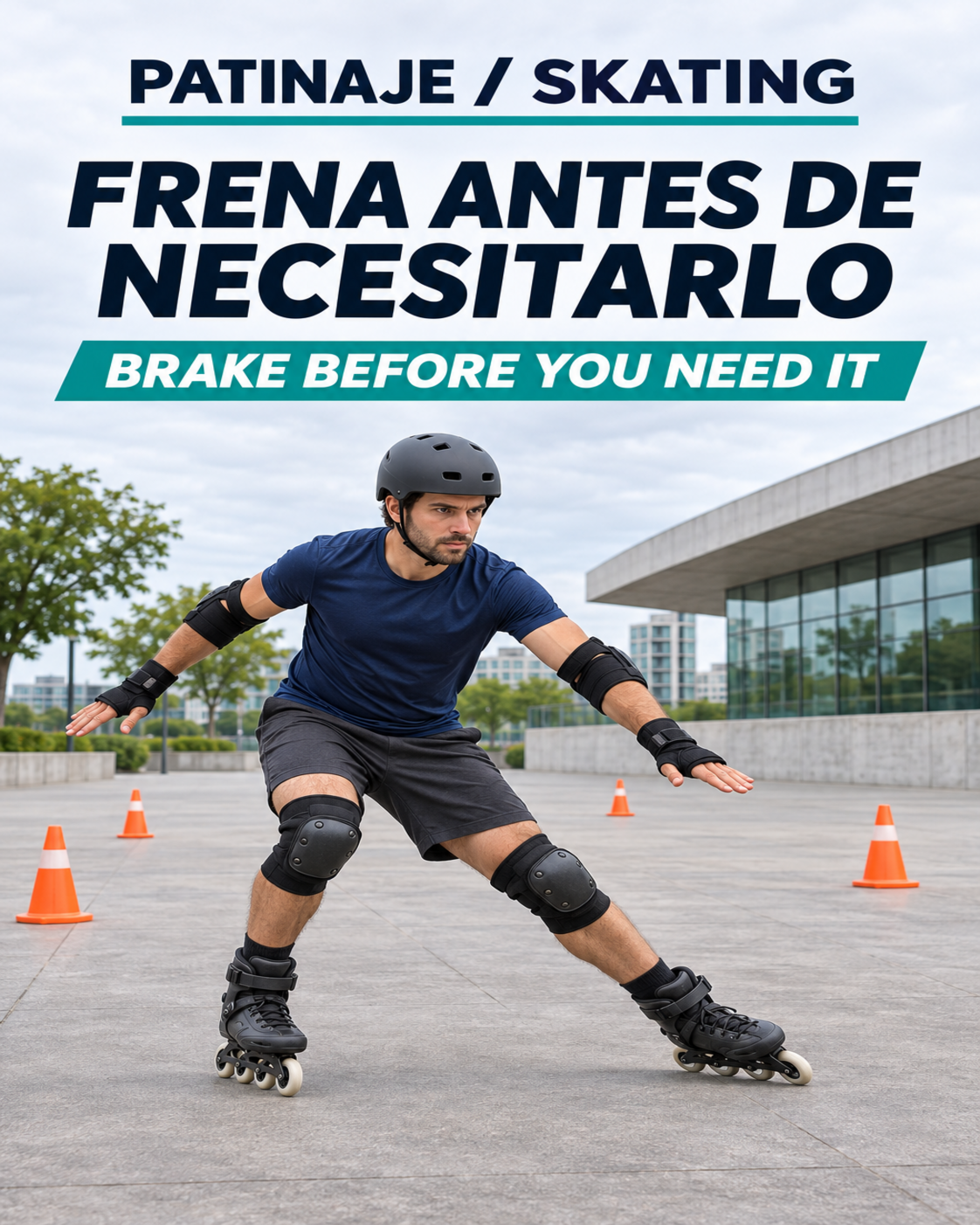
You can stop when you choose the moment. Uncertainty appears when something crosses ahead and you need an instant to decide. Before braking begins, you have already travelled some distance. A technique that works slowly without surprise is therefore not yet a reliable response in every situation.
Routine stopping and an emergency response
A routine stop is prepared: choose where to slow, organise support and finish with room. An emergency adds perception, decision and execution under pressure. Fatigue, slope, surface and people around you can reduce the available margin.
You do not need to create danger to practise that distinction. Rehearse simple decisions in a safe area, at low speed and with spare space. An agreed variation must never become an obstacle thrown in front of someone or an invitation to test the limit.
The aim is not to discover the speed at which you fail. Recognise controllable conditions, stop within a broad area and retain the ability to repeat without losing stability. If that is not possible, simplify the task.
What the available evidence says
A field study of inline skating documented braking difficulties and gaps in instruction among participants. It is an older observational study: its figures cannot be applied to all current skaters or used to choose one winning technique. It supports paying attention to instruction in basic control.
Research on knee flexion and impact attenuation examined skating on a treadmill and found changes in impact transmission at different knee positions. It did not study emergency stops or establish that greater flexion always shortens stopping distance.
The CPSC skating safety guidance recommends learning to stop, wearing protective equipment and using suitable surfaces without traffic. The progression here combines that guidance with cautious editorial recommendations; it is not an experimentally validated emergency protocol.
Lower your position without losing mobility
A position available for stopping includes comfortable knee and hip flexion, an organised trunk and support you can control. Lowering does not mean sitting so far back that balance disappears or bending only at the waist. You still need to direct pressure through the skates.
The precise position depends on technique, equipment and ability. Work on it with a qualified instructor before adding an unexpected cue. If a position forces you to lock the legs or spread your arms simply to avoid falling, reduce speed and return to a familiar task.
This is not instruction in an advanced manoeuvre or high-speed stop. Choose a stopping technique you already know and that suits your equipment. A heel brake, drag stop and lateral manoeuvre have different requirements; reading their names does not make them interchangeable.
Allow room to perceive and act
Total stopping distance begins before the wheels start slowing: it includes travel while recognising the situation and initiating the response. Good execution cannot recover space already spent on a late decision. More speed rapidly reduces the time available to interpret the surroundings.
There is no universal number of metres. Surface, slope, wear, wheels and technique alter the result. Observe your stop in a straightforward setting and leave a generous reserve beyond it. Never use a wall, kerb or person as the compulsory endpoint of an exercise.
Read the route early: crossings, entrances, pedestrians, dogs and places where somebody could appear without visibility. The most useful decision may be slowing before a junction or declining a slope. Good braking includes choosing situations that do not require a last possible response.
Prepare an area that allows mistakes
Find a permitted, level, dry, clear space without vehicles. Check for cracks, sand, water and obstacles. Wear suitable helmet and protection, check their fit and inspect wheels and brake condition. Protection can reduce particular consequences; it does not replace technique or spare room.
Define a start, a broad stopping zone and a clear exit. Keep cones out of possible fall paths and avoid unnecessarily narrowing the route. An observer belongs to the side at a distance, never directly ahead as a target.
Agree beforehand how to cancel an attempt. If somebody enters the area, interrupt the practice. Completing a repetition matters less than keeping the space clear. Check that you can also reach the area on foot without descending a slope you cannot yet manage.
Progress with room to spare
Start with a planned low-speed stop using your familiar technique. A stable finish with spare room matters more than stopping as close as possible to a mark. Repeat only while that quality remains and you feel comfortable.
With appropriate supervision, you may then vary the starting moment slightly within an agreed zone. A simple visible signal can train recognition and action without obstacles or extra speed. If the response becomes disorganised, return to the planned stop.
Increase one difficulty at a time, only when your instructor considers it appropriate. Do not combine higher speed, less space and fatigue to make practice “real”. One successful exercise does not demonstrate transfer to the street: the environment may demand decisions you have not practised.
Observe fatigue rather than deliberately creating it
If knees start remaining rigid, recovery steps appear or support takes longer to organise, finish the set. You do not need exhaustion to demonstrate that technique deteriorates. Practising a new response while losing control adds noise and risk.
A break provides time to reassess. If a clear stop still does not return, end practice. Pain, dizziness, unusual weakness or a fall mean stopping and considering professional assessment. After a significant impact or concerning symptoms, seek appropriate help rather than skating again to test yourself.
Consider the return journey as well. A good practice area is less useful if leaving it requires a difficult downhill route after your legs have tired. Arrange a simple exit or another way home before starting, so the final decision does not become a forced test of skill.
Common mistakes
Trying an advanced stop on a slope, practising between vehicles and removing space to force a reaction turn learning into exposure to danger. Wearing a helmet is not permission to increase speed without control of stopping.
Counting only your best attempt can mislead you too. A useful response needs comfortable repetition, known conditions and the ability to decline a situation. If stopping works only when everything is anticipated, keep building that foundation and use earlier decisions during outings.
Checklist before rolling
- Is the area level, dry, permitted and free of traffic?
- Does the technique suit my equipment and current ability?
- Is there room to decide, brake and retain a reserve?
- Can I cancel if someone enters the route?
- Are my legs still responsive and the finish stable?
- Am I increasing only one difficulty with suitable guidance?
Save the session in YouVisible with the conditions in which you controlled the stop. Recording surface, technique and spare space supports another practice; one successful repetition does not certify stopping ability on every street.