


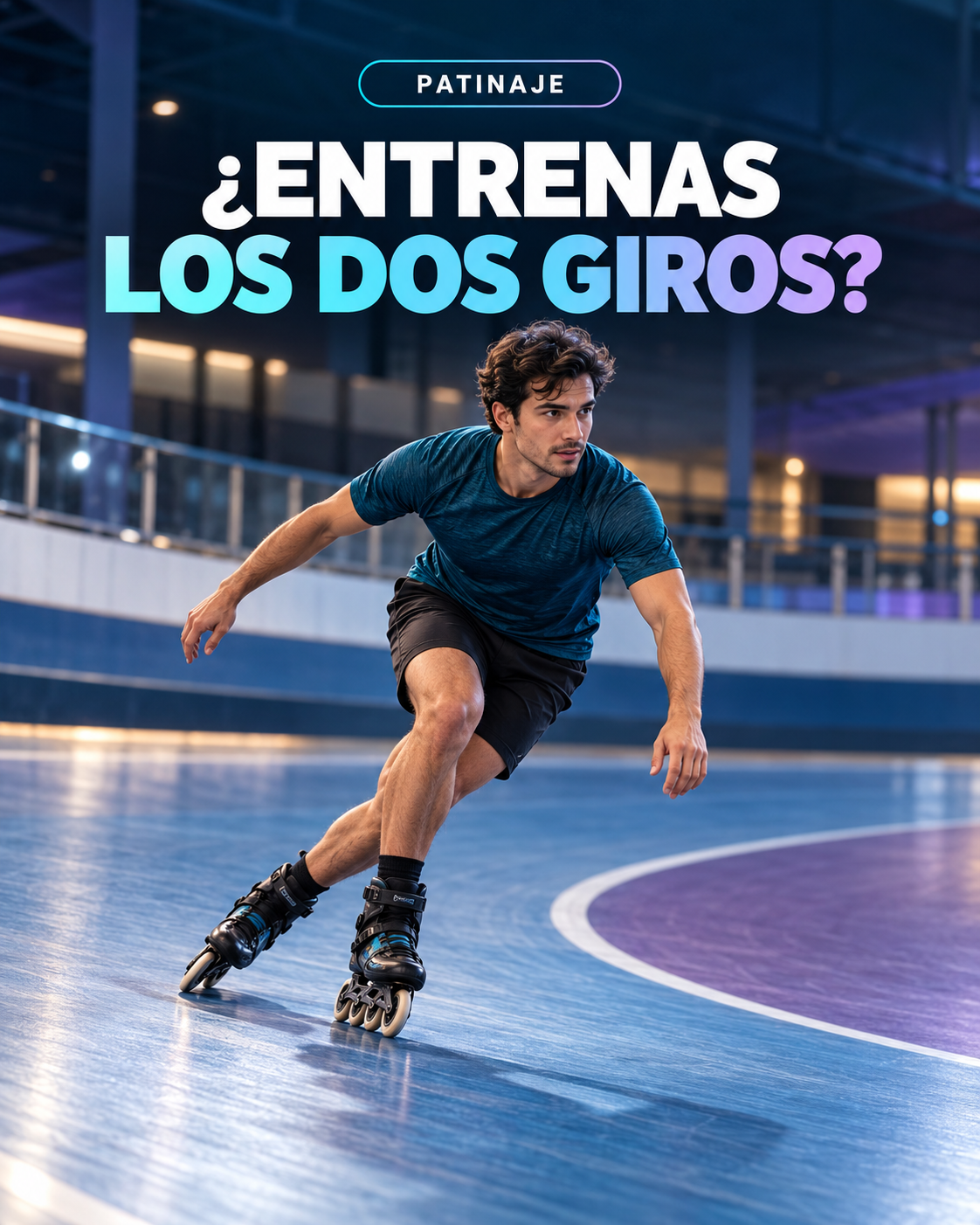
You turn left without thinking. Turn right, however, and you stand upright, slow down unintentionally and leave the foot that should cross stuck on the ground. You do not need speed to notice the difference: simply changing direction brings it out.
This experience does not prove that one leg is damaged. It may reflect accumulated practice, confidence or adaptation to your discipline. The aim is to expand your control, rather than turn your legs into perfect copies. Start by separating what the turn requires from what actually limits you.
Two legs with changing roles
The inside leg is closer to the centre of the turn; the outside leg is further away. Reverse your direction and they exchange positions. Your body lean, path and supporting feet must work together to keep you turning.
In a turn without crossovers, both legs can share support and guide your path, with differences depending on speed and technique. During a crossover, the outside leg passes in front of the inside leg and accepts weight; the inside leg can continue pushing underneath before recovering. Both can support and propel, at different moments. Saying that one pushes while the other only balances oversimplifies the movement.
Exact positions differ between wheels and blades, and between disciplines. Avoid forcing a knee angle or body lean simply because someone else uses it. When learning, notice when your weight transfers and whether you can recover your foot without interrupting the turn.
Asymmetry does not always need correcting
Repeating one direction gives each leg experience of different tasks. A stable preference that causes no discomfort and meets the demands of your sport can be a specific adaptation. An unfamiliar feeling on one side is also insufficient evidence of a strength deficit.
In Liu and colleagues (2024), twenty elite speed skaters showed technical differences between sides on the straight, without a significant association between asymmetry indices and overall performance. This does not establish that every difference is harmless.
Meanwhile, Jin and colleagues (2025) found associations between certain jump-test asymmetries and skating times in seventeen adolescent boys. They assessed different tasks in another population; their findings provide no diagnostic threshold for recreational skaters.
A reasonable interpretation is to consider each difference in context. The exercises below are a learning proposal; those studies did not test whether practising them prevents injuries. Pursuing compulsory equality could lead you to change effective supports or accumulate practice you do not need.
A familiar difference or a meaningful limitation?
Pay particular attention to these signs:
- A clear difference in control: you choose your path in one direction, while the other feels like simply trying not to fall.
- Being unable to sustain a glide: you immediately put the other foot down or need to keep pushing.
- Unintentional braking: the skate changes direction and slows you down as your weight transfers.
- Increasing local fatigue: one area tires progressively sooner and changes how you move.
- Persistent discomfort in an ankle, knee, hip or groin, during or after skating.
These are not diagnoses. Their progression, recent onset and impact on previously comfortable tasks matter. A less fluent but stable side deserves practice; a new loss of ability or increasing pain calls for stopping the task and considering help.
A 2023 study of nine short-track athletes observed differences in loading, muscle fatigue and sensitive points compared with controls. This small elite comparison does not demonstrate that turning one way causes injuries in every skater.
A simple assessment without devices
Find a flat, enclosed, dry, spacious area without traffic, where practice is allowed. Check your skates and fastenings, wear a helmet and appropriate protective equipment, and confirm that you can stop. Leave space to exit every turn. Assess yourself while rested, after some gentle rolling.
- Wide turns: make comfortable arcs in both directions at similar speeds, without crossovers. Notice whether you maintain knee flexion and direction or straighten up when reversing direction.
- Slow figure eights: link two generous curves. Observe whether one half becomes unintentionally tighter or you need to brake before entering it.
- Controlled crossovers: if you already know them, try a few in each direction. Otherwise, explore weight transfer without lifting or crossing your feet; learn crossovers with a coach.
- Single-leg gliding: on a straight line at low speed, briefly unload one foot and set it down calmly. Compare both supports without trying to stay up until you lose balance. Skip this task if it is not yet safe for you.
Compare control, confidence, continuity and discomfort, rather than repetitions or seconds alone. “Right: looking down and dropping the foot abruptly” tells you more than “right: three attempts”. Check whether order or tiredness explains part of the difference; you can start with the other direction in a later session.
Keep turn size and speed comparable. A small, fast turn and a large, slow turn are different tasks. One observation can guide practice, but it cannot identify an injury or decide which muscle needs treatment.
A small addition to your warm-up
Introduce these tasks after your gentle initial warm-up. Choose only those you can control and finish before fatigue makes your execution worse. There is no universal duration: a short, clean sequence is enough to begin with.
- Progressive figure eights: start very wide and slow. Link both directions while looking towards the exit; reduce the space slightly only while you remain relaxed.
- Turns without crossovers: learn the less familiar support without adding the crossing step. Keep your knees comfortably bent and avoid turning your shoulders alone.
- Slow crossovers: add one familiar crossover, regain a stable position and repeat once you have control. Build continuity before chasing speed or tighter curves.
- Braking and exiting both ways: use a stop you already know; stop, reorganise your feet and set off on a gentle curve towards each side. This does not mean suddenly learning a new sideways stop.
- Basic single-leg work off skates: wearing stable shoes with support nearby, practise sitting down and standing up with more load through one leg, low step-ups or heel raises. Adjust the range and use assistance when needed; avoid jumping to prove equality.
Initially, alternate a familiar task with a less practised one. If the opposite direction makes you stiffen up, widen the turn or return to two-foot support. Progress one challenge at a time: continuity, turn size or speed. You can give the less familiar direction extra attention without making it a punishment session.
In Bongiorno and colleagues (2023), three competitive roller skaters showed differences between sides in fatigue resistance during a static muscle test. This exploratory work does not validate this warm-up sequence or let you infer your muscle fatigue from particular sensations.
Adapt practice to your discipline
Recreational skating: prioritise wide curves, direction changes and a safe exit. Choosing a calm path is more useful than linking impressive crossovers. You do not need to cross your feet to begin expanding your options.
Inline skating: learn to transfer weight without unintentionally turning out the skate receiving it. Use generous arcs and ask an instructor about your positioning if braking always happens at the same moment. Avoid changing your wheel setup to compensate without advice.
Artistic skating: distinguish these basic exercises from the specific rotation directions, jumps and entries in your programme. Work on support and travelling skills with your coach; avoid reversing complex elements to achieve equivalence or sacrificing an established entry.
Speed skating: preserve discipline-specific technique and preparation priorities. A supplementary low-speed task can expand your options, but it does not require splitting competitive training equally between directions. Agree its place with whoever leads your session.
Do not practise against the designated direction on a regulated track or during an organised session if it interferes with circulation or safety. Find an authorised place and time for bidirectional exercises; avoid skating against the group even when your intention is to “balance things out”.
Mistakes that get in the way
Speeding up to overcome fear usually reduces your margin for correction. Leaving every difficult attempt until the end confuses unfamiliarity with tiredness. Forcing identical positions on both sides can hide necessary differences between tasks.
Labelling one leg “bad” without checking what happens is another trap: perhaps you support your weight well but hesitate during recovery. Change one specific cue, such as looking towards the exit or widening the arc, then observe again. Avoid correcting five details simultaneously or accumulating increasingly poor crossovers.
When to stop and seek help
Stop the exercise if you experience sharp pain, giving way, loss of control or increasing discomfort. Avoid trying to solve it by repeating more on the difficult side. If you cannot bear weight, develop substantial swelling after a fall or have severe pain, seek prompt medical assessment.
A coach can help with fear, trajectory and weight transfer. A physiotherapist or healthcare professional should assess persistent discomfort, recurrent local fatigue or loss of function. Bring a description of the task and when the problem appears; you do not need to attribute it to a particular structure yourself.
Scientific sources
- Comparative study: 2023, loading and fatigue in elite short track; PMID 37700332.
- Observational study: Liu et al. (2024), technique asymmetry and 500 m performance; PMID 39329641.
- Observational study: Jin et al. (2025), asymmetries and performance in adolescents; PMID 40443450.
- Exploratory study: Bongiorno et al. (2023), fatigue resistance in roller skating; PMCID PMC10077145.
Your next session
In an authorised space, start with wide turns and a slow figure eight through both directions. Then choose one task you can repeat calmly and finish by noting which direction retained better control. The aim is to have more options on skates while respecting the useful adaptations of your discipline.