


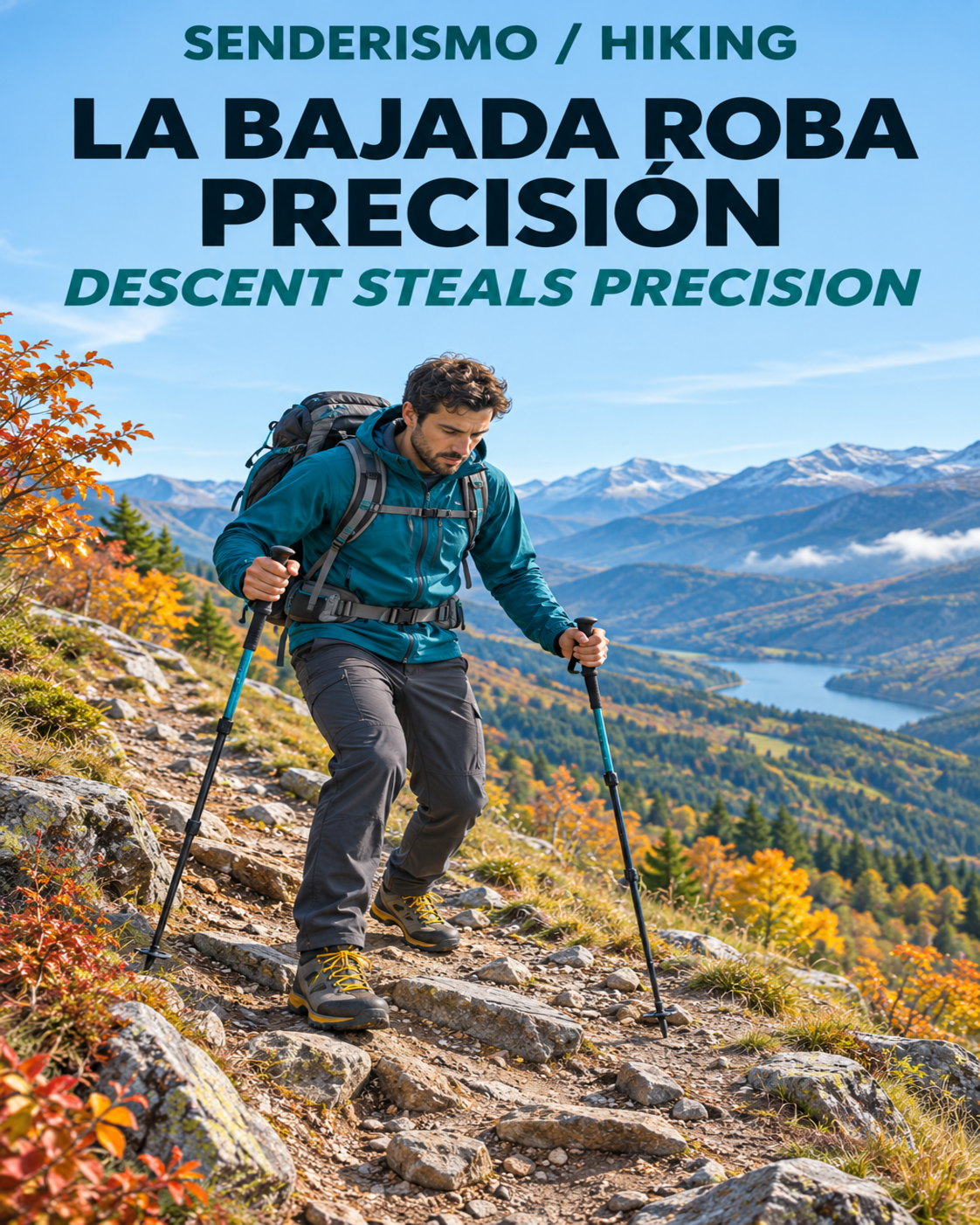
The stone has not moved. What has changed is that your boot no longer lands exactly where you intended. You were breathing hard on the climb; now you can talk, yet you catch small rocks and need an extra step after each ledge. That difference deserves a decision before the next difficult section.
Going downhill still means working
During descent, leg muscles brake while lengthening under load: eccentric work. Easier breathing does not make that work disappear. A long descent repeats the braking action many times, particularly when a large step requires you to absorb a substantial drop in body height.
A study of sensorimotor control after simulated downhill walking found changes in leg dexterity and forward-backward balance without a corresponding reduction in maximum leg extension strength. That distinction matters: retaining the strength to push does not prove that precise foot placement is intact. The laboratory protocol involved young, healthy participants; it cannot tell each hiker how many minutes of descending are safe.
Our practical interpretation is an editorial recommendation: watch placement quality as well as tiredness. You do not need to reproduce the researchers' tests or wait until your legs feel empty. A descent you have the strength to finish may already be using more coordination than you can comfortably sustain.
Three changes you can notice
First, your foot lands close to the intended spot rather than on it, and you correct after loading it. Second, your toes start catching small obstacles that caused no trouble earlier. Third, an ordinary step down requires additional steps to regain balance.
One loose stone can explain an isolated stumble. Repeated errors on similar ground are a reason to reassess your pace. Late decisions matter too: finding the next foothold only as you fall towards it, automatically following another walker or looking away because the path seems easy.
Do not attribute every error to muscle fatigue. Light, footwear, mud, hunger, distraction and terrain difficulty all affect the task. Recognising a reduced margin is more useful than identifying one definitive cause while you are still moving.
Shorten the step without becoming rigid
Choose nearby footholds that let you transfer weight with control. A very long step can demand abrupt braking and leave little time to solve a balance problem. Shortening your stride does not mean dragging your boots: keep enough clearance and check that the chosen surface is stable.
Keep your knees available to adapt. Avoid descending with locked legs, sitting far back or chasing somebody else's cadence. Slope, grip and mobility matter more than a universal posture. If a drop exceeds what you can manage comfortably, choose a permitted alternative or ask for assistance before committing your weight.
On technical ground, reduce conversation and leave enough space to see. Watching the boots ahead restricts your options. Stop somewhere stable before checking the map, adjusting your backpack or enjoying the view; all those activities compete with attention to foot placement.
Poles add support, not permission to rush
In a study of mountain walking with trekking poles, pole users showed smaller changes in some markers of muscle damage and better preservation of certain functional measures after the hike. That does not establish that any pole prevents injuries, or turn the findings into an individual guarantee.
Another study examining downhill walking with external loads found reductions in several lower-limb mechanical demands with poles. Those are biomechanical outcomes, not proof that poles prevent falls on every trail.
As general guidance, use them only if you can place them without tangling your steps. Check the security of the tip before relying on it, and keep other walkers' space clear. Where rock requires the use of your hands, secure the equipment before entering that section. If your poles repeatedly strike each other, coordination or available space may be the issue: stopping is more useful than persisting.
Pause before the stumble
Choose a wide, stable place away from passing walkers. Put down your pack if safe, eat or drink according to your needs and notice how you feel. A short pause may restore attention; it does not automatically erase accumulated muscular loading.
Restart with a few straightforward steps. If you still need frequent corrections, slow further, rest longer or consider a safer way out. Do not treat the first good step as proof of complete recovery. Assessment continues throughout the descent.
In a group, agree on breaks before spreading out. The slowest descending walker should not use the entire rest period catching everyone else. Wait somewhere they can actually stop, and leave enough room to assist without pushing them to adopt your pace.
A decision you can make on the trail
Imagine a descent that begins on a broad track and later reaches stone steps. On the track, your toes catch twice. You have not reached the hardest section yet: this is the time to stop, check your equipment and tell the group.
You then restart with shorter steps. If placement improves, keep that pace as you approach the stones. If it deteriorates again, decide before entering the steps. Check a genuine route alternative, ask the leader for support or reorganise the outing. Do not improvise shortcuts off the trail to save a few minutes.
Return planning includes daylight and available time. A small reserve encourages rushing precisely when you need more accuracy. Before climbing, consider how much descending remains, where the difficult sections are and what option exists if the group takes longer than expected.
Errors that spend your remaining margin
Accelerating because the finish is near, jumping down ledges to save time and copying the most skilled companion all increase demands when you may already be correcting too late. Using unfamiliar poles for the first time on a difficult descent adds another task at an unhelpful moment.
Next-day soreness is not the only useful measure of what happened. Safety decisions depend on your control during the descent. Pain that changes your walking, unusual dizziness, weakness or a fall mean stopping and considering qualified help; severe symptoms need immediate assistance.
Checklist before the next section
- Am I placing my feet where I choose, or correcting afterwards?
- Can I see the ground with enough space from the group?
- Do my steps allow controlled weight transfer?
- Are my poles helping, or creating extra obstacles?
- Is there a safe place to rest before technical ground?
- Do daylight, time and the group's condition support continuing on this route?
Afterwards, record in YouVisible where your precision began to change and which decision helped. That context can inform another outing with more room to spare, without turning downhill walking into a speed contest.