


Executive summary
An artistic gymnastics final becomes easier to understand when you separate what a routine attempts from how it is performed. Difficulty attracts attention, but a sequence also has shape, amplitude, continuity and a finish that requires control. Its most striking element cannot explain the entire result.
Dakar 2026 offers a chance to practise richer observation, especially as a family. The purpose is not to turn spectators into judges or teach children to attempt elements. It is to describe quality without judging bodies, guessing pain or reducing a performance to a landing step. These suggestions concern watching and conversation. Technical practice belongs in a supervised setting, with appropriate teaching and progressions rather than imitation of a television highlight.
Official information: Games dates and finals differ
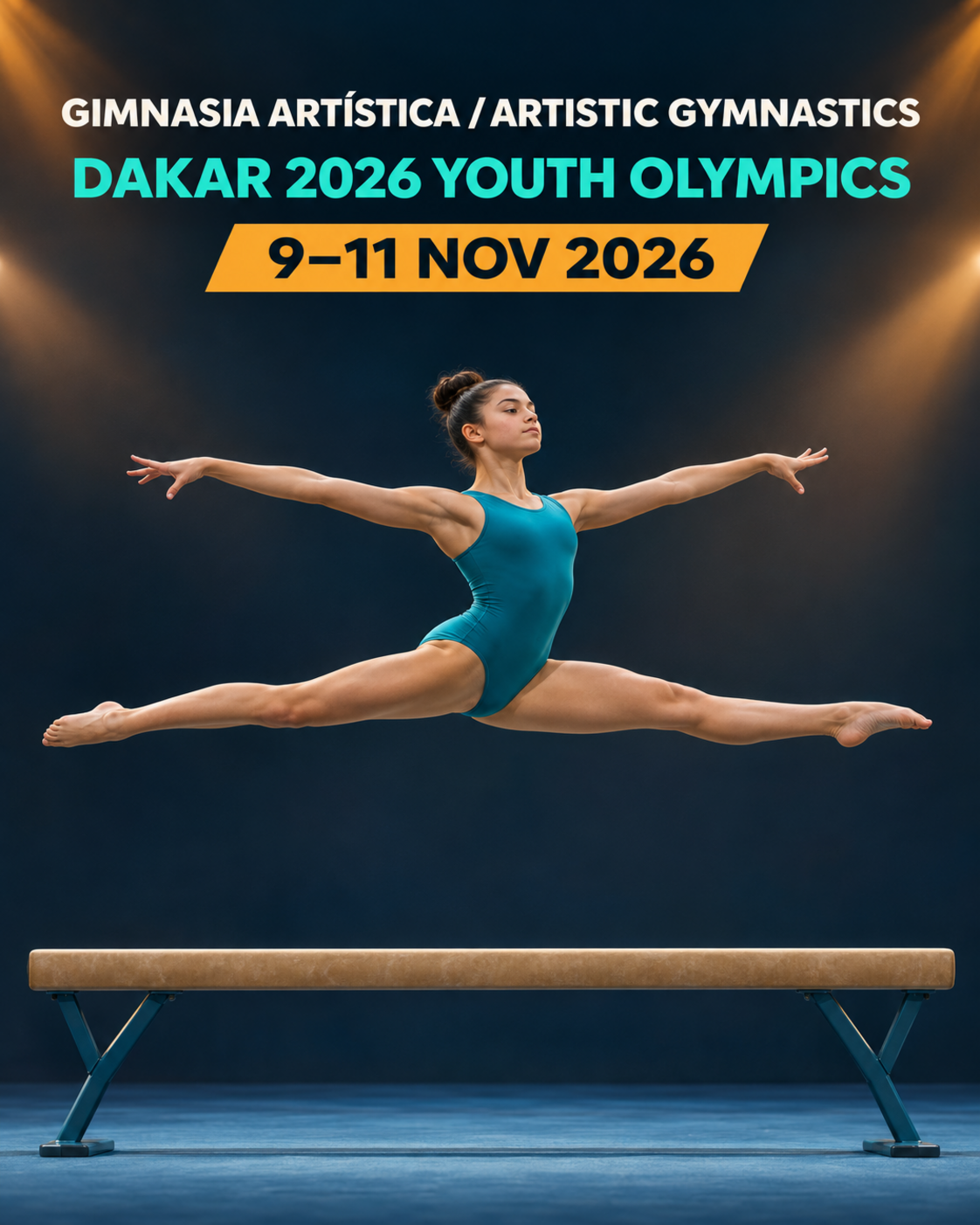
Information checked on 07/11/2026. The official World Gymnastics listing for event 18178 identifies Dakar and displays the wider Games period. Section 9 of the official Dakar 2026 rules gives a provisional programme of team finals on 9 November, all-around finals on 10 November and the mixed team final on 11 November.
The World Gymnastics live schedule could not be retrieved during this check. We therefore do not present session times as confirmed. The rules support the days and format, but organiser updates still need checking. General Games dates are not individual final dates. Spectator access is also separate from sporting entry, which is managed through official bodies rather than open recreational registration.
Difficulty and execution answer different questions
Difficulty describes part of a routine's content; execution assesses how it is performed under the applicable code. You do not need to memorise element values to understand that a more difficult proposal does not guarantee a higher final score. Penalties and specific requirements may also matter in ways that an isolated image cannot resolve.
Ask two separate questions: what demand does the sequence appear to present, and what control is visible in performing it? Avoid calculating exact deductions from the stands. Perspective, speed and missing technical details can mislead. For deeper study, use World Gymnastics' official rules with a coach's or judge's explanation, without treating your estimate as a correction to the official score. Observation can be valuable without pretending to provide full adjudication.
Body shape: describe actions rather than evaluate bodies
Watch whether a position is recognisable and how it changes between elements. Discussing an arm, leg or alignment during a particular action does not require comments about weight, size, maturation or appearance. Useful conversation concerns what the movement does, not the body a young gymnast supposedly needs in order to belong in the sport.
At home, ask which part of a sequence was clearest or where an adjustment appeared. Avoid making physical appearance a condition of sporting value. Execution is learned through technique and context; spectators do not need to compare physiques to appreciate precision. A still photograph also cannot represent an entire sequence performed at speed, with positions that change through each phase. Keep descriptions tied to the action actually visible.
Amplitude: consider movement and apparatus together
An action may show space, height or range even when you do not know its name. Watch its relationship to the apparatus and to the elements before and after it. Do not compare amplitude across different disciplines as though they presented the same task.
Camera angle matters. A frontal shot may conceal travel, while a distant perspective can compress height. Before declaring that an action was smaller, acknowledge what the view allows you to see. An official replay can clarify continuity and position without enabling an exact score from one frame. Missing visual information does not need to be filled with a confident conclusion. The best learning question may simply be what another angle would reveal.
Continuity lives between the major elements
Follow a whole sequence. Notice whether transitions create a clear thread or whether visible reorganisation precedes the next element. A pause may have a purpose within the routine; not every apparent stop demonstrates an error.
The question is how action connects, rather than how many spectacular moments you remember. Choosing one transition in a family review draws attention to work often omitted from highlights. For a young gymnast, that conversation may become a question for their coach without creating an obligation to imitate world-level content. Recognising a quality is useful learning. Attempting an element because it looked brief on screen is a different and inappropriate response without the necessary supervised preparation.
Landings: watch preparation, reception and exit
A step is visible and easy to discuss, but it does not summarise the whole routine. Observe how the airborne phase ends, what adjustment follows contact and how position is recovered. Do not infer injury or absence of pain from the image. Health cannot be diagnosed from the stands.
Avoid presenting a motionless landing as an instruction to be achieved at any cost. Technique and safety require professional teaching and suitable progressions. This guide does not teach a rigid reception or encourage enduring discomfort to finish. Spectators can appreciate control and recognise a correction without turning it into a judgement about courage, commitment or personal worth. A considerate explanation separates what the action shows from what it cannot tell us about the athlete.
The mixed team final changes what to follow
The official rules define a mixed team competition with rounds. It should not be confused with a collection of individual apparatus finals. To understand it, establish which round is taking place and how the result is determined under the current document.
Follow a team sequence before comparing isolated performances. A score belongs to the context of that phase. We do not invent final team composition, selection tactics or medal predictions. The rules describe the framework; actual lists and decisions require event information. Mixed format alone does not reveal the exact combination you will see at any moment. Use the official display and explanation to keep track rather than assuming that a familiar format from another competition applies unchanged.
Talking with a young gymnast
Ask what caught their attention and what they would like to understand. If they focus on a landing, you can widen the discussion towards preparation or continuity. If they prefer enjoying the final without analysis, that is also a valid way to watch.
Avoid comparing their level with the Games or normalising continued performance through pain because champions supposedly do so. We do not know the internal situation and should not turn it into a lesson about sacrifice. Elite sport can encourage curiosity without setting a deadline for learning elements or making the next training session an examination of what was seen. A young person's own questions can guide the conversation more constructively than an adult's list of corrections.
Common mistakes and observation checklist
Typical mistakes are ranking routines only by difficulty, assigning deductions from incomplete views and interpreting every pause as lost confidence. Another is planning for a specific final using general Games dates or assuming a provisional timetable cannot change.
- I have checked which final and day I want to follow.
- I will consult the updated schedule before relying on a time.
- I will separate difficulty, execution and the official result.
- I will watch a complete sequence, including its connections.
- I will describe actions without comparing bodies or guessing pain.
- In the mixed final, I will identify the round and team context.
Official sources and a learning record
Use the World Gymnastics event listing, Games rules and live programme, checking last-minute changes with the organiser.
Record your own gymnastics activity in YouVisible and share an authorised, supervised moment that explains a quality you have worked on. Respect broadcast and image rights; you do not need to republish a final to describe what watching it taught you. A note about continuity or control can preserve the learning better than another comparison of difficulty.