


Executive summary
A kilometre has no fixed cost in cross country. Two laps can cover the same distance yet demand different decisions when the footing changes or a group forms ahead of a turn. Defending your watch pace through every section may spend effort where extra speed is expensive, leaving little reserve for ground where you could otherwise run freely.
Soria offers a useful setting for studying another approach: distributing effort according to terrain, position and the ability to accelerate again. This guide helps you read those decisions. It does not prescribe a universal pace or predict mud. Actual conditions will depend on the day, and a race preview cannot establish how the surface will behave underfoot.
Official event information and remaining checks
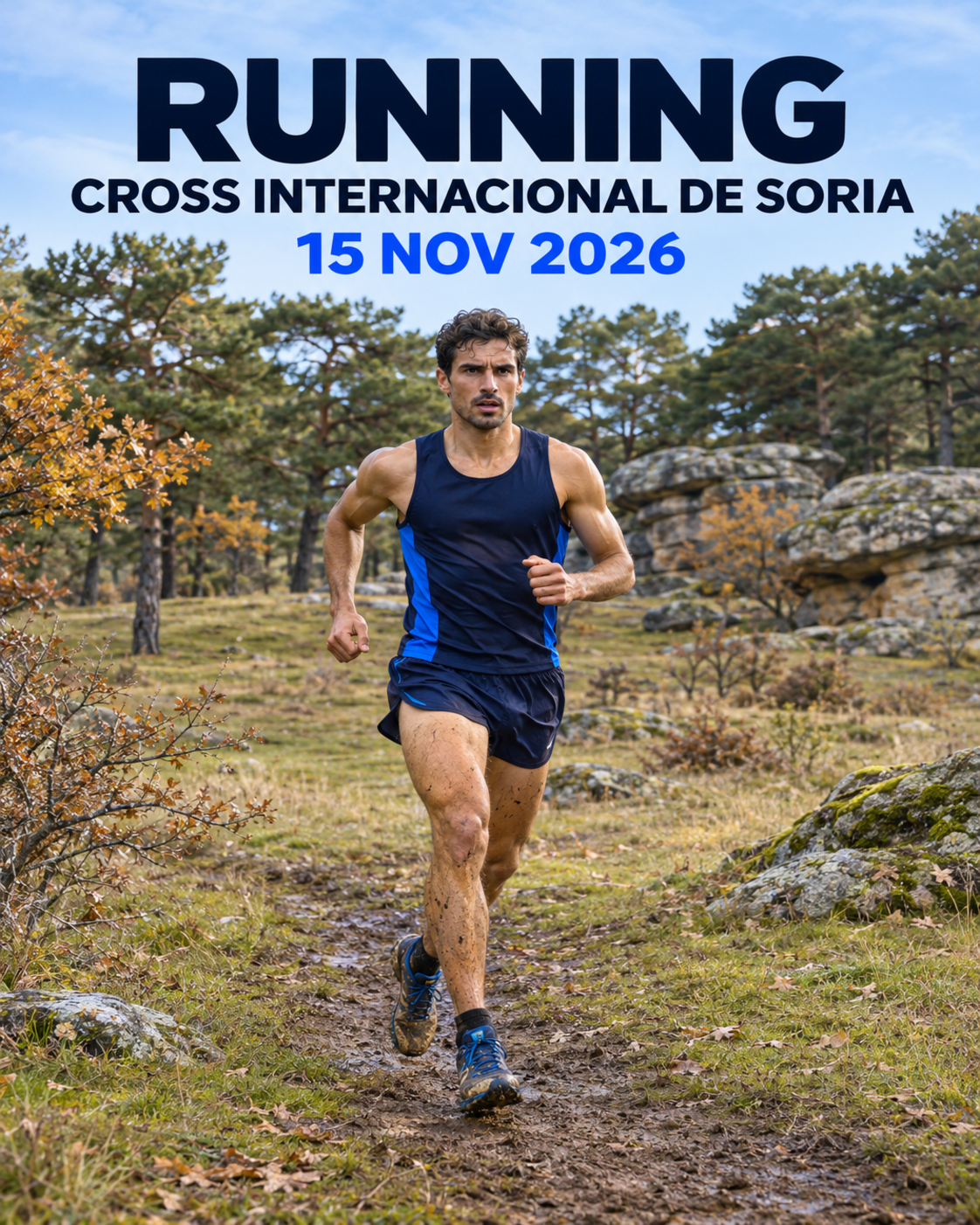
Information checked on 07/11/2026. The World Athletics calendar for 15 November lists the 32nd Campo a Través Internacional de Soria, at Monte Valonsadero, as a Cross Country Tour Gold meeting. The calendar confirms the event, not every participation detail.
Check the official organiser's programme, access arrangements, race categories and entry conditions before travelling. An international field does not mean every race has open registration or uses the same distance and start time. The following advice is editorial analysis of cross country. It is not an advance inspection of the course surface or a claim about confirmed athletes.
Divide a lap by decisions rather than equal distances
Permitted reconnaissance helps identify where the task changes. That might be a narrow bend, uncertain footing or a climb whose exit tempts you to accelerate too soon. Choose a small number of meaningful points and remember entry, decision and exit. A few clear references are more useful than memorising every metre without knowing which part affects your race.
At each point, ask what you need to preserve for the next one. A fast entry may force braking inside the turn. A slightly less advanced position with more room may produce a better exit. There is no fixed answer. The useful habit is connecting a choice with its consequence, rather than judging it solely by the kilometre split displayed afterwards.
Grip: adapt before you slide
Inspect the ground from permitted areas without interfering with another race. Grass may conceal unevenness, and a firm-looking patch can change after many runners have crossed it. The most heavily used line is not automatically the most dependable. Equally, searching for better ground does not justify leaving the course boundaries.
Footwear decisions must follow the rules and actual conditions. There is no universal spike length for this event: suitability depends on the ground, permitted equipment and the runner's experience. Test any changed setup in an appropriate setting beforehand. Race morning is a poor time to discover that unfamiliar traction changes your movement more than expected. Ask your coach or the relevant event official when uncertain about equipment or restrictions.
Turns: judge the speed you can use afterwards
Watch a group through the whole sequence, not just at the apex. Who must correct their line? Who keeps space? Who leaves with their first steps already directed towards the straight? The shortest route may lose its advantage when it ends behind runners who are slowing.
For recreational racers, the practical recommendation is to arrive with room to adjust and avoid cutting abruptly across another runner. Moving forward before a bottleneck can be valuable, but the required surge may cost more than it returns. If there is no clear, safe opening, holding position briefly may be wiser than forcing a pass that ends in heavy braking. The exit tells you more about the choice than the appearance of aggression on entry.
Short climbs continue beyond the crest
It is tempting to follow the first athlete who accelerates up a rise. Look at what happens afterwards. Reaching the top with no capacity to link the next steps can make a small gain expensive. A useful goal is to crest while still able to reorganise, rather than reaching the highest point at the greatest possible effort.
You can observe this without laboratory measurements. Look at continuity in the first steps after the climb, the space a runner keeps and how quickly attention returns to the ground ahead. Discuss these sections with your coach during established training on familiar terrain. Do not add last-minute maximal efforts simply to prove that you understand the tactic. Preparation and race-week experimentation are different tasks.
Descents: restore control before chasing seconds
A descent offers speed but does not guarantee recovery. If tension rises, every landing becomes another correction. A good choice leaves you able to select the next step and hold your line within the course. A faster number on the watch does not establish that the section was well managed.
Do not copy an elite athlete's stride from behind the barrier. Their capabilities and reading of the ground differ from yours. If the slope carries you faster than you can control, reduce your ambition for that section. A stable exit may let you run better immediately afterwards. When spectating, compare entry and exit; the most dramatic-looking runner halfway down is not necessarily the one who retains the most options at the bottom.
Position: a group can impose its own cost
A group provides references but may hide the surface and require repeated changes of speed. Assess whether you can see enough ground and react without contact. A useful position changes as the course approaches a turn, a narrow passage or a wider straight.
Separate observable decisions from imagined intentions. You can say that a runner moved forward before a bend. You cannot know that they were exploiting a rival's weakness unless that information has been published. Learning from elite racing works best when you describe actions and outcomes, rather than treating a broadcast as evidence of somebody's thoughts, fatigue or private race plan. Uncertainty is part of a careful observation.
Common mistakes and an observation plan
Typical mistakes include chasing road pace, answering every pass and treating every downhill as rest. Another is blaming a poor lap entirely on fitness without considering traffic or footing. Dividing the race into meaningful sections makes the review more precise.
As a spectator, choose a permitted position with a visible approach and exit, then watch several laps. Compare where gaps open and where they close. Stay in spectator areas and never cross the racing line to improve your view. As a runner, use only authorised reconnaissance times and spaces. The event's safety arrangements matter more than completing a personal tactical analysis from every possible angle.
Checklist for racing or watching well
- I have confirmed my particular race and its official conditions.
- I know where a decision must happen before an acceleration.
- My footwear is familiar and meets the applicable rules.
- My effort reference can adapt; it is not a compulsory pace.
- I can distinguish uncertain grip, traffic and excessive effort.
- I will examine both entry and exit before judging a decision.
Official source and a useful race record
Revisit the World Athletics calendar and official organiser communications for last-minute changes. Gold status does not replace access instructions or an individual race programme.
Record your activity in YouVisible with a moment that explains a choice: waiting before a turn, preserving reserve over a rise or adapting to different footing. Respect other people and the event's image rules when sharing. One specific observation helps turn Soria into a lesson without prescribing the same kilometre pace for everyone.