


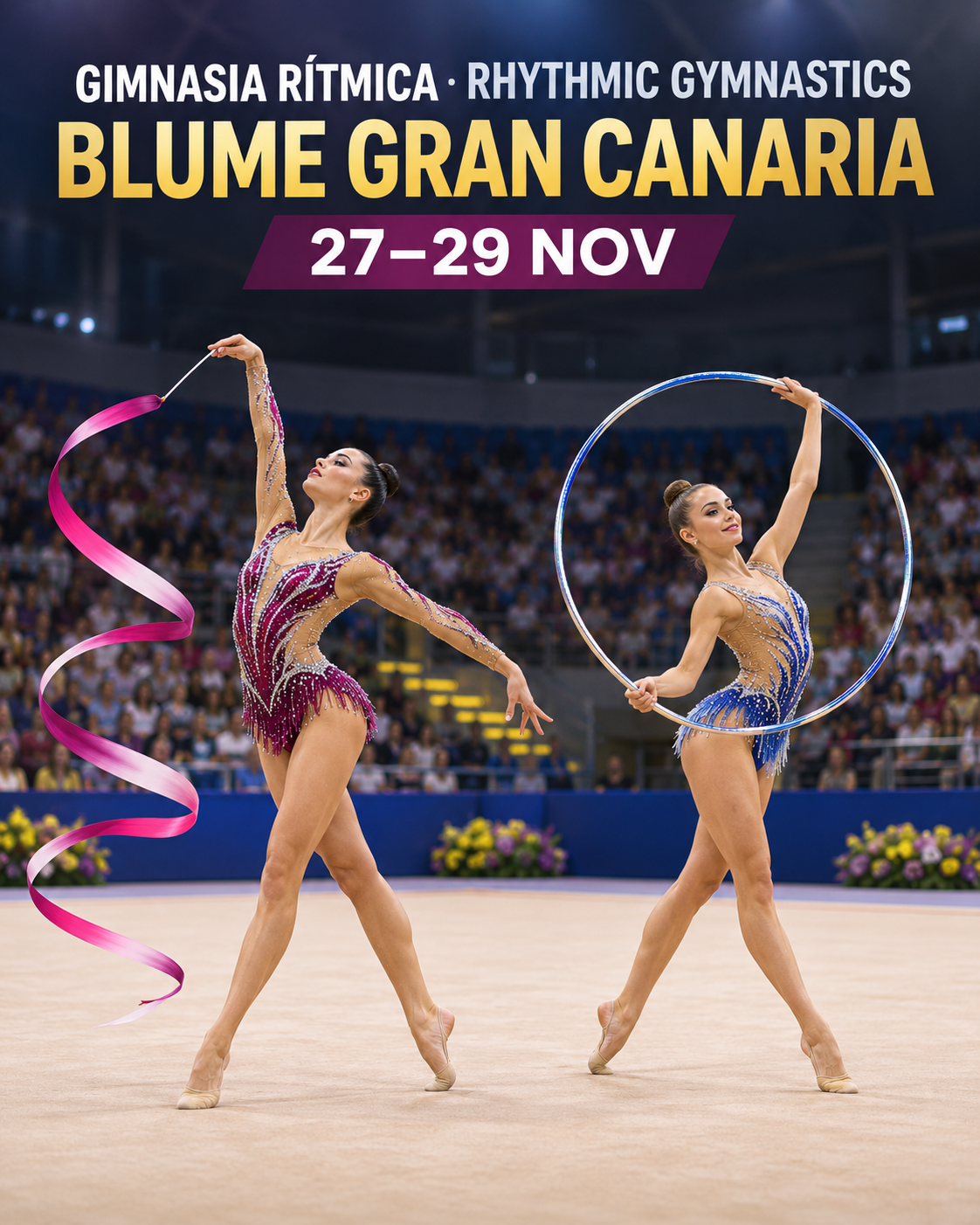
A ribbon drawing shapes in the air attracts attention immediately. Understanding its place in a complete routine also means watching body movement, music and continuity. When a group follows, the question changes again: what each gymnast does matters alongside the relationships between them. The Blume Cup offers a way to explore both perspectives without turning a visit into a scoring lesson. A little structure can make the spectacle easier to follow.
Verified dates and inconsistent programme versions
Sources checked on 16/11/2026. The Blume Gran Canaria rhythmic page places training on 27 November and individual and group competition on 28 November, with competition at Polideportivo Jesús Telo, Las Palmas de Gran Canaria. Its linked official bulletin includes Friday accreditation and training at San Fernando, Saturday competition and festival participation on 29 November.
A single final timetable is not established: the website gives 15:00 for groups, while the PDF directives say 14:30 and other tables differ. The bulletin also retains Gran Canaria Arena references alongside Jesús Telo. Use Jesús Telo as the venue in the specific directives, but reconfirm venue and block with the organiser. Those inconsistencies should not be treated as resolved when arranging travel or a precise viewing time.
Follow an individual routine as a continuous relationship
In an individual exercise, watch how one gymnast links body movement and apparatus handling. Instead of waiting only for the highest throw, follow a complete phrase: preparation, action, recovery of the apparatus and continuation. This reveals what a still image cannot show and helps explain why a seemingly modest movement may matter within the whole routine.
Our approach is an accessible editorial guide, not a translation of the official score. We do not assign technical values or certify criteria from a distant view. If accompanying a gymnast, ask afterwards what they intended within the programme. Their explanation may reveal a musical connection or challenge that went unnoticed from the stands. Listening to that account adds context without requiring you to decide whether every element met a rule you have not studied.
Body difficulty is not a flexibility contest
Balances, turns and jumping actions may attract attention through their shapes. Watching body difficulty should not become a comparison of range or appearance. Notice the approach to a position, retained control and the exit towards the next action. Sequence matters for understanding, alongside the instant that first draws your eye. The preparation may explain why the action seems smooth or demanding.
With children, avoid framing the visit as a search for an ideal body for the sport. Talk about precision, learning and expression without comments about weight or personal comparisons. Do not suggest copying difficult positions in a corridor or at home. Technical practice requires suitable conditions and supervision, while a competition image does not show the preparation behind it. Admiration can remain thoughtful without becoming a request that someone immediately reproduce what they have just watched.
Apparatus trajectories begin before release
With hoop, ribbon or another apparatus, observe direction, continuity and the relationship to travel. A throw does not begin only when the object leaves the hand: preparation and positioning come first. Catching is not necessarily the end where another movement follows immediately. Tracking that path gives newcomers a clear thread even without knowing technical element names or the intended content in advance.
Do not equate throw height with overall quality. Some coordination demands are less obvious from a distance. If the apparatus is lost, watch how continuity returns rather than reducing the whole performance to the error. You do not need to guess an exact deduction to appreciate the need to reorganise and maintain attention under pressure. A complete view leaves room to recognise recovery as well as a disruption, instead of treating one moment as the only thing worth remembering.
Risk includes preparation and the way out
The word risk often brings spectacular moments to mind. Spectators can instead notice what must coincide: apparatus path, body orientation, timing and available space. We do not claim every striking throw is a recognised risk element or provide a formula for judging it. That requires the applicable rules and officials' assessment, not just an impression from a seat.
A practical way to watch is to follow the whole sequence and describe what made it understandable. Was the preparation clear? Did the apparatus arrive where expected? Did the following action retain continuity? These questions support enjoyment and discussion rather than execution advice. They do not justify requesting extra attempts from a younger gymnast after competition to recreate a photograph. The visual appeal of a movement should not obscure the effort, learning and conditions behind it.
Open your attention when groups perform
Following only one gymnast means missing important relationships. Alternate a broad view with attention to one particular sequence. Notice whether formation changes create space, how paths cross intentionally and how actions depending on other people are coordinated. Much of the interest exists between performers, so allow your gaze to move beyond a familiar individual.
A collaboration is not understood merely by counting simultaneous individual actions. Ask how one action makes another possible and who needs to coordinate. Different seats reveal different relationships; a partial view should not become certainty about the entire exercise. An impression of disorder may change once you recognise the pattern organising arrivals, exits and encounters. You may also find that a broad view explains an individual decision that initially seemed surprising while watching only one person closely.
Synchronisation and music allow variation
Coordination does not always mean identical movement at the same instant. A routine may alternate unison with successive actions or contrasts between parts of the group. Watch whether changes relate recognisably to the music and whether a shared reference returns. Before interpreting a difference as an error, look for an idea that repeats across the programme.
Music also helps explain intensity, pauses and continuity. You need not agree on a single interpretation of what a piece communicates. Comparing observations with relatives can enrich the visit where comments concern specific moments and remain respectful. Avoid turning every conversation into an informal ranking of children or clubs. Learning can happen without a continuous verdict, and people may notice complementary details rather than compete to give the most authoritative account of a performance.
Plan around venues and blocks
Training and competition are separate programme activities; do not assume identical admission or the same hall. Confirm your block, current address and spectator conditions. Delegation package tariffs are not automatically general admission prices. We also do not guarantee transport, facilities or unrestricted access because the competition belongs to a festival. Ask about the particular arrangement you need rather than transferring information between categories.
If travelling with athletes, follow club instructions for accreditation, reporting and preparation. Independent spectators should request visitor information instead of relying on a delegation timetable. Allow margin for travel and breaks and remember that Gran Canaria times are local. A satisfying visit need not include every block. Choosing a manageable part of the programme may leave more attention for what happens on the floor and more flexibility if the organiser updates a schedule.
What remains beyond the scores
Afterwards, ask the participant which part felt best and what they want to remember before discussing results. A placing summarises competition under its rules; it does not summarise effort or prescribe the personal experience someone should take away. Allow each person time to talk on their own terms.
Through YouVisible, share a more informed view of individuals and groups: an apparatus relationship you discovered, how a collaboration became clearer or which practical arrangement helped the visit. That context makes rhythmic gymnastics accessible to other families and fans without turning attendance into a search for mistakes or imagined scores. Understanding can be a worthwhile result of the day too.