


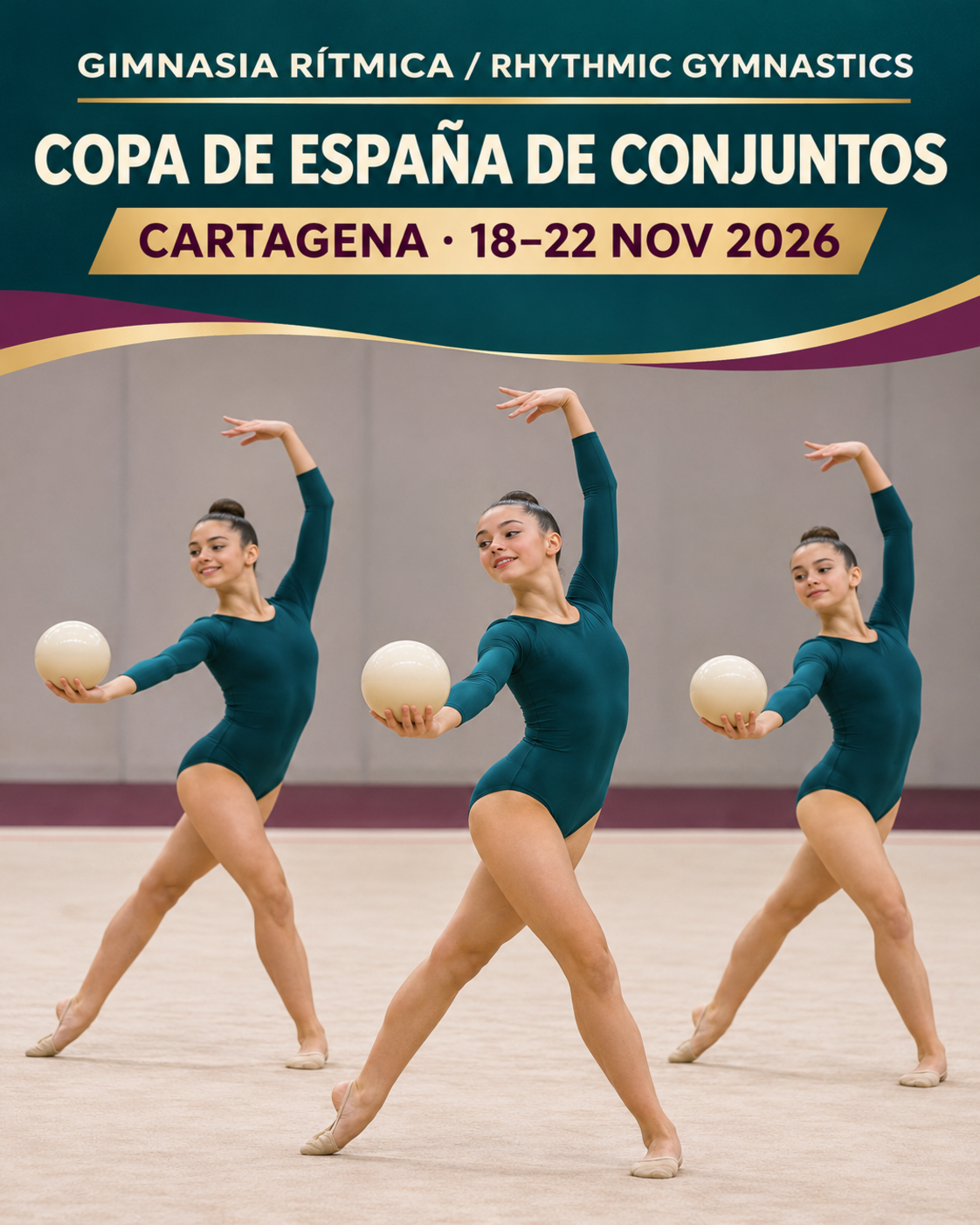
Shared timing does not require identical bodies
In a group, five gymnasts can understand the same count while needing different references to arrive together. Synchronisation is not about imposing identical physical amplitude on every movement. It means developing shared timing, spatial relationships and apparatus handling so the collective intention remains clear, safe and continuous across the exercise.
Cartagena's Spanish Groups Cup provides context for that work. This guide does not teach complex throws or prescribe difficulty. It offers rehearsal decisions to discuss with a coach, including questions families can use to understand the work between a formation, an exchange and the collective recovery following an error. Bodies and appearance are not measures of personal worth.
Official facts and the date discrepancy
Editorial date: 10/11/2026. Documentary verification: 11/11/2026. The National Base Groups competition and third phase of the Iberdrola Spanish Groups Cup are listed in Cartagena in November 2026. Their starting date differs between documents. The national calendar PDF linked by RFEG, labelled as updated on 7 June, gives 18–22 November.
The current national competitions page and rhythmic gymnastics page show 19–22 November. We have not located a final programme or specific regulation explicitly explaining whether the difference concerns competition, training or another activity. We do not assume that the 18th means accreditation, or claim a documented correction when none has been found.
The supplied cover retains 18–22 November. Its wording does not resolve the discrepancy. Confirm your category's programme with RFEG and your club before organising travel. World Gymnastics codes and documents provide general technical context. Base and Cup conditions still require the applicable national rules rather than an automatic transfer of every international provision.
Begin with a shared timing reference
Before seeking visual uniformity, ask which signal starts a movement. It might be a count, a musical accent or a reference agreed with the coach. If each gymnast interprets a different beginning, repeating with greater intensity may not remove the mismatch. First understand what each person is listening for and whether the cue can be recognised consistently.
As an editorial exercise, review a short section and describe its start and arrival. There is no need to interrupt every gesture. Select a meaningful point and check whether everyone can recognise it without continuously watching the others. A timing reference should help performance, rather than becoming a requirement to count rigidly through every part of the music.
Visual references need an appropriate moment
Looking at a teammate can support a formation but may interfere when apparatus requires attention. Identify what visual information each section needs and when it can be collected. The coach can adjust references so a demanding situation does not rely on an improvised head movement or a view that is routinely unavailable.
A late correction is observable: someone changes direction after noticing the formation has already moved. That does not prove inattention or identify a single person as the cause. Ask whether the reference was visible, whether timing was clear and whether the planned distance could be covered with control. Those questions produce information that a personal judgement cannot supply.
A formation is a relationship between positions
A collective shape depends on distances, orientations and shared changes. Arriving at individual marks is insufficient if the route between them creates crossing conflicts or leaves no space for an exchange. Treat travel and arrival as one sequence, with attention to what the next action requires as well as where this one finishes.
Use rehearsal aids selected by the technical team while respecting the surface and space. We do not publish universal measurements or patterns suitable for every group. The aim is to establish which relationships need to remain stable and which can adapt, so the formation stays understandable without demanding travel that the gymnasts have not yet mastered.
Adapt amplitude through technical judgement
Different people do not produce the same movement with an identical sensation. A coach can develop amplitudes compatible with the intention, applicable code and current ability. Adaptation is not permission to disregard an element's requirements. Equally, meeting requirements does not justify comments about bodies, weight or appearance as though they explained every technical problem.
Replace personal comments with task information: a movement finishes before the accent, the formation opens too far or the apparatus arrives in a difficult receiving area. These descriptions suggest something to change. “Your body does not fit” does not describe a solution and has no place in respectful preparation. The aim is coordination of learned actions, not uniformity of identities.
Apparatus changes the synchronisation margin
An exchange adds conditions that rehearsal without apparatus cannot reproduce. Timing, trajectory, receiving space and the ability to continue afterwards all matter. Develop difficulty through suitable supervised progressions. This article does not explain how to perform throws or increase risk in pursuit of a score; those choices require appropriate technical instruction and the relevant rules.
In an editorial example, the count aligns but a reception requires an extra repositioning before the next movement. Repeating only the count may not solve the difficulty. Review the trajectory and formation with the coach, including whether the sequence is suitable now. Observation should include apparatus and continuity rather than examining only the gymnasts' bodies in isolation.
Prepare a collective recovery
One error changes several tasks. While a gymnast handles an incident, the others need to know which reference to preserve and how to avoid further spatial conflicts. The response depends on the exercise and rules. Prepare it with the technical team rather than relying on a generic instruction to continue regardless of the circumstances.
Agree a few understandable signals and review recovery without finding someone to blame. If rehearsal always ends at the first error, the group may never practise the section requiring the most decisions. Continuity training does not mean normalising danger. Pain, injury or an unsafe situation calls for stopping and seeking appropriate assistance, whatever the original exercise plan says.
Review the group respectfully
An authorised recording allows repeated viewing with different attention: timing first, formation next and apparatus afterwards. Separate observations can prevent one overwhelming conversation that tries to correct everything. Ask what information was missing before the error and identify the specific change to try during the next rehearsal, rather than demanding a generally better performance.
Families can recognise communication, attention and collective work without making an individual gymnast publicly responsible for every error. Respect image permissions and minors' privacy. Review belongs to the team's learning process. Publishing a clip to identify who was late does not build trust or provide the full technical context needed to understand what occurred.
Common mistakes and checklist
Avoid demanding visual equality without clarifying timing, correcting only the gymnast who loses the apparatus and presenting the event start as settled while official sources disagree.
- I have checked the programme with my club and RFEG.
- I understand the 18–22 versus 19–22 November discrepancy.
- We share usable timing and visual references.
- We review formation, trajectories and apparatus together.
- Recovery is rehearsed and conditions for stopping are clear.
- We describe actions while protecting privacy and images.
Use YouVisible to organise rehearsals and share an authorised sequence showing collective work. Include the current official link and keep calendar uncertainties visible before coordinating travel with teammates and families.