


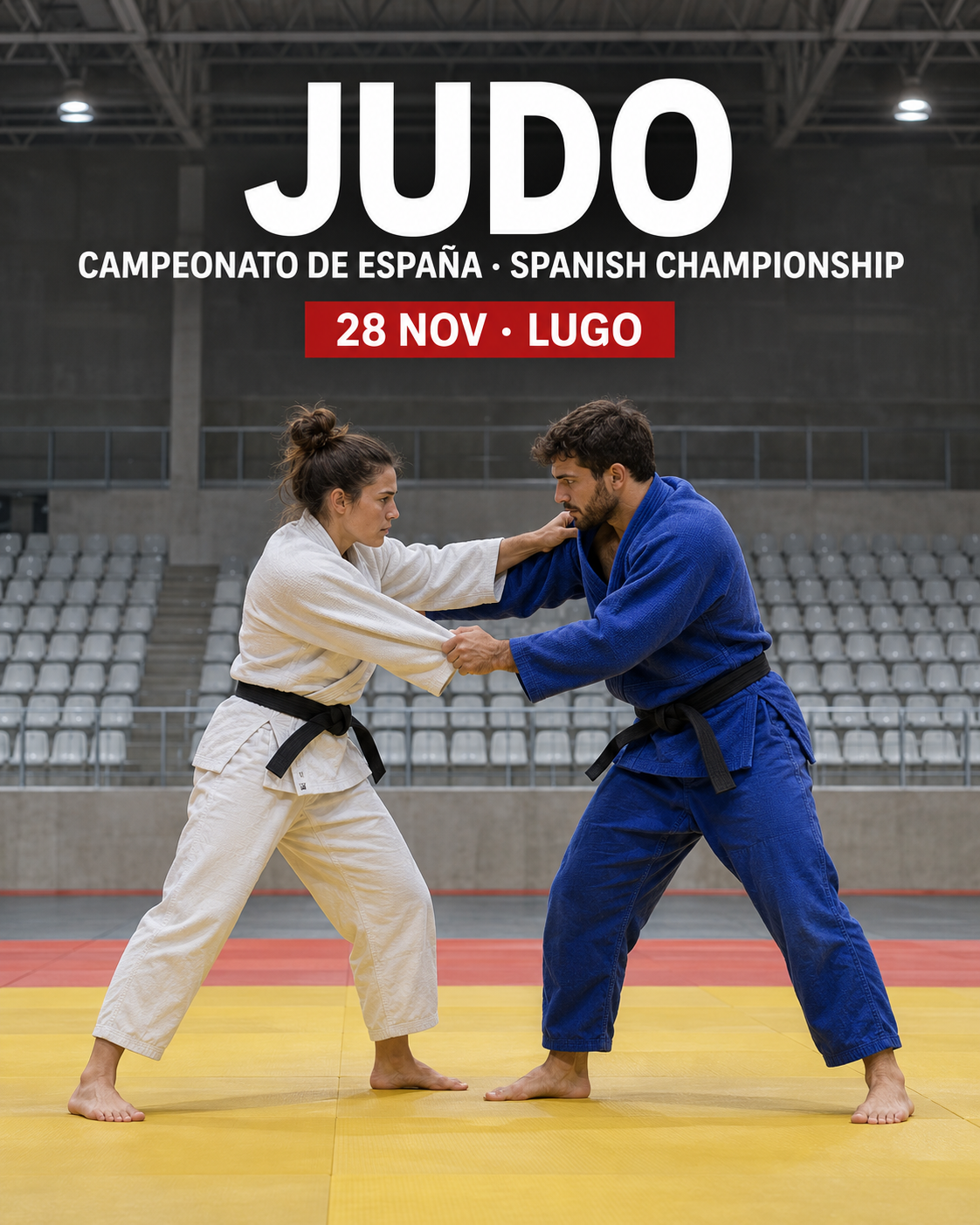
Judo becomes easier to follow when you stop waiting only for a fall and start noticing what prepares it. Gripping, moving, provoking a reaction and continuing on the ground belong to the same sporting exchange. Lugo offers a chance to discover that sequence across different categories. Before planning a visit, however, there is a date discrepancy still visible in federation sources that deserves explicit attention.
Veterans: the specific circular says the 28th
Sources checked on 16/11/2026. The RFEJYDA senior calendar places the Senior Championships in Lugo on 28 November. Its Veterans calendar retains 29 November. However, general circular 228, dated 4 November and hosted by the Madrid federation, calls the Veterans event for Saturday 28 November, at Pazo Provincial dos Deportes.
We prioritise that specific notice: it publishes a 17:30 start, a 20:00 final block and medals at approximately 21:00. The calendar discrepancy remains; check for amendments before travelling. The Navarra federation announcement also says Saturday 28 afternoon. These times concern Veterans; they must not be transferred to Senior competition or treated as public door opening times.
These championships are not open-entry fun events
Senior and Veterans championships have federation conditions, qualification arrangements or their own categories. An audience guide is not an invitation to arrive and compete without meeting requirements. Participants should use their club and federation for documentation, accreditation, weigh-in and amendment instructions. The competition timetable is only one part of preparation and does not replace information addressed specifically to athletes.
Visitors need separate answers: which block they want to watch, what admission allows and how to identify the category in the programme. We do not confirm free entry, available seating or a broadcast. Named communications staff in a circular do not by themselves establish a public streaming link. Check channels and conditions for this edition before making the visit depend on a particular option. Knowing which information is still missing is more useful than assuming a national event must offer every service.
Read a grip as an intention
Two judokas may spend several seconds disputing hand positions without a visible throw. That does not mean nothing is happening. Notice whether someone controls a sleeve, changes the opponent's orientation or prevents a comfortable stance. A grip can prepare one attacking direction while limiting another. Watching what follows makes the exchange more understandable.
You do not need to name every variation. Ask what changes after a position is gained and whether it produces a step, turn or other reaction. Apparent strength is not automatic control: tension and balance can be hard to see from a distance. A useful reading connects hands, feet and movement instead of focusing only on who seems to pull hardest on the jacket. Allow the whole exchange to develop before deciding which athlete had created the better opportunity.
Movement can open an opportunity
Watch how the pair moves across the tatami. A direction change can force the opponent to reorganise their feet and create an opening. Sometimes an initial attack does not finish the exchange but changes the response and prepares another action. Following a sequence helps reveal why a seemingly small movement matters to what comes next.
This is editorial observation rather than instruction for practising techniques. Do not reproduce throws at home or on improvised surfaces. Anyone wanting to learn should seek qualified teaching in an appropriate environment. From the stands, you can enjoy relating movement and reaction without acting as a coach or assigning a technical name to every gesture. Recognising that a position has changed is already a useful step, even when the details remain unfamiliar and you need an explanation afterwards.
An attack may belong to a chain
When one athlete enters and the other avoids the action, watch the immediate continuation. Is position recovered? Does another direction appear? Does the exchange move to the ground? The opponent's response is part of the problem the athlete is solving. An initiative need not produce an immediate fall to make sense within the contest.
Distinguish your impression from the officials' result. A visually striking action may receive a different assessment from what you expected. Angle, control and applicable conditions affect the decision. Rather than disputing it using partial information, observe the scoreboard and follow the continuation. For deeper understanding, consult current rules with someone able to explain them clearly. A first visit need not become an examination, and admitting uncertainty often keeps attention on the sport rather than on an argument in the stands.
Ground transitions are not an interval
A standing action can lead into an exchange on the ground. New spectators can follow who retains initiative, how control is attempted and whether the opponent finds a way out. Do not automatically stop watching when both athletes leave their feet. Continuity may be central to what is happening rather than a break between the interesting parts.
Respect interruptions and referee instructions. A position seen from your seat does not by itself prove injury, surrender or a result. If a contest stops, wait for official information. A child asking questions can hear a simple explanation: the athletes are solving a situation under rules and supervision. There is no need for a physical demonstration between seats to understand that judo continues beyond the throw. Keeping the explanation verbal also respects the limited space and other spectators around you.
Penalties and the scoreboard need context
Sanctions can affect the next exchange. Watch the scoreboard and referee signals, but avoid identifying a specific infringement from a pause you did not understand. Rules evolve, and something remembered from another season may be incomplete. This guide does not replace the regulations or list scoring values as though a short explanation were enough to officiate accurately.
To follow the contest's story, ask who may need to change initiative and how much context you lack. Avoid turning that question into an accusation about passivity or an athlete's character. Tactical choices have conditions that may be invisible from the stands. A cautious comment can support more learning than instant certainty about the last visible gesture. Different viewers may also have seen different parts of the same exchange, so listening can add useful information.
Knockouts, pools and waiting between contests
The Veterans circular distinguishes systems according to participation; every category does not follow a single knockout structure. Check the published draw to identify a pool, round or medal contest. Do not assume someone's day has ended after a loss without checking their actual route through the competition. The draw explains relationships that a single scoreboard cannot show.
When following several categories, note tatami and block once published. Contests do not all occupy identical elapsed time, so an estimated turn is not an exact appointment. Plan breaks and avoid expecting athletes to answer messages while preparing. For families, respecting that waiting period may be as useful as encouragement during competition. It gives the athlete room to follow their own preparation while supporters manage their separate needs calmly.
Prepare a visit that leaves room to learn
Before leaving, review the circular, amendments, programme and admission. Keep the Veterans distinction explicit: 28 November in the specific notice, versus 29 still shown in the general calendar. Do not base travel only on an old screenshot or a date printed on an illustrative cover.
Through YouVisible, share how your understanding changed: a grip you recognised, a transition or patient work within a category. That context makes judo more accessible and values the experience beyond a medal, without promising visitor conditions only the organiser can confirm. The most useful memory may be a connection you finally noticed between two actions.