


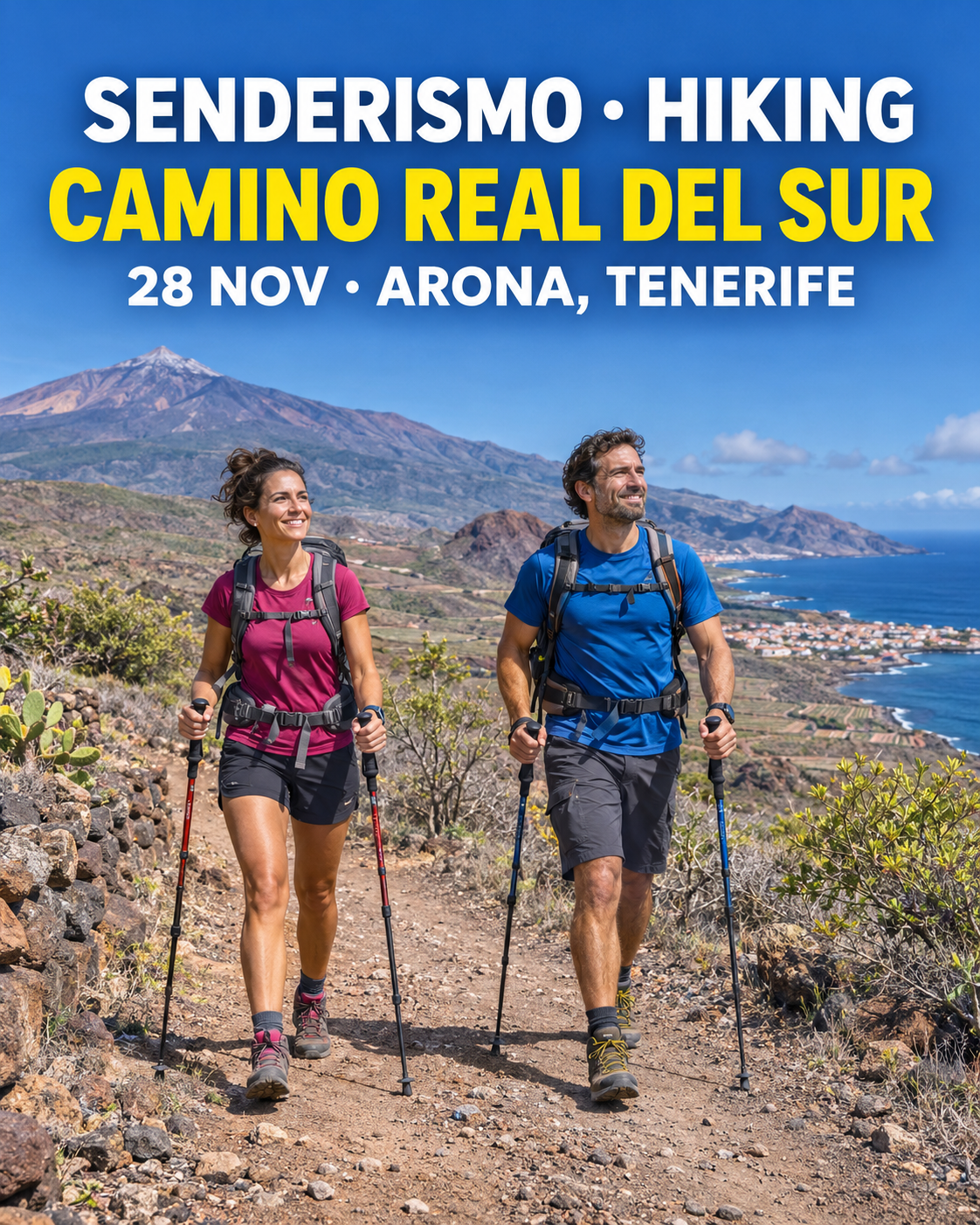
When someone suggests a sixteen kilometre walk in Tenerife, it is tempting to compare the distance with a familiar stroll. An excursion between municipalities, with uneven ground and five or six hours expected on foot, needs a different plan. Before buying equipment, establish whether the effort suits you and how you will return to the place where your day began.
Confirmed information and questions still open
Sources checked on 16/11/2026. The Arona council announcement schedules the Fasnia–Güímar Camino Real del Sur hike for Saturday 28 November. It lists approximately 16 km, medium-high difficulty, 5–6 hours, a €12 price and a maximum of 20 participants. The meeting point is the entrance to Los Cristianos Cultural Centre at 08:00.
The advertised application period runs from 16 to 19 November, using municipal procedure Modelo 940 or the council's in-person service. An application window does not prove that spaces remain: the page checked provides no verifiable live availability counter. Before paying or travelling, ask the Aula de la Naturaleza whether your application can be accepted and what confirms your booking. The meeting time is also distinct from the actual start of walking.
The return journey belongs in your plan
The announcement connects Fasnia and Güímar, while the meeting point is in Los Cristianos. These are different references. They do not by themselves confirm a particular included transport service, parking beside the trail, or a walk back to your original starting point. Ask where walking begins and ends and how both ends connect with the meeting point.
If transport is organised, confirm its conditions, approximate return arrangements and the procedure if someone needs to withdraw. If any transfer is your responsibility, check that it fits the group's timetable. A linear hike can be straightforward to manage; discovering at the finish that the return depended on an assumption is the avoidable problem. Keep the organiser's answer with your booking so everyone travelling together understands the same plan.
What medium-high difficulty means for you
The published rating describes the activity; it does not certify your suitability. Think about your most recent long outing on uneven ground. Did you retain control of your footing at the end? Were frequent stops necessary? Could you have managed another demanding section? Fitness from indoor training or urban walking does not necessarily reproduce hours of attention on stones and slopes.
Without recent comparable experience, speak to the organiser before applying. Ask about elevation gain, exposed sections, surface and expected group pace. Sixteen kilometres alone answers none of those questions. Avoid using this excursion to discover your limits for the first time. If an injury or health condition affects your ability to walk for hours, also seek advice from a professional familiar with your circumstances rather than relying on a general difficulty label.
Managing five or six hours without racing
Our editorial recommendation is to start at an intensity that lets you talk and notice the ground. Going too fast early reduces your margin for later heat, tiredness or more demanding footing. If the group stretches out, follow the leader's instructions rather than rushing blindly or taking an unauthorised shortcut to catch up.
Use permitted pauses to drink, eat familiar food and adjust clothing or footwear. Waiting until you feel exhausted makes simple decisions harder. The advertised duration is approximate, so avoid booking a tight onward connection. Regular progress with attention is more useful than a fast opening section followed by lengthy interruptions. Remember that your whole day also includes waiting and transfers, whose timing still needs confirmation. A comfortable first hour should leave capacity for the final one.
Volcanic terrain rewards precise steps
The volcanic setting is a reason to consider loose stones, uneven surfaces and changing grip, without claiming that every section of this edition contains each feature. Look several steps ahead and shorten your stride when the ground requires it. Following another hiker does not mean placing your foot exactly where theirs just slipped.
Wear footwear you have already used on similar terrain, with soles in good condition. A long excursion is an unhelpful occasion to discover how new boots fit. If you normally use poles, ask whether they suit the route and adjust them properly; they do not replace balance or justify a faster pace. Stop somewhere safe for photographs, leaving room for others. Looking at a screen while moving takes attention away from the next foot placement.
Prepare for sun, wind and changing conditions
November does not remove exposure to sunlight. Bring suitable protection, enough water for prolonged walking and a layer that lets you respond to changes in temperature or wind. Individual needs, effort and conditions affect the amount required. This guide does not prescribe universal litres or promise fountains, shade or refreshments absent from the announcement.
Check forecasts and official warnings near the date, and ask how the council will communicate changes or cancellation. A sunny Tenerife illustration is not a forecast. Pack so you can drink or reach a layer without emptying the bag. Tell the leader about dizziness, unusual weakness or pain that changes your walking. Concealing a problem can reduce your options later and makes it harder for the group to respond appropriately.
Give everything in your bag a purpose
The evening before, check requested identification, booking confirmation, a charged phone, organiser contact, water, familiar food, sun protection and planned clothing. Add anything required by the final instructions. Do not assume continuous mobile reception or treat a navigation application as a replacement for the leader and authorised itinerary.
Your bag should let you move steadily. Test the fit with its actual load before Saturday and check that nothing bounces or interferes with your hands. Each person should carry their own essentials: becoming separated by a few metres should not leave someone without water or a warm layer. A short shared check prevents every member of a friendship group from assuming somebody else has packed a necessary item. Keep the load practical rather than adding equipment you cannot use.
Making a family decision
A municipal activity is not automatically suitable for children. Before including minors, confirm permitted ages, authorisations and expected experience. Consider each person's ability to walk attentively for hours as well as the distance. A child with plenty of energy at the meeting point may still find a long day without an easy exit difficult.
Agree how to report tiredness or discomfort without pressure to continue. If the format does not fit, a different outing may offer a better experience. Do not bring unregistered companions on the assumption that the group is open to everyone. The participant limit and organiser's conditions remain relevant even where the landscape can also be visited independently. Family preparation includes accepting that different people may need different plans that weekend.
Check once more before leaving
Confirm acceptance, meeting point, transfers, return arrangements, weather and equipment. Ask about any essential unanswered question before beginning your journey. The cover is illustrative and does not identify a precise viewpoint along the itinerary. Enjoying the Camino Real del Sur does not require turning every section into a photograph.
Afterwards, sharing what helped you prepare through YouVisible can offer more than a distance total. A practical decision about pace, equipment or transport gives context to your experience and helps other people discover hiking with realistic expectations. Describe what actually happened on your outing, keeping personal observations separate from the organiser's conditions for future visits.