


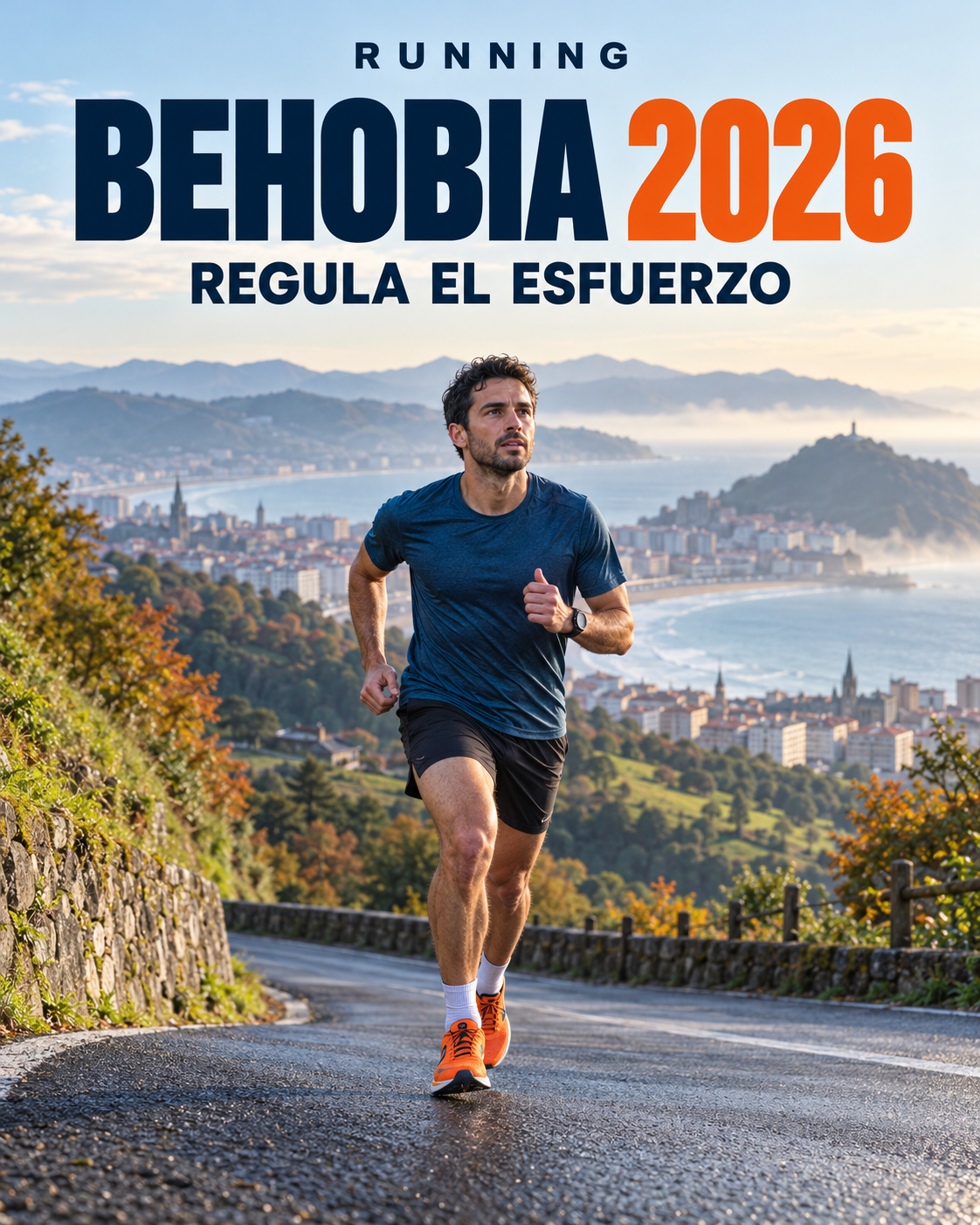
The average pace trap
A runner wants to finish 20 km averaging 5:30 per kilometre and decides to hold that number from the start. This is an example, not a recommended pace. On flat ground it sounds sensible. Once the road climbs, protecting the split starts to demand too much.
At Behobia, that rigidity can mean overspending uphill, tiring your legs downhill and reaching Miracruz with nothing in reserve. A better approach is to keep effort reasonably steady while allowing pace to change.
- Pace: the minutes taken to cover one kilometre.
- Effort: what moving actually costs you, reflected in breathing, legs and overall feeling.
- Finishing result: the combined effect of effort, terrain, weather and decisions made along the way.
Your average emerges across the whole race. Every slope does not need to match it, and you do not need a power meter or sophisticated heart rate monitor to make useful adjustments.
What makes Behobia different
The 2026 regulations confirm the 61st edition on Sunday 8 November, over 20 km, with a maximum of 30,000 participants. The finishing limit is 2 hours 35 minutes from crossing the start mat yourself.
Official information checked: 28 October 2026. The race sheet places the start in Behobia, Irun, and the finish on Alameda del Boulevard in Donostia–San Sebastián, describing the distance as uncertified. However, it still says its 2026 update is pending, so that page does not confirm those details for this edition.
The course page carries the same warning. Its 192 metres of ascent and kilometre references are treated here as provisional, awaiting specific confirmation for 2026.
The published profile runs from the riverside through Irun's climbs and rolling roads. Gaintxurizketa comes around kilometre 7, followed by a descent towards Errenteria and easier ground near halfway. Capuchinos and smaller rises lead towards Miracruz around kilometres 16–17. The descent into Gros still leaves a slight rise at kilometre 19 before the Boulevard. Check the final course before race day.
A strategy in five sectors
This approximate breakdown is editorial advice based on that reference profile, rather than an official pacing instruction or a promised finish time. Adapt it to the final course, your preparation and conditions. On smaller screens, scroll the table sideways to read every column.
| Sector | Aim | Effort | Common mistake | Cue to adjust |
|---|---|---|---|---|
| Km 0–5: hold back | Find space and settle. | Comfortable, controlled. | Following every passing runner. | A short sentence is impossible: ease off. |
| Km 5–8: Gaintxurizketa | Climb with something in reserve. | Firm, without desperate breathing. | Defending flat-ground pace. | Breathing runs away: slow down. |
| Km 8–12: descend and recover actively | Settle breathing and stride. | Controlled. | Winning back every second. | Heavy landings or tension: ease off. |
| Km 12–17: Capuchinos, approach and Miracruz | Keep a response for the last climb. | Firm, hard but sustainable uphill. | Attacking every rise. | Empty before Miracruz: reset expectations. |
| Km 17–20: descent, Gros and finish | Consider a controlled progression. | Hard but sustainable if able. | Sprinting over the crest. | Coordination deteriorates: stop accelerating. |
Do not judge these efforts against the runner beside you. Their firm effort might already be too much for you today.
Use breathing without technology
Early on, you should be able to say a short sentence. You do not have to chat throughout the race: an occasional check can reveal that the start has pulled you beyond your intended effort.
Breathing can become stronger on Gaintxurizketa without reaching a desperate, near-maximum urgency. After the crest, some control should return. If it does not, make the next section easier instead of accelerating to compensate.
Before Miracruz, you should still have room to increase effort. If breathing feels impossible to control within the opening kilometres, your pace is probably too ambitious. Ease back and observe what changes.
These are practical cues, not a medical assessment. Being able to speak a few words is never a reason to dismiss worrying symptoms.
Climb without fighting the clock
Shorten your stride slightly and keep a natural cadence rather than chasing a particular step count. Look for smooth movement, relaxed shoulders and a posture that does not fold sharply at the waist.
Accept a slower kilometre split. Trying to regain seconds during the climb itself can turn an appropriate adjustment into a demanding surge, particularly when the slope keeps changing.
Save any acceleration until the gradient eases, then check how you feel before increasing speed. Staring at your watch can hide the fact that several successive ramps have pushed breathing beyond what you can sustain.
Descend without exhausting your legs
A descent is not free time. Avoid braking with every landing or stretching your stride excessively to gain speed. Allow a modest, flowing increase in pace without turning the downhill into a sprint.
Use it to restore breathing and organisation: relax your hands, look ahead and find foot placements you can control. You do not need to reclaim everything lost uphill immediately.
Legs respond differently depending on experience, gradient and fatigue. No single technique guarantees freedom from discomfort. If landings feel awkward or stability starts to deteriorate, reduce speed and regain control before asking for more.
Where earlier decisions catch up with you
The approach to Miracruz can expose choices made much earlier. Arriving there with frantic breathing and unresponsive legs leaves little room for another climb, even when the finish seems close.
A useful aim is to reach kilometre 15 feeling that you have worked, without feeling completely empty. This does not mean the entire race should feel easy. It means retaining enough capacity to respond to the terrain ahead.
After the summit, consider building speed only if coordination remains good, breathing is manageable and there are no worrying symptoms. Check again before making another increase. The crowd can encourage you, but it cannot judge your condition.
The final ten days
From 28 October until race day, focus on arriving recovered. Do not try to catch up on missed training or prove now that you can cover the distance.
Gradually reduce your workload while retaining some familiar mobility and light activation, adjusted to your usual routine and any coaching advice. There is no need for everyone to follow the same fixed schedule.
Prioritise sleep and recovery. Avoid new shoes, gels, breakfasts or equipment. Check the weather forecast once it becomes reliable enough to inform clothing, expectations and travel arrangements.
Confirm your bib, starting group, transport and baggage arrangements. Read the official instructions again a few days before the race: an old screenshot can preserve information that has since changed.
Drinking and aid stations
Use only a strategy you have practised. Adjust intake to expected duration, temperature and tolerance. Do not automatically drink everything offered or combine several unfamiliar products because they happen to be available.
The race sheet lists eight aid stations on the course and at the finish, but awaits updating. The official 2026 magazine, page 51, also lists eight; the regulations enumerate seven intermediate locations and the finish, plus drinks at the start. Check the final distribution before planning supplies.
On B/SS Salud, the organisers report more medical assistance when temperatures exceeded 15°C. That observation does not make lower temperatures a guarantee of safety. Warmer conditions call for reviewing effort and needs, not simply forcing more fluid. Ask for help before a problem becomes serious.
Logistics that can undermine good preparation
Check the group and time on your bib. The regulations allow a later start, while starting early means disqualification. Do not move into an earlier group to join someone else.
Plan the journey to Behobia well ahead. Use only official 2026 train and shuttle information, including the magazine's instructions. The start page still awaits updating: do not infer this year's transport timetable from older services.
Prepare a closed bag with your bib-number sticker and respect the regulations' 5 kg maximum. Check current handover and collection instructions through baggage information, whose webpage also flags a pending update. Agree a meeting place after finishing, and never buy a bib through informal channels.
If you do not have a bib
The official registration platform shows general entries as sold out. The official name-transfer process remains available until 5 November. It transfers an existing entry; it is not an open registration window.
Complete the process and all payments exclusively within the organisers' platform. Follow its steps alongside the regulations rather than accepting informal arrangements. The registration calendar retains a pending-update notice, so the platform is the source for the current status. If that changes, this article should be revised to reflect the official position.
When to stop or ask for help
Stop and request assistance for chest pain, severe dizziness, disorientation, disproportionate breathing difficulty, loss of coordination, chills or an abnormal sensation of heat. Sudden pain that clearly changes your running gait also warrants stopping. Follow any instruction from medical staff or race officials. These signs do not establish a diagnosis, and protecting a split is never the appropriate response.
Let the clock inform, not command
At Behobia, the clock should inform you, not command you. The strongest strategy is not defending an identical number every kilometre. It is reaching Miracruz with the capacity to keep racing the course.