


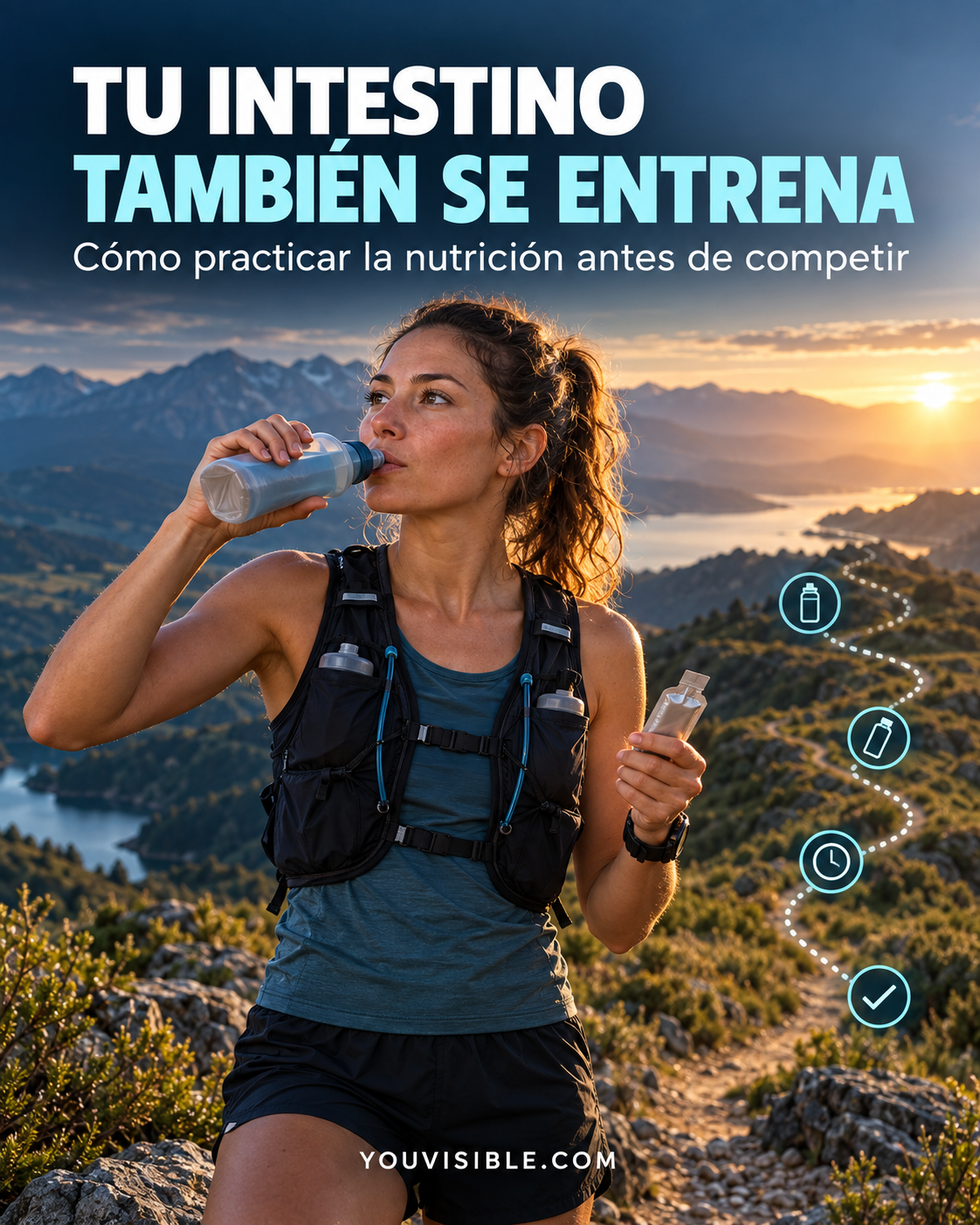
A gel feels fine at home but upsets your stomach when you run. Before ruling it out, look at the circumstances: perhaps you took it all at once, with little fluid, on a climb in the heat. Eating and drinking during exercise is different from doing so while sitting down. Preparing for an event also means learning to fuel while moving.
What gut training means
Gut training means progressively practising your intended food and hydration strategy during suitable training sessions. It does not mean eating huge amounts, forcing your stomach or deliberately triggering symptoms to «toughen it up». Start with familiar options and manageable demands, then adjust according to your response.
The digestive system can adapt: comfort may improve, fullness may decrease, and gastric emptying or absorption may change. Jeukendrup’s review describes these possibilities. This does not mean every mechanism is equally well established in athletes or that everyone will experience every adaptation.
Human evidence remains limited and there is no universal protocol. The samples, products and conditions studied are specific. Better tolerance does not guarantee freedom from all symptoms: competition adds circumstances that can be difficult to reproduce.
Symptoms do not always point to the last food eaten
Running’s mechanical impact, intensity, heat and humidity can change digestive responses. Too little or too much fluid, large concentrated intakes, unfamiliar product combinations, caffeine or other ingredients, previous meals and race nerves also matter. Individual differences exist even between people taking part in the same event.
De Oliveira and Burini’s review places symptoms in a mechanical, physiological and nutritional context. A symptom appearing after a food does not diagnose an intolerance. Before blaming the gel, record the effort, drink and what happened beforehand too.
Check the relationship between gel and fluid against the product’s instructions: a gel requiring water differs from one formulated for a different method of use. Combining it with a carbohydrate drink changes total intake. Forcing yourself to drink to compensate for poorly planned feeding is not a useful solution either.
A nutrition plan and a tolerated plan
A nutrition strategy describes what you would like to take. A tolerance strategy demonstrates what you can actually use. The first organises needs and opportunities; the second incorporates trials while moving, including limits and alternatives.
The position paper by Thomas, Erdman and Burke provides general guidance on sports nutrition planning. An individual plan requires adapting it to the event and athlete. We set no universal carbohydrate or fluid amount here: duration, intensity, conditions and tolerance change the decisions.
You might prepare a perfect product list and discover you cannot open the packets, drink at the intended time or keep eating as effort rises. That finding helps revise the plan; it is not a failure of willpower.
Six variables to practise
- Format. Drinks, gels, soft foods and solids feel different. On a bike, chewing on an easy stretch may be comfortable; while running, you might prefer another texture. A long hike also offers opportunities to try foods without assuming they will work in a race.
- Concentration and fluid. Reproduce the drink preparation and available water. A more concentrated mixture or several products together changes your intake. Record the fluid accompanying a gel too.
- Timing and frequency. Practise when you start and how you spread out intakes. Avoid bunching them together because you forgot to eat earlier. Do not wait until exhaustion to find out whether you can recover the plan.
- Sport and intensity. Tolerating something on a bike does not establish that you tolerate it while running. In triathlon, practising the transition between the two matters. Use perceived effort and the talk test to describe intensity.
- Environment. Consider heat, humidity, altitude, clothing and water access. In trail running, a long climb and a distant aid station change opportunities. Simulating conditions does not mean deliberately seeking extreme heat.
- Logistics. Rehearse wrappers, carrying systems, pockets, bottles and aid stations. Opening a gel with wet hands or reaching a bottle is part of the strategy too. Keep packaging until you can dispose of it properly.
Build your individual tolerance map
This is an observation tool, not a clinical protocol or a laboratory experiment to copy:
- Define the event and its conditions. Describe expected duration, sport, effort, environment and water access points. Identify what you need to rehearse and what requires individual professional guidance.
- Record a normal session before changing anything. Note previous meals, products, timing, fluid and sensations. A baseline helps avoid conclusions based only on memory.
- Change one variable at a time. If trying a different format, keep effort and preparation comparable. If several conditions inevitably change, record that and limit your conclusions.
- Progress without trying to cause symptoms. Repeat manageable trials before adding difficulty. Do not increase intake when significant symptoms occur; reduce or stop the trial and consider professional help.
- Simulate with real equipment and products. Practise containers and the order of use in a session suited to your preparation, without turning it into another competition.
- Prepare an alternative. Decide which tested option you would use if water is unavailable, you lose a product or the main format becomes difficult to tolerate. Rehearse the backup too.
| Time of intake | Product | Fluid | Effort | Environment | Symptom | Time until onset | Effect on pace or intake |
|---|---|---|---|---|---|---|---|
| After the first section | Usual gel | Water; record how much | Conversational | Cool, flat | No symptoms | None occurred | Pace and intake maintained |
| Before a climb | Tested drink | Record volume and mixture | Harder | Hot, uphill | Fullness | Record when it started | Record whether you slowed down or paused intake |
These rows illustrate recording, not consumption instructions. Record «no symptoms» too and compare similar days. If an intake coincides with discomfort, look for a pattern without deliberately repeating a situation that harmed you. Your map records experiences; it does not identify diseases.
Products and evidence: keep promises in perspective
Trials by Costa and colleagues and Miall and colleagues observed digestive improvements after two-week interventions in runners. These are promising findings in specific samples and conditions, not a compulsory timeframe or an individual guarantee.
The systematic review by Mlinaric and Mohorko finds gut training promising, no clear superiority of hydrogels over conventional products, and mixed evidence for probiotics.
A low-FODMAP diet, restricting certain fermentable carbohydrates, may help in particular situations, but it is restrictive. It should not be recommended automatically or maintained without professional supervision. Removing foods can make meeting nutritional needs harder. An expensive product does not replace practice and recording; no strategy can guarantee prevention of every symptom.
Mistakes to avoid
- Trying new products in competition or testing them only at rest.
- Copying another athlete’s amounts or assuming more carbohydrate always means better performance.
- Changing several variables together or waiting until exhaustion to start eating.
- Treating every symptom as an intolerance and removing food groups without guidance.
- Relying only on expensive products and ignoring intensity, heat and fluid.
- Increasing intake despite significant symptoms or treating warning signs as normal.
Today’s YouVisible challenge
Create a block within an activity called Nutrition tolerance trial. Record product, timing, fluid, intensity, environmental conditions, symptoms, time until onset, effect on pace and the variable you will change next session.
In YouVisible, you can split an activity into blocks, save photos or moments, record sensations and compare trials on different days. A sports diary helps build a personal tolerance history. Include pre-exercise food as context.
Your goal is not to find the best gel, but to build your own tolerance map.
An activity is more than kilometres, pace and elevation gain. It is also learning what your body needs and what it can use while moving.
Competition nutrition should not make its debut in competition. It is designed, practised and adapted.
Download YouVisible
Sources
- Jeukendrup — Training the Gut for Athletes
- Costa et al. — Gut-training: the Impact of Two Weeks Repetitive Gut-Challenge
- Miall et al. — Two Weeks of Repetitive Gut-Challenge Reduce Exercise-Associated Gastrointestinal Symptoms and Malabsorption
- Mlinaric & Mohorko — Nutritional Strategies for Minimizing Gastrointestinal Symptoms During Endurance Exercise
- Thomas, Erdman & Burke — Nutrition and Athletic Performance
- De Oliveira & Burini — Carbohydrate-Dependent, Exercise-Induced Gastrointestinal Distress
Notice: General educational information. This does not replace medical assessment or an individual plan prepared by a qualified dietitian or nutrition professional. Severe pain, blood, persistent vomiting, recurrent diarrhoea, weight loss, symptoms outside exercise or any other concerning sign require professional assessment.
Save your sporting story. Share it. Make it visible.