


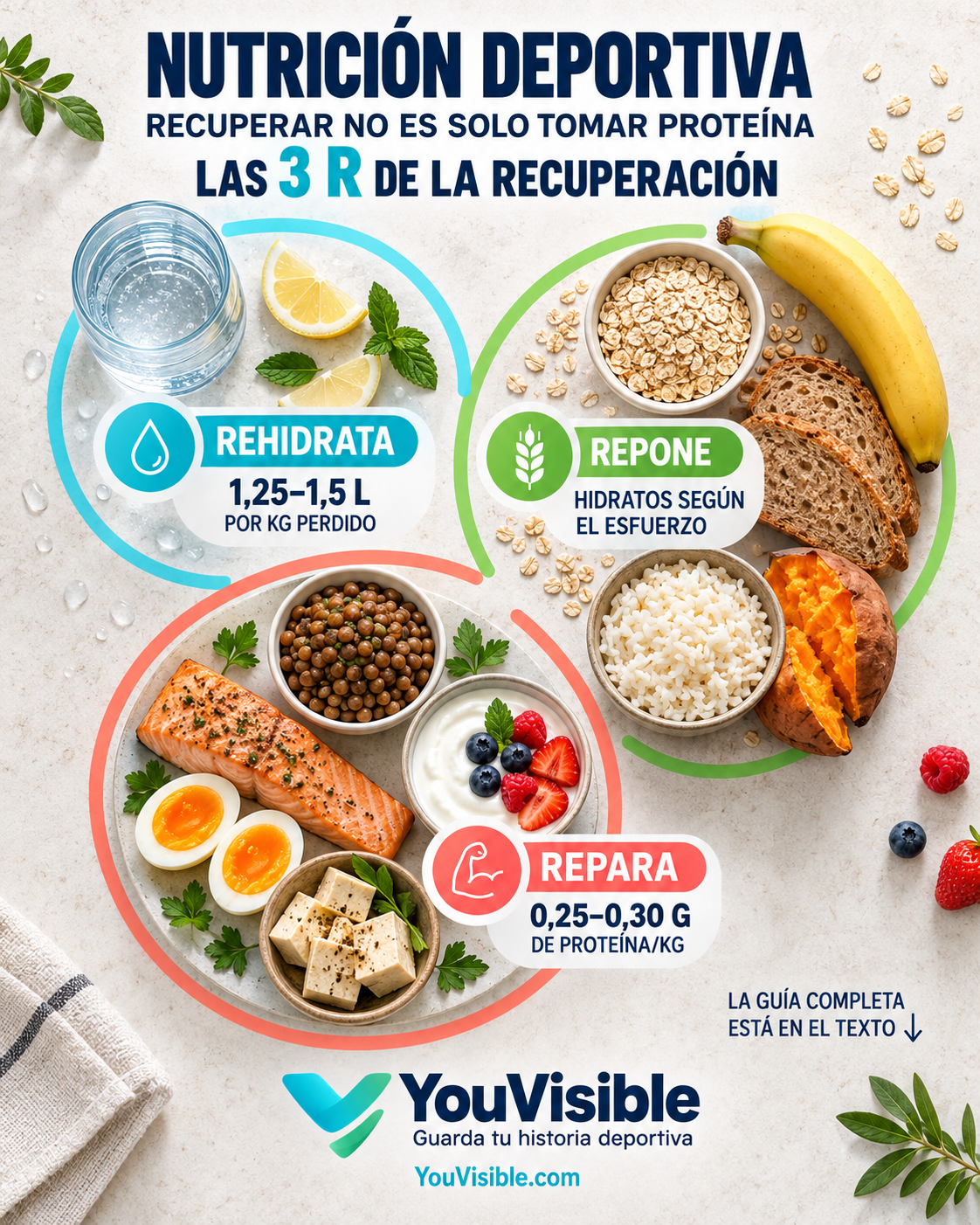
When a demanding session ends, protein is often the first thing that comes to mind. Recovery, however, does not depend on one nutrient, and it does not always require a shake. Your body may need to replace fluid, restore some of the energy used and receive protein for repair and adaptation.
The three Rs—rehydrate, replenish and repair—are an easy way to remember those priorities. They are not a rigid formula, and they do not mean that everyone must eat the same thing immediately after exercise. The right approach depends on the sport, the session’s duration and intensity, the heat, sweat losses and the time before the next effort.
1. Rehydrate: replace lost fluid
Exercise causes water loss through sweat. The amount varies widely between people and from one day to another. Heat, humidity, clothing, duration and intensity all affect it.
Weighing yourself before and after a session can provide a practical estimate. Compare like with like, use as little wet clothing as possible and account for fluid consumed or passed during the session. A decrease of roughly one kilogram of body mass is commonly treated as close to one litre of fluid deficit, but it is not an exact clinical measurement.
When only a few hours are available and hydration must be restored quickly, sports guidance commonly suggests gradually drinking about 1.25–1.5 litres for each kilogram lost. The volume is greater than the estimated loss because urine production continues after exercise.
You do not need to drink it all at once. Spread it across the following hours and include some sodium in food or drink after long sessions, training in the heat or heavy sweating. Sodium can help retain some of the fluid consumed, although requirements remain individual.
After a short, easy session in normal conditions, drinking to thirst and continuing with regular meals may be enough. Excessive water intake does not improve recovery. The American College of Sports Medicine position stand on exercise and fluid replacement provides the context behind these fluid-replacement principles.
2. Replenish: restore energy
Carbohydrates help restore glycogen used during exercise. How urgently they matter depends above all on the work completed and the timing of your next session.
If another demanding workout or competition is less than about eight hours away, replenishment deserves closer planning. A reference used for rapid recovery is approximately 1–1.2 grams of carbohydrate per kilogram of body mass per hour during the first few hours.
For a 70-kilogram person, that is about 70–84 grams per hour. This is not a compulsory target for everyone after every workout. It mainly applies when demanding efforts are close together.
Everyday foods can provide carbohydrates: rice, pasta, potatoes, bread, oats, fruit, pulses and cereals. If there is no further hard session that day, you will not normally need to chase an hourly number. A complete meal adjusted to appetite and the work performed is often a simpler answer.
The whole day matters too. No single food makes up for insufficient overall intake or a plan that does not match training load. The joint position paper on nutrition and athletic performance places energy, nutrients and fluid within the athlete’s individual training context.
3. Repair: include a protein source
Protein supplies amino acids used in post-exercise repair and adaptation. As a practical reference after a demanding session, consider roughly 0.25–0.30 grams of protein per kilogram.
For a 70-kilogram person, that is approximately 18–21 grams. It is a general guide, not an individual prescription or a quantity that must automatically follow every activity.
Supplements are not compulsory. Eggs, fish, meat, milk, yoghurt, cheese, soy, tofu, or combinations of pulses and grains can provide protein as part of a normal meal. A shake may be convenient when food is unavailable or appetite is low, but convenience does not make it essential.
Recovery also extends beyond the first meal. Total daily protein and energy, their distribution and overall diet quality matter more than treating the minutes after training as a race against the clock. The International Society of Sports Nutrition position stand on nutrient timing helps place timing within the wider diet and training plan.
The three Rs at a glance
| Priority | Purpose | When it matters most | Indicative reference |
|---|---|---|---|
| Rehydrate | Replace fluid and some lost electrolytes | Heat, long sessions, heavy sweating or a short recovery window | About 1.25–1.5 litres per kilogram lost in rapid recovery |
| Replenish | Restore glycogen used during exercise | Another demanding session in less than about eight hours | About 1–1.2 g carbohydrate/kg/hour for the first few hours |
| Repair | Supply amino acids for repair and adaptation | Particularly after demanding or strength sessions | About 0.25–0.30 g protein per kilogram |
Do not automatically add these figures together. They are tools for understanding priorities and making decisions that fit the situation.
Simple ideas after training
You do not need a special meal or sports products every time. Straightforward combinations can supply fluid, carbohydrates and protein:
- Yoghurt or a soy alternative with oats, banana and water.
- Rice or potatoes with eggs, fish, chicken, tofu or pulses.
- An omelette or tuna sandwich with fruit and water.
- Milk or a soy drink with cereal and a piece of fruit.
- Pasta with vegetables and a protein source you enjoy.
The right quantity depends on appetite, body size, training, goals and the rest of the day’s food.
Mistakes to avoid
- Treating recovery as protein alone.
- Applying rapid-recovery figures after every easy session.
- Drinking a large volume of water at once without considering actual losses.
- Forgetting carbohydrates when another hard session follows within hours.
- Assuming a shake or supplement is compulsory.
- Copying another person without accounting for sport, climate and digestive tolerance.
- Comparing pre- and post-session weight under different conditions.
- Ignoring medical restrictions involving fluid, sodium, kidneys, metabolism or diet.
Recovery belongs within the wider training plan. You can also read why training more does not always mean training better.
Today’s YouVisible challenge
After your next demanding session, record more than distance, time or calories. Note in YouVisible:
- What type of session you completed.
- How long remains before your next workout.
- What the heat and sweating were like.
- What you chose to drink and eat.
- How you felt in the following hours and the next day.
The aim is not to find a perfect meal, but to observe which choices fit your activity and recovery. YouVisible lets you record the workout, your recovery strategy and the sensations that followed, turning each activity into a useful learning opportunity.
Find YouVisible on Android, iPhone and the web.
Recovery starts when the session ends, but it is built through all your habits.
Sources
- Thomas, Erdman and Burke — Position of the Academy of Nutrition and Dietetics, Dietitians of Canada, and the American College of Sports Medicine: Nutrition and Athletic Performance.
- Sawka et al. — American College of Sports Medicine Position Stand: Exercise and Fluid Replacement.
- Kerksick et al. — International Society of Sports Nutrition position stand: nutrient timing.
Notice: This is general educational content. It does not replace an individual assessment by a registered dietitian, doctor or other healthcare professional. If you have an illness, injury, exercise-related symptoms or specific instructions concerning fluid, sodium, protein or carbohydrate, consult a healthcare professional.