


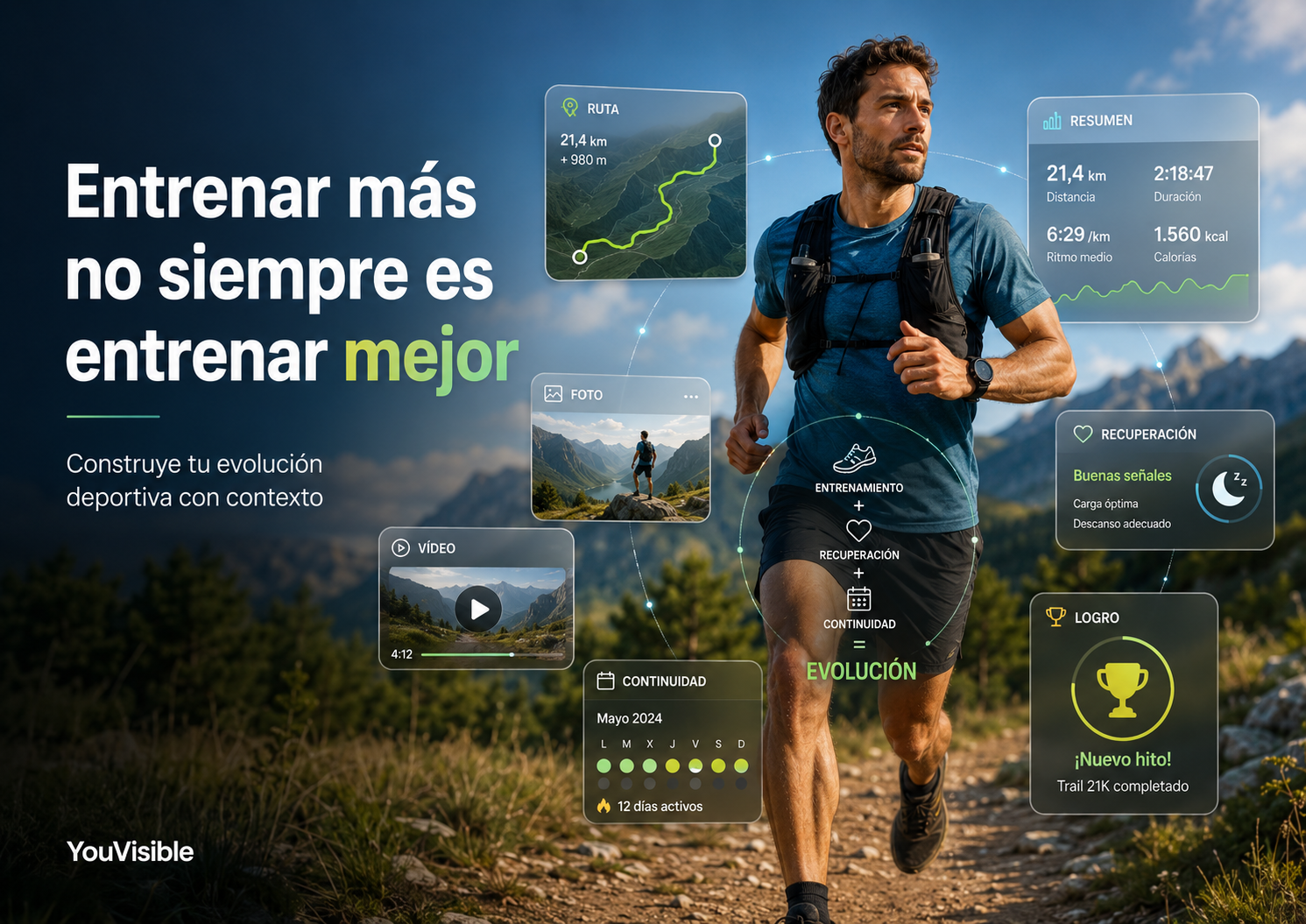
Training more is not always training better: how to build sports progress with less chaos and more context
In amateur and grassroots sport, one idea is repeated often: the more I train, the more I improve.
Reality is more nuanced.
Improvement is not just about collecting more kilometers, sessions, routes, matches or workouts. It also means resting, adapting, recovering, reviewing progress and understanding what is happening in the body over time.
This applies to runners, cyclists, hikers, trail athletes, football players, gym athletes, families following their children's development and coaches who need to see more than a single isolated moment.
The problem: we see individual workouts, but not always the full progression
Today we have many useful tools.
Sports watches record distance, pace, heart rate and elevation. Apps like Strava, Garmin, Polar and other activity platforms store training data. Social networks let us share photos, videos and specific moments. Our phones are full of sports memories. Cloud folders keep files that are often saved without much order.
All of that has value.
The problem appears when each piece lives in a different place.
A route stays in one app. A video remains on the phone. A photo is posted on Instagram. An achievement is mentioned on WhatsApp. A match gets lost in a gallery. An entire season ends up split across folders, chats and platforms.
That makes it hard to understand an athlete's real evolution.
Training load: not only how much you do, but how you progress
In endurance sports such as running, hiking, cycling or trail running, one of the most common mistakes is increasing load too quickly.
It can happen because of motivation, because you are preparing for an event, because you are coming back after a break or simply because one day you feel strong.
But the body needs time to adapt.
Load is not only how many kilometers you did this week. It also matters:
- what your longest recent session was;
- how much elevation you added;
- whether intensity increased;
- whether you stacked several demanding days;
- how you slept;
- whether you arrived recovered;
- whether there had been previous discomfort;
- whether you were returning from an injury or a break.
That is why looking at one activity in isolation can be misleading. The sequence is what matters.
Recovery is also part of the sports story
Rest is not wasted time. It is part of training.
Sleeping well, hydrating properly, eating enough, spacing out hard sessions and respecting discomfort are decisions that also build performance.
An athlete is not defined only by what they do on race day, match day or route day. They are also defined by how they arrive there.
A real sports history includes:
- good training sessions;
- bad training sessions;
- injuries;
- gradual comebacks;
- completed challenges;
- rest days;
- changes of sport;
- seasons;
- lessons learned;
- important moments;
- photos, videos and activities that explain the journey.
For families: the value is not only in the nice video
In youth and grassroots sport, many families keep videos from matches, competitions or training sessions, but over time those files get lost among phones, WhatsApp groups and folders without context.
A video of a goal, a race, a route or a technical improvement has much more value when it can be understood as part of a progression:
- which season it belonged to;
- how old the athlete was;
- which team or club they were with;
- what goal they were working on;
- what other important moments happened that year;
- how they have changed since then.
That turns a loose file into sports memory.
For clubs and coaches: context is worth more than an isolated highlight
A highlight can attract attention, but it does not always explain the athlete.
For a club, coach or scout, context is key:
- continuity;
- progression;
- commitment;
- variety of situations;
- ability to learn;
- consistency;
- sports background;
- competition moments;
- training sessions;
- physical and technical evolution.
An organized sports profile can provide more useful information than a viral post or an isolated video.
YouVisible: from scattered workouts and memories to organized sports history
YouVisible is not meant to replace the apps you already use.
You can keep measuring your training with Strava, Garmin, Polar or other platforms. You can keep sharing moments on Instagram, Facebook or WhatsApp. You can keep storing files on your phone or in the cloud.
The difference is that YouVisible helps you bring all of that together in one sports space with context.
In YouVisible you can organize:
- sports photos;
- videos from training sessions, matches or competitions;
- recorded or imported activities;
- routes;
- albums;
- seasons;
- achievements;
- important moments;
- shareable links;
- private or visible content, depending on what you choose.
This way your sport is not scattered across applications. It becomes an organized story.
A simple way to start
If you practice running, cycling, hiking, football, fitness or any other sport, you can start with a very basic structure:
- Create your sports space.
- Upload your most important videos or photos.
- Add your activities or routes.
- Group them by season, album or challenge.
- Save everything privately first.
- Share only what makes sense.
You do not need a professional career or thousands of followers.
Every sports story starts by giving order to what you are already building.
Conclusion
Training more does not always mean training better.
Sometimes improvement means progressing with judgment, resting when needed, recording what matters and looking at your evolution with perspective.
Sports apps can measure your data. Social networks can show your moments. YouVisible helps you build the story that connects all of it.
Your sport is not only what you did today.
It is the whole path that brought you here.