


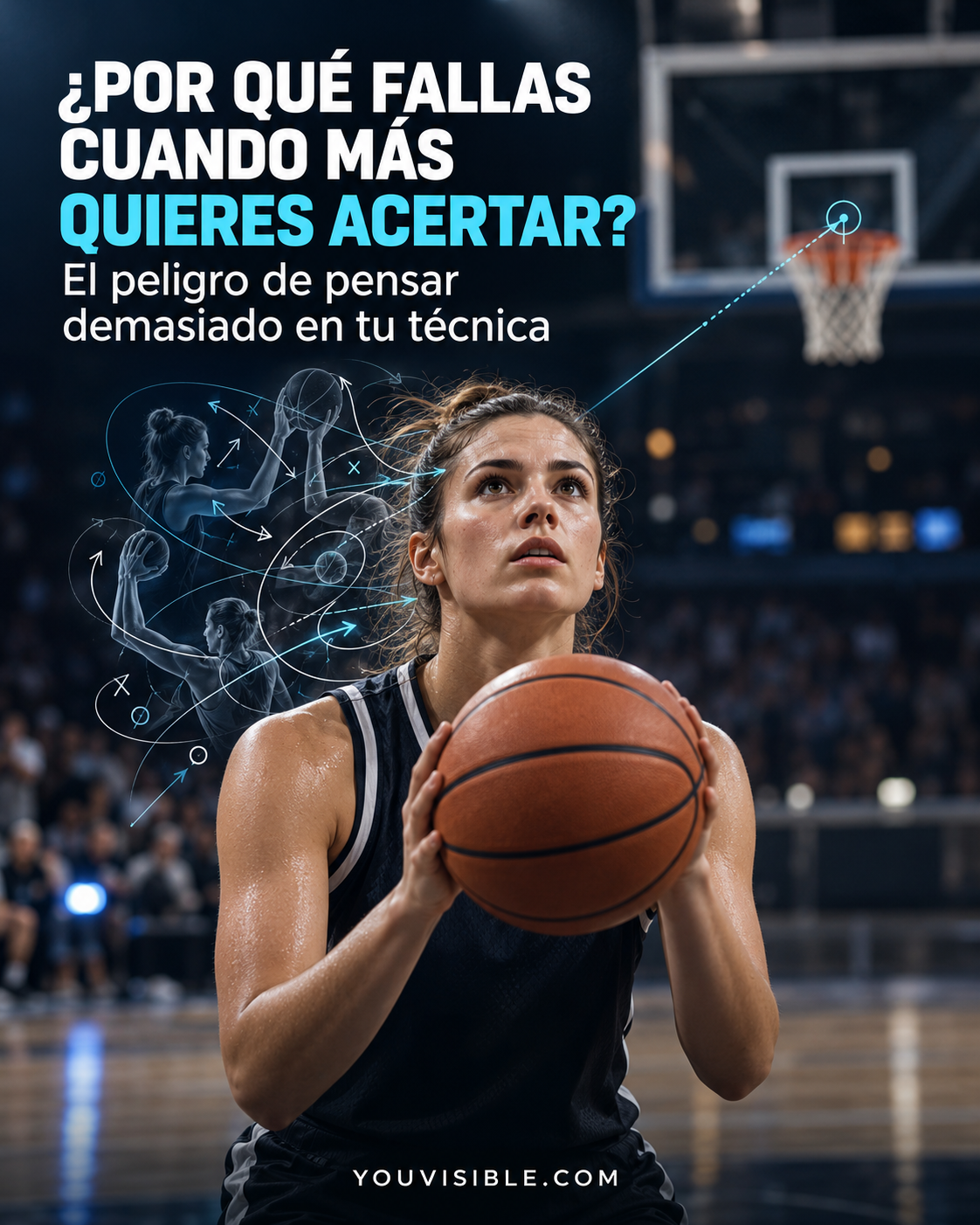
You have made plenty of free throws. Now one matters, and you start checking your knees, elbow, wrist and fingers. The ball leaves your hands awkwardly. You knew the movement; perhaps you tried to manage it in more detail than you usually need.
Errors under pressure do not always reveal a lack of preparation, motivation or ability. They are not evidence of mental weakness either. For occasional competitors, experienced amateur athletes, families and coaches, this is a useful possibility to consider: adding instructions does not always help.
When monitoring can get in the way
With practice, some skills become relatively automatic. You still pay attention, but you do not need to issue an order for every component. During a tennis or padel serve, preparing, tossing and hitting can feel like one coordinated action.
Conscious reinvestment is one explanation researchers have studied: pressure may prompt you to use explicit rules again to control an automated skill. Reconstructing its parts can disrupt continuity. This is an explanatory hypothesis, not a universal fact or the only cause of choking.
Your attention can also drift towards the score, spectators, consequences or fear of making a mistake. Excessive monitoring and distracting worries are different explanations that can coexist. Feeling pressure does not inevitably worsen performance, as the ESSA position statement points out.
Thinking about technique has its place
A beginner is still building the movement and may need explicit instructions about the body. An experienced athlete using their less skilful side may need similar support: experience does not transfer completely to every action.
The experiments by Beilock and colleagues distinguished less practised skills from experienced execution. Their findings do not mean that nobody should ever think about their body.
A technical change introduced in training deserves deliberate attention and practice. Performing a sufficiently automated skill under competitive pressure is a different situation. The problem is not thinking about technique, but trying to rebuild it step by step at the wrong moment. You can analyse running technique between blocks without monitoring every joint throughout a run.
Internal, external and holistic focus
An internal focus directs attention towards body parts or body movements. An external focus directs it towards the intended effect on the environment. A holistic focus uses a word or sensation representing the whole action, such as “smooth” or “rhythm”, provided it already means something to you.
These examples are cues to try and evaluate, rather than universal instructions or complete biomechanical corrections:
| Sport or situation | Body-focused instruction | Cue aimed at the movement's effect |
|---|---|---|
| Free throw | Extend your elbow and wrist | Give the ball height and send it towards the back of the rim |
| Running | Lift your knees | Push the ground backwards |
| Swimming | Keep your elbow high | Press against the water and move your body forwards |
| Tennis or padel | Turn your shoulders earlier | Send the ball deep into your chosen area |
| Football kick | Position your foot like this | Send the ball through that gap |
| Dance | Extend your ankle | Lengthen the line of the movement |
| Strength training, lifting a load | Extend your knees | Push the ground away to raise the load |
| Precision sport, a putt | Control your wrist movement | Roll the ball along your chosen line |
In strength training, no phrase replaces learning safe execution and selecting a suitable load. In dance, a holistic intention can represent continuity without checking each segment.
Favourable evidence and critical reviews
The systematic reviews and meta-analyses by Chua reported favourable findings for external focus in motor performance and learning. However, the systematic review and meta-analysis by McKay questioned their magnitude and robustness: accounting for publication bias substantially reduced the estimated advantages.
This bias can arise when favourable results are more likely to be published. Not every external cue works: the task, experience, wording and context matter. We cannot claim that external focus prevents injuries or automatically improves performance. A scientific trend should not become another compulsory rule.
Different sources serve different purposes. An experiment tests particular conditions; a narrative review, such as Mesagno and Beckmann's, organises models and interventions. A systematic review searches for and selects studies using an explicit method; a meta-analysis combines findings statistically. A professional position statement provides applied guidance without guaranteeing an individual outcome.
Separate three moments: analyse, prepare and execute
1. Between repetitions: analyse
Review the result, watch a video, listen to feedback or decide what to change. Ask what happened before piling on adjustments. When learning, agree with your coach on the detail that needs practice.
2. Before execution: select
Choose one intention, target, trajectory or holistic word. That might be an area for your serve. Pick something practised that you can return to when pressure appears.
3. During execution: act
Direct attention towards the task and let the movement unfold without simultaneously checking every joint. Detailed analysis can return afterwards. In a changing passage of play, acting includes continuing to read the situation.
After an error: stop the chain of overcorrections
Practise this short routine in training:
- Pause before repeating impulsively.
- Describe the result neutrally.
- Release unnecessary tension through a practised action, such as loosening your hands or a comfortable exhalation.
- Recover relevant information: target, distance or teammates' positions.
- Choose one intention.
- Execute and postpone detailed analysis.
“I'm terrible under pressure” judges your entire ability without preparing the next action. “The shot fell short; I'll look at the target again” provides observable information. It does not deny frustration; it gives you something concrete to work with. You can apply this perspective when reviewing a bad workout.
Train pressure gradually
Once the skill is sufficiently learned and you know a coping strategy, introduce pressure progressively: limited attempts, a scoreboard, a countdown, teammates watching or a small competition. Simulate a familiar match situation; any consequences should be reasonable and agreed beforehand.
Pressure training does not mean shouting, punishing or constantly provoking anxiety. Explain the purpose, adjust difficulty and review what happened afterwards. Exposure must not harm wellbeing. In sensitive settings or high-performance sport, qualified professionals should design it.
A free throw, serve or putt is a closed or self-paced skill: you can prepare in relatively stable conditions. Responding to changing play in football, basketball or padel is an open skill, requiring updated decisions about opponents and teammates. A lengthy pre-putt routine does not fit a fast break in the same way.
Zeng's meta-analysis found more consistent results for closed than open skills. It does not support assuming that the same strategies work equally well in both settings.
Mistakes to avoid
- Trying to make your mind completely blank: you need task information.
- Using too many instructions: choosing what to attend to becomes difficult.
- Debuting a routine in competition: practise it first.
- Confusing external focus with distraction: the chosen effect belongs to the task.
- Correcting several body parts during movement: save that review for afterwards.
- Using an unpractised word: it may not yet mean anything to you.
- Drawing conclusions from one attempt: other factors also affect results.
- Giving everyone the same cue: experience and preferences differ.
- Expecting all anxiety to disappear: practise how to act with it present.
- Treating an error as a lack of mental toughness: this hides useful information.
Today's YouVisible challenge
Choose a familiar skill you can practise safely. Complete three short blocks under similar conditions of distance, equipment, effort and rest:
- Perform with your usual attention.
- Perform with one internal cue.
- Perform with an external cue or holistic word.
Afterwards, record the observable result, cue used, fluidity or fragmentation, perceived tension, ability to maintain attention, reaction after an error and strategy you would try again. One session cannot establish which strategy is superior: look for patterns across different days, considering order and fatigue.
In YouVisible, you can divide an activity into blocks, save videos or execution moments, record feelings and note technical and psychological learning. A sports training diary helps you compare your responses across sessions and preserve aspects that numbers do not show.
An activity is more than kilometres, repetitions, points or time. It also involves attention, decisions, confidence and learning. Technique is corrected in training. When it is time to act, you need a clear intention and room to execute.
Download YouVisible
Sources
- ESSA — Performance Under Pressure in Sport: A Position Statement
- Beilock et al. — When Paying Attention Becomes Counterproductive
- Chua et al. — Superiority of External Attentional Focus for Motor Performance and Learning
- McKay et al. — Reporting Bias, Not External Focus
- Mesagno & Beckmann — Choking Under Pressure: Theoretical Models and Interventions
- Zeng et al. — Counteracting Choking Under Pressure in Sport
Note: This is general educational content. It does not replace individual assessment or work with a coach or sport psychology professional. If sporting pressure causes intense or persistent distress, affects your wellbeing or extends beyond sport, seek professional help.
Save your sports story. Share it. Make it visible.