


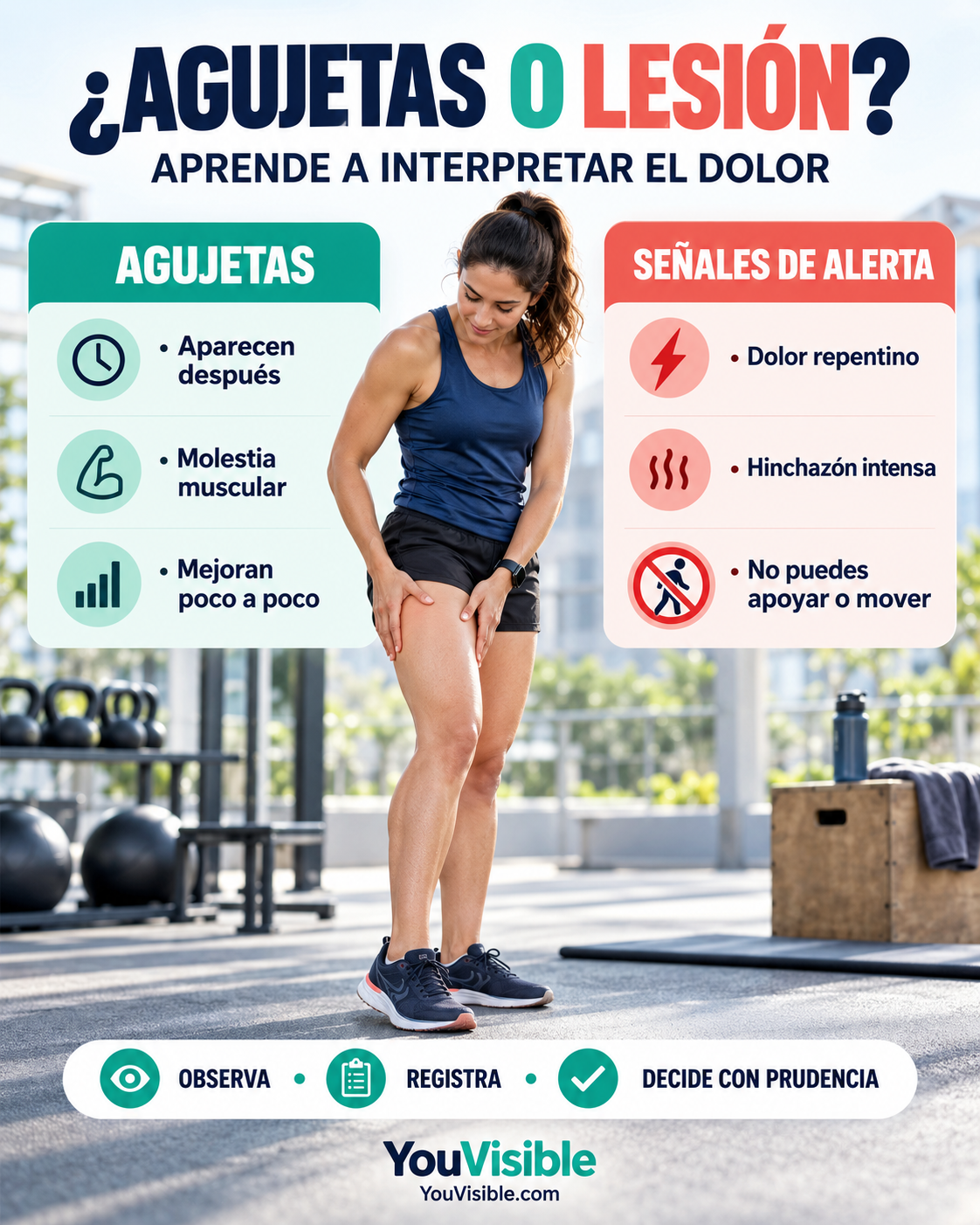
You finish a demanding session and the next day a question appears: is this normal muscle soreness, or have I hurt myself?
Not all pain after training means there is an injury, but you should not treat every discomfort as an inevitable consequence of exercise either. Noticing when it began, where it is located, how it changes and how much it limits movement can help you make more cautious decisions.
This observation cannot replace a medical assessment or provide a diagnosis. Its purpose is to help you recognise patterns, stop motivation from making you ignore important signs, and know when reducing the load or consulting a professional is the better choice.
What is delayed-onset muscle soreness?
Post-workout soreness is known scientifically as delayed-onset muscle soreness, or DOMS. It often appears when you try a new activity, increase the demands of training or introduce movements your body is not yet used to.
It is especially common after actions in which a muscle produces tension while lengthening. Examples include lowering a weight under control, walking downhill, landing from a jump or performing the lowering phase of a squat.
Its main characteristic is that it does not usually begin as sudden pain during exercise. Discomfort develops in the hours afterwards and is generally more noticeable between one and three days after the session.
You may notice:
- Tenderness when touching the muscles you trained.
- Stiffness or a temporary reduction in range of motion.
- A feeling of muscle weakness or heaviness.
- Discomfort when repeating the movement used in training.
The sensation should gradually decrease over the following days. Severe soreness is not proof that a workout was better. A session can produce a useful adaptation without leaving you in pain.
Muscle soreness and possible injury: useful differences
No single symptom can confirm what is happening, but comparing the overall pattern can help you respond more sensibly.
| Aspect | Pattern more consistent with DOMS | Sign to stop and seek assessment |
|---|---|---|
| Onset | Develops gradually in the hours afterwards | Sudden pain during a movement, impact or fall |
| Location | Muscles used during the session | Pain concentrated in one point, joint or injured area |
| Sensation | Stiffness, tenderness or muscle discomfort | Sharp, stabbing, constant or increasingly intense pain |
| Movement | You can move, although it may be uncomfortable | You cannot bear weight, walk or use the area normally |
| Progress | Improves little by little over the following days | Gets worse, does not improve or returns more intensely |
| Other signs | No major visible changes | Severe swelling, growing bruising, deformity, numbness or loss of strength |
This table is only a guide. An injury does not always begin with dramatic pain, and intense DOMS can also be temporarily limiting. If you are unsure, have a relevant medical history or the discomfort does not develop as expected, seek professional assessment.
Signs you should not ignore
Stop training and seek medical advice if pain is very intense, is increasing, or prevents you from bearing weight or using part of your body normally. Significant swelling or bruising, a joint that feels unstable or an area that looks deformed also require attention.
Numbness, tingling, loss of sensation, a change in colour or coldness around an injury may need urgent care.
There is also a rare but serious condition called rhabdomyolysis, associated with significant muscle damage. The CDC lists possible symptoms including muscle pain more severe than expected, unusual weakness or tiredness, and dark urine that looks like tea or cola. These symptoms require immediate medical attention and cannot be confirmed or ruled out by appearance alone.
Do not use this information to label what is happening to you. Its purpose is to help you recognise when discomfort falls outside the usual pattern and should not be hidden behind the term “muscle soreness”.
What to do when the pattern looks like DOMS
If the discomfort appeared after a new or more demanding session, affects the muscles you used and is gradually improving, you can adapt the following days:
Temporarily reduce the intensity. Avoid heavily loading muscles that are still very sore.
Keep moving gently if it feels comfortable. Walking, light mobility or normal daily activities may be more tolerable than staying completely still. Stop if movement makes the pain worse.
Watch how it develops. Check whether your movement returns and the discomfort decreases each day. The trend tells you more than a single measurement.
Adjust your next session. You can train another area, choose a light activity or rest. Following a plan does not mean repeating it without considering how your body responds.
Seek advice if it does not improve. Pain that remains for a week, becomes sharp or constant, or is accompanied by significant swelling deserves medical assessment.
These suggestions are not treatment for an injury. If pain began during one particular movement, there is a major loss of function or you suspect an injury, do not try to test it by repeating the movement.
How to reduce mistakes when increasing training
You cannot always prevent DOMS or injury, but you can manage some decisions more effectively:
- Introduce new exercises gradually.
- Avoid increasing volume, intensity and difficulty at the same time.
- Allow time to learn technique before adding more load.
- Consider your sleep, fatigue and previous experience.
- Do not repeat intense movements on an area that has not recovered its usual function.
- Record changes so you can identify what may have influenced your response.
Your body does not interpret one session in isolation. The same load may be manageable after several well-rested days and excessive when fatigue, stress or other training has accumulated.
Mistakes to avoid
Thinking “no pain, no gain”
Soreness is not a quality score. Chasing it can lead you to introduce more load than you can absorb.
Training through sharp pain to “test it”
Repeating the movement that causes pain is not a reliable test. If an action clearly hurts, stop and assess the situation.
Letting motivation hide discomfort
Discipline also means changing a session when circumstances require it. Stopping or reducing the load does not make the workout a failure.
Comparing yourself with someone else
Your response depends on the exercise, experience, recent load and other individual factors. Someone else being able to continue does not determine what you should do.
Looking for a diagnosis in a table
The differences above help organise information, but they cannot replace an examination or a healthcare professional’s judgement.
Today’s YouVisible challenge
After your next session, take two minutes to record:
- The activity you did and whether you introduced a new exercise.
- When the discomfort appeared: during the session, at the end or the next day.
- Where you feel it and its intensity from 0 to 10.
- Whether you can walk, bear weight and perform everyday movements normally.
- Whether there is swelling, bruising or another visible sign.
- How it changes over the next 24 hours.
The aim is not to diagnose yourself, but to identify patterns. This information may also be useful if you need to consult a professional.
In YouVisible, you can save your workout together with your sensations, changes in load and subsequent progress. An activity is not only kilometres, time and speed. It is also sensations, lessons and progress.
Understanding how your body responds is part of training. Sometimes you will be able to continue with a lighter session; at other times, resting or asking for help will be the best decision.
Save your sports story. Share it. Make it visible.
Download YouVisible
Sources
- Cleveland Clinic — Delayed Onset Muscle Soreness
- NHS — Sprains and strains
- CDC/NIOSH — Signs and Symptoms of Rhabdomyolysis
- Cheung, Hume and Maxwell — Delayed onset muscle soreness: treatment strategies and performance factors
- Hospital for Special Surgery — What Is an Overuse Injury?
Notice: This is general educational content. It cannot diagnose an injury or replace assessment by a healthcare professional. Seek medical care if you have severe or increasing pain, major loss of function, warning signs or concerns about your condition.