


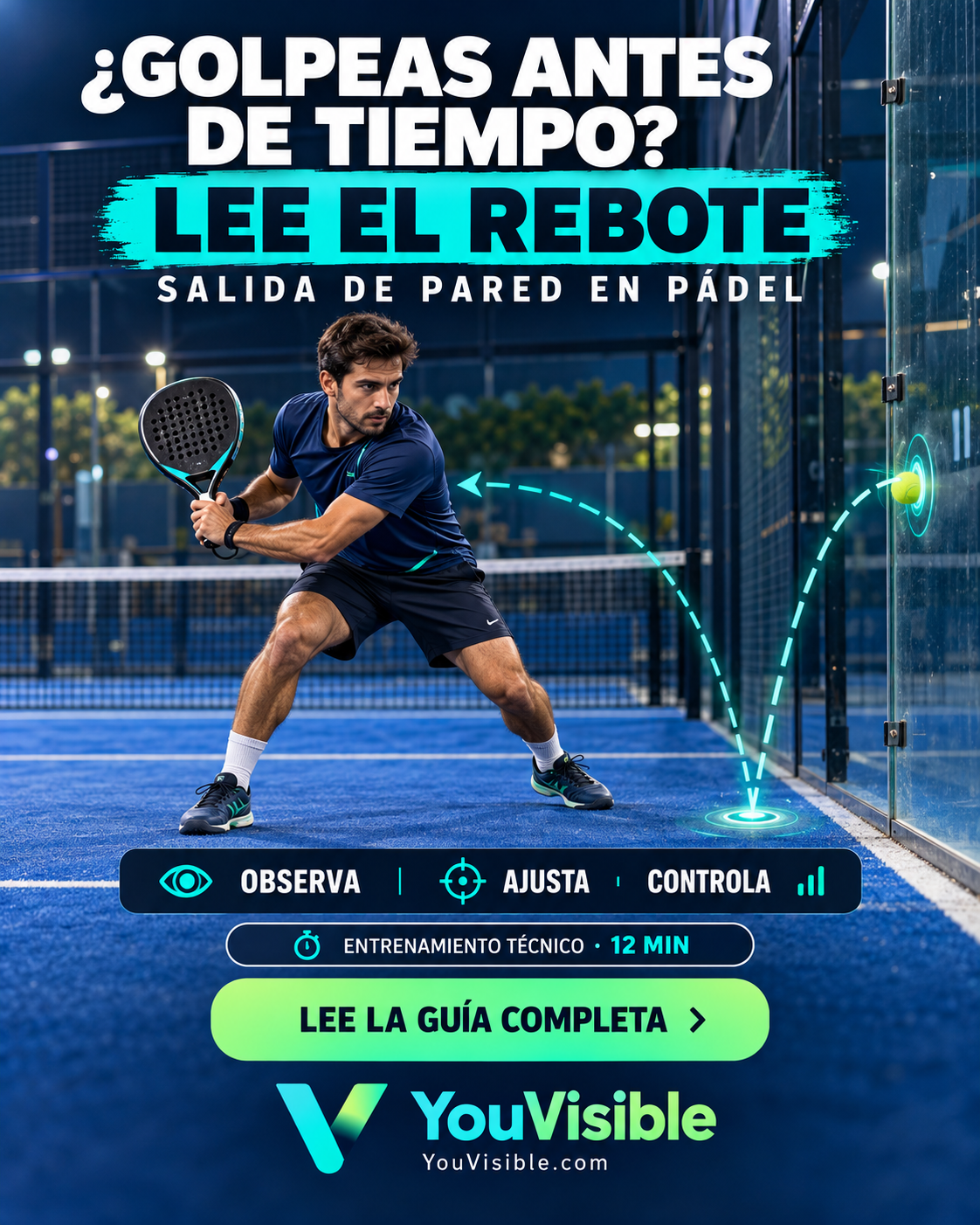
Many beginner padel players see the glass as an obstacle and try to hit every deep ball before it reaches the back wall. That rush reduces the available space and often leaves them off balance at contact.
In some situations, allowing the ball to bounce and rebound off the back glass gives you more time and a trajectory that moves forwards. The wall does not play the shot for you: using it requires you to read the flight, create space, adjust your feet and prepare a controlled response. It does not mean waiting passively or standing against the glass.
What is a back-wall return?
For a back-wall return, the opponent’s ball first bounces in your court, then touches the glass or wall, and you return it before its second bounce on the floor. The FIP Rules of Padel 2026 establish when the ball remains in play; the positioning explained here is technical guidance, not a federation rule.
This differs from taking the ball directly before it reaches the glass. It also differs from using your own wall as part of the return: the rules allow a ball to hit one of your walls first if it then bounces directly in the opponents’ court. If it reaches an opponents’ wall or metal fence directly without first bouncing in their court, the point is lost.
Wall, glass and metal fence do not behave alike. The rules require walls to provide a uniform rebound, whereas the metal fence does not. Greater caution is sensible near the join. Nor should every deep ball be allowed through: sometimes an early, direct shot provides more time and balance.
When should you let it rebound?
The choice depends on the depth of the first bounce, speed, height, angle, spin, room between you and the wall, preparation time, and the positions of your partner and opponents. These clues work together; they are not a fixed formula.
A slower, deep ball whose rebound carries forwards will often offer a comfortable return. A fast ball may come off the glass with energy, so watch it before committing your swing. A low, uneven rebound or one that crowds your body may require a compact defensive answer. If you can intercept out in front with stability, playing directly may be the better option.
How to position yourself to read the rebound
Keep an active ready position, with the racket available and your eyes following the ball from the opponent’s strike through the rebound. Prepare early without making an exaggerated backswing. Instead of retreating on exactly the same line as the ball, move away from its path so it can enter, meet the glass and come out without trapping you.
Use short adjustment steps. Depth and angle dictate the space required, so there is no single correct distance from the glass. Seek balanced contact in front of or beside your body according to the actual rebound. Then recover to a useful court position and coordinate with your partner.
The Spanish federation’s training plan considers ready position, grip, preparation, foot adjustment, contact point and follow-through. It also recognises grip variations, so this article does not prescribe one mandatory grip for every rebound.
A table for reading the ball
These decisions are practice references, not universal answers.
| Situation | What to watch | Guiding decision | Common mistake |
|---|---|---|---|
| Deep, relatively slow ball | Depth and room for the ball to come out | Let it meet the glass if you can create space | Waiting with your body against the wall |
| Fast ball | Direction, spin and energy after the glass | Read first and use a compact swing; defend if awkward | Taking a big backswing before seeing the rebound |
| High rebound moving forwards | Height and distance from your body | Adjust forwards and aim with margin | Chasing power because the ball is high |
| Low rebound | Actual height and the approaching second bounce | Lower your centre of gravity and play safely | Forcing an attacking shot while off balance |
| Ball angled towards the side wall | Order and direction of wall contacts | Make room and follow the whole trajectory | Watching only the back glass |
| Irregular rebound near the fence | Wall-fence join and change of direction | React with a compact, defensive solution | Expecting a clean glass rebound |
| Ball available for a direct shot before the wall | Time, contact in front and opponents’ positions | Hit directly if you retain balance and control | Automatically letting every deep ball pass |
Simple back wall, side wall and double wall
The simple back-wall return is the focus here: one floor bounce, contact with the back wall and a return. When the side wall is involved, the angle changes and you need to track the ball for longer. With a double wall, two walls are involved and reading the order of contact becomes essential.
The Spanish Padel Federation’s introductory training plan includes simple, side-wall and double-wall returns. Double walls demand more experience to read that order, so learn them progressively after gaining control of the simple rebound.
A 12-minute technical session
Ideally, practise with a partner, coach or feeder who can deliver controlled trajectories. Prioritise reading, positioning, control, recovery and repeatability—not power.
- 2 minutes: activate and rally gently without using the wall, keeping an active ready position and short steps.
- 3 minutes: receive predictable feeds that bounce and reach the back glass; create space and return softly.
- 3 minutes: deliberately alternate one ball to strike before the glass and one to let rebound; call your decision before contact.
- 2 minutes: direct the back-wall return towards a large, safe target in the opposite court, then recover your position.
- 2 minutes: play conditioned points where the objective is the right decision, not winning the rally.
This session adapts the Lawn Tennis Association’s “back glass” drill: feed near the back wall, wait for the rebound and return softly. The LTA also recommends coaching to develop technique and understanding.
Mistakes to avoid
- Standing against the glass.
- Hitting every ball before it reaches the wall.
- Retreating along exactly the ball’s path.
- Preparing an oversized swing.
- Losing sight of the ball as it approaches the glass.
- Seeking power before control.
- Striking while off balance.
- Staying at the back after the return without reading what happens next.
- Practising double walls before controlling the simple rebound.
- Treating the regular glass rebound like the metal fence rebound.
Safety and learning
Begin with slow, predictable feeds, keep loose balls off the court and avoid uncontrolled runs towards the glass. Increase speed, spin and angle progressively. Ask a qualified coach for help if positioning or reading remains uncertain. This session is general learning guidance, not injury prevention or treatment, and it does not replace individual coaching.
Today’s YouVisible challenge
Complete the 12 minutes and record how often you correctly chose between a direct shot and a back-wall return, which rebound was hardest, when positioning broke down, whether contact felt balanced, which adjustment you will try next time and how confidence changed during the session. Do not make it a competition based only on successful shots: a sound decision can still lead to an imperfect stroke.
With YouVisible, you can record more than the match result: note the type of rebound you worked on, the mistake that keeps returning and the technical adjustment you want to remember next time. Add feelings and lessons to preserve the work you completed, as explained in our guide to creating a sports diary, and share the experience in Comunidad Visibles if you choose.
Find YouVisible on Android, iPhone and the web.
Let the wall give you time
Learning to use the glass changes how you understand padel: gaining time does not always mean hitting earlier; sometimes you gain it by letting the wall help.
Notice: This article provides general information and does not replace individual instruction from a qualified padel coach. The cited rules govern play; technical choices must adapt to each ball and player.
Sources
- Spanish Padel Federation — FIP Rules of Padel 2026.
- International Padel Federation — Rules of Padel.
- Spanish Padel Federation — Introductory training plan.
- Lawn Tennis Association — Training tips to improve your padel skills.
Save your sports story. Share it. Make it visible